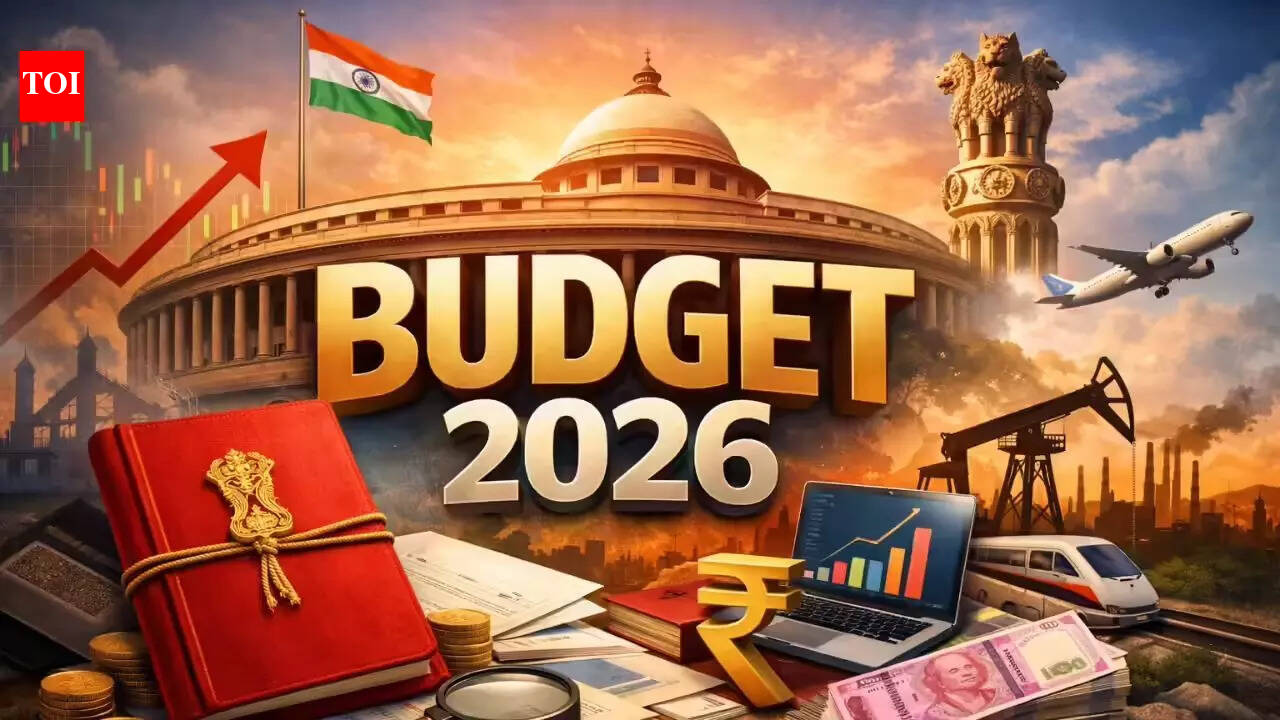
Finance minister Nirmala Sitharaman will present her ninth consecutive Union Budget on February 1, a rare Sunday sitting and a first in independent India’s history. The Budget for FY27 (April 2026–March 2027) is expected to outline measures to sustain growth momentum, maintain fiscal discipline and push reforms to shield the economy from global trade frictions, including potential US tariffs.Continuing recent practice, the Budget will be presented in a paperless format, as has been done over the past four years. In her first Budget in 2019, Sitharaman had replaced the decades-old leather briefcase with a traditional red cloth ‘bahi-khata’, signalling a shift away from colonial-era symbols.With the Economic Survey tabled in Parliament on January 29, industry and businesses have laid out clear expectations from Budget 2026, particularly around artificial intelligence, infrastructure spending, telecom reforms and manufacturing support.
AI & digital push in focus
Technology firms expect Budget 2026–27 to accelerate the development of India’s AI ecosystem, covering innovation, digital infrastructure and liquidity support for adoption across sectors.The Economic Survey described AI as an economic strategy rather than a prestige technology race, advocating a bottom-up, sector-specific approach built on open and interoperable systems.Former Tech Mahindra CEO and AIONOS co-founder CP Gurnani said the Survey “brilliantly captures India’s AI momentum.”“India’s way forward is exciting, which is to leverage our engineering strength to create affordable, human-centric AI that solves local challenges first, then scales globally. This positions us not just as participants, but as leaders in the next wave of meaningful innovation,” Gurnani told PTI.
Logistics, telecom and digital infrastructure
Logistics SaaS firm FarEye expects policy support to improve reliability and global competitiveness, with a focus on autonomous logistics orchestration.“Incentives for applied AI, advanced planning systems, and interoperable digital workflows will be essential to unlocking productivity gains across multimodal networks,” said Suryansh Jalan, Chief Business Officer, FarEye.He noted that while logistics may add nearly 10 million jobs by 2027, the focus must shift to productivity and technology readiness.GlobalLogic sees Budget 2026 as a moment to move from digital-first to intelligence-first infrastructure.“The next opportunity lies in scaling this intelligence into the physical world,” said Piyush Jha, VP and Asia-Pacific head at GlobalLogic.
Semiconductors seek continuity
Semiconductor firms want the Budget to focus on continuity, execution certainty and long-term competitiveness as projects move into implementation.Ashok Chandak, President of industry body IESA, said schemes under the India Semiconductor Mission have shown tangible progress.“Key expectations include continuity and strengthening of ISM 2.0, higher budgetary allocations for approved projects in FY27, and a simplified, time-bound pari-passu disbursement mechanism,” Chandak said, adding that tax certainty is as important as incentives.
Telecom sector flags financial stress
The Cellular Operators Association of India (COAI) has sought a major overhaul of the telecom sector’s financial framework, especially spectrum pricing and levies.“There is a big problem and that is the spectrum prices that are charged. They are very high and we don’t get much revenue as we should,” said Lt Gen (retd) Dr SP Kochhar, Director General of COAI, speaking to ANI.Kochhar said telecom should be viewed as the backbone of the economy.“That is very important sector and it is ours, government’s and the industry’s job to see that its working properly and in a sustainable manner,” he said.The industry body has also called for a reduction in regulatory levies and GST on license and spectrum fees.“Our demand from the government is that the GST on license fees and spectrum fees should be reduced from 18% to 5%,” Kochhar said, adding that it would benefit both the government and the industry.
Capex push likely to continue
Economists expect capital expenditure to remain the backbone of Budget 2026, with sustained investments in roads, railways, defence manufacturing, renewable energy, urban infrastructure and logistics.For FY27, capex growth is likely to continue, albeit at a more measured pace, with continued support for state infrastructure via interest-free loans.
Jobs, MSMEs and green transition
Job creation is expected to feature prominently, with incentives for labour-intensive manufacturing, skilling and apprenticeships. MSMEs could see enhanced allocations or credit-guarantee support, while PLI schemes may be refined.On the green front, Budget 2026 is expected to strengthen support for renewable energy, green hydrogen, battery storage and electric mobility, while maintaining oil and gas allocations to ensure energy security amid global volatility.Economists said Sitharaman also faces the challenge of restoring investor confidence amid uncertainty over India-US trade talks, continued foreign portfolio outflows and a record-low rupee.Some analysts believe the government may tap petrol and diesel excise duties to shore up revenues, without passing on the burden to consumers, by adjusting against earlier retail price cuts.With investor sentiment unsettled by global trade uncertainties and a weak rupee, Sitharaman faces the dual challenge of restoring confidence while keeping the fiscal balance intact, making Budget 2026 one of the most closely watched in recent years.
About the Author