MUMBAI: A weakening rupee is pushing Toyota to accelerate localisation and exports from India.“It (weaker rupee) pushes us for more localisation, but it also pressurises us for exports,” Tadashi Asazuma, deputy MD of Toyota Kirloskar Motor, told TOI in an interview ahead of the launch of the company’s first electric vehicle in India. The rupee depreciated about 5% in 2025. Toyota is gearing up to export the made-in-India Urban Cruiser Ebella to Europe. The carmaker has sourced the electric SUV from Maruti Suzuki – it’s a rebadged version of eVitara – under its global alliance.
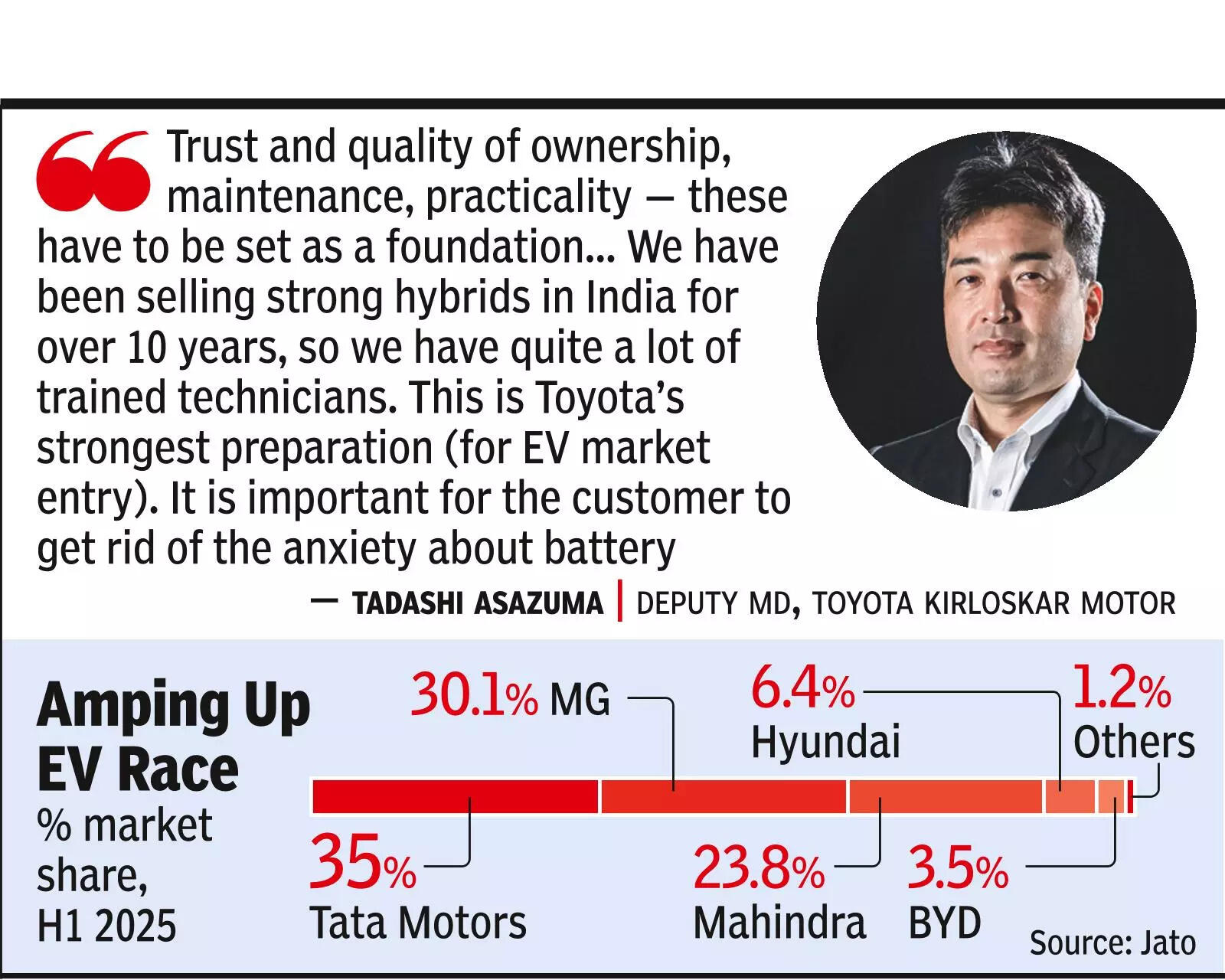
Toyota’s passenger vehicle exports from India grew 42% in 2025 to 37,221 units as compared to a 17% growth in domestic sales to just over 3.5 lakh units. Japanese carmakers like Toyota, Honda & Suzuki are stepping up operations as they pivot away from China, both as a market and a manufacturing base, Reuters reported from the Tokyo Auto Show in Nov. However, Toyota Kirloskar Motor country head and executive VP (corporate affairs & governance) Vikram Gulati told TOI that it’s not a China play. “Toyota has always looked at India as a very important market in its own right, and that’s why you see even the export numbers going up very significantly,” Gulati said.On the EV front, Toyota is leaning on its decade-long experience with hybrid electric vehicles in India. “We have quite a lot of trained technicians. Over 500 outlets can directly repair, fix parts. This is Toyota’s strongest preparation. Why? Because of strong hybrids – high-voltage treatment operations and similar mechanisms…,” Asazuma said.He added that apart from addressing anxiety about batteries, Toyota is looking at assured buyback and battery-as-a-service models to sweeten the deal. Asazuma said Toyota sees it as the right time to enter the EV market as consumer confidence is increasing. “Battery EV market is gradually growing… as people are seeing more such cars on the road. Confidence is increasing. We are bringing our cars with the assurance of customer care.“On the policy front, Gulati said the GST change has inadvertently led to a situation where focus is only on the size of a vehicle. “Earlier, there was differentiation…. but we don’t see govt trying to push back any clean technology,” he said.
About the Author