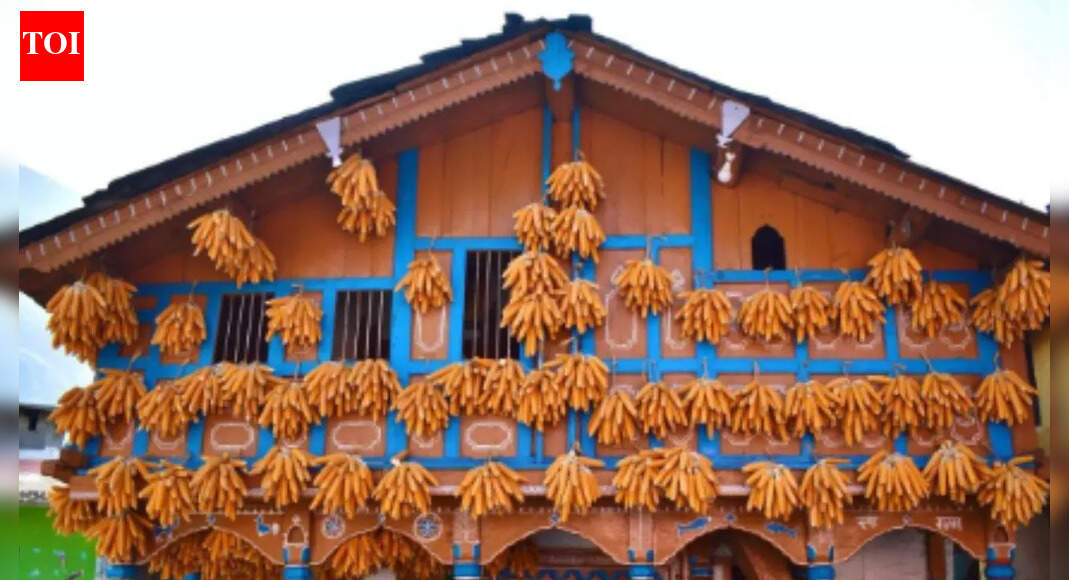
Just beyond the busy curves of Mussoorie, where the chatter of tourists slowly dissolves into birdsong and mountain wind, is a village that seems to breathe at its own pace. Sainji does not announce its arrival by signboards or souvenir shops. It states its name in colour: rows of golden corn cobs hang outside homes, within balconies, or across wooden windows, gently swaying in the Himalayan air.This tiny hamlet in Uttarakhand’s Tehri Garhwal district has been wontedly termed India’s Corn Village, the name only a hint at a deeper story. Here, maize is not decoration or branding. Memory, survival, and a lifeline in how people have learned to prosper in harmony with their land.
How corn drying became the village’s agricultural identity
In the Sainji villages, the corn hung around the houses for display or for the outside world to see via photography on online social networking websites has never happened. This tradition has existed for many centuries and has arisen as a matter of wisdom. Once the harvests are complete, the corn is hung in bunches to dry in the cool mountain climate.It sustains the crop for months, ensures seed survival for the upcoming crop cycle, and also offers an endless source of flour for every meal. Over the years, this vital agricultural practice developed into the biggest mark in the village, where every corner is lit up with colours ranging from yellow to gold, symbolising dwellings that signify prosperity and future planning in every nook and cranny. Sainji consists of approximately 40 to 50 families, with agricultural practices that signify communal knowledge as opposed to contemporary agricultural trends. Most farmlands in Sainji are organic, as chemical fertilisers and intensive farmlands never took root in Sainji since there was no need for them in the first place.Crop rotation, seed conservation, and natural manure are also practised and have been passed down through observation and experience.
Why is community Sainji’s greatest resource
What truly distinguishes Sainji is not just what it grows, but how its people live together. Daily life here is deeply communal. Farming knowledge, seeds, and even labour are shared, ensuring no family stands alone during difficult seasons.Festivals, weddings, and celebrations are collective affairs, strengthening bonds and reducing unnecessary consumption. Even cultural practices follow local rhythms. Diwali, for instance, is celebrated later than in most of India, guided by regional traditions rather than mainstream calendars.This strong sense of togetherness has allowed Sainji to remain largely self-sufficient, proving that sustainability can thrive when community comes before convenience.
Discovering Sainji through everyday life, not attractions
Sainji’s growing recognition as an offbeat destination has emerged quietly. Travellers who find their way here are usually seeking something different from crowded hill stations, a slower, more grounded experience.There are no curated tours or staged cultural performances here. Instead, visitors wander through narrow lanes lined with corn-draped homes, walk past terraced fields, and sit quietly as village life unfolds around them. Conversations with locals often turn into lessons about farming, food, and the rhythms of mountain living.The food is simple and regional. Corn-based foods like makki ki roti and veggies are indicative of food with its roots in soil, and not in indulgences. Sainji’s houses are another aspect that holds an element of silent interest. Most of these are painted in bright colours, and the doorframes are made of wood with lower entrances. The lower entrances were originally meant to keep evil spirits at bay.In some of the houses, there are doors that look like windows. These details encourage questions and discussions among the guests. These architectural details show how the generations have learned to adapt to the environment with houses designed to overcome the weather, retain warmth, and observe traditions.
Why Sainji feels so different
Sainji leaves a lasting impression because nothing feels performative. Clean lanes, neatly stored harvests, and shared spaces reflect pride without display. Corn hanging outside homes was once a symbol of prosperity. Today, it still represents abundance, but of a quieter kind.There is enough food, enough community, and enough care for the land. Modern influences have reached the village, but they have not replaced its core values. Farming still dictates daily rhythms, neighbours still depend on one another, and sustainability remains a lived practice rather than a borrowed concept.
How to reach Sainji and the best time to visit
Sainji is in the Tehri Garhwal District of Uttarakhand, five kilometres away from Kempty Falls, which in turn is near Mussoorie. The nearest major transportation hub is Dehra Dun, easily accessible from anywhere by all kinds of transportation methods available on the route. One can drive or take a taxi to Mussoorie from Dehradun.The best time to visit the village will be during September and October, after the harvest period. It is during this time that corn is dried, making the entire village a gold canvas. The weather is also ideal, with greenery and daily village life that exhibits the authenticity of their culture.
About the Author