
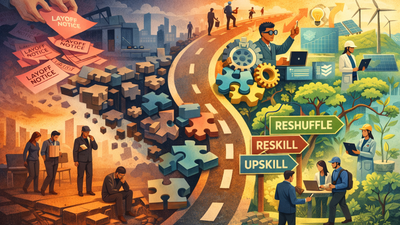
Layoffs are the workplace equivalent of a public guillotine. A number is announced, a few senior leaders offer solemn adjectives, and everyone is expected to pretend the story ends there. But the modern labour market rarely ends things cleanly. It repackages them. It takes work, breaks it into tasks, automates some, relocates others, renames what remains, and then calls the result “a new operating model”. The World Economic Forum’s Future of Jobs Report 2025 argues, with the cold confidence of aggregated employer surveys, that the next five years are not chiefly a tale of jobs disappearing. They are a tale of jobs moving. By 2030, it estimates a churn that is large enough to feel like upheaval but structured enough to be measurable: 170 million roles created, 92 million displaced, a net gain of 78 million, and a combined reshuffle equal to 22% of today’s formal jobs.
The churn economy
The public conversation about layoffs is often staged as a morality play: technology as villain, workers as victims, and companies as slightly smug narrators. WEF’s numbers are less cinematic and more unsettling because they describe a world where multiple truths can coexist. Yes, jobs are displaced. But job creation is also substantial, and the sum of creation plus displacement is the real headline: a labour market being reorganised at scale. WEF frames this as “structural labour market churn” within the formal jobs dataset it studies.This is the first reason layoffs mislead. A layoff can be real pain and still be only a local symptom of a larger reallocation. The work often survives, it just migrates to different job titles, different departments, or different contract types. Organisations are not always cutting work. They are cutting the old arrangement of work.
The technology that creates, and the technology that displaces
If you want a neat culprit, you will not find it here. WEF’s breakdown suggests technology is a dual force: It expands some labour demand while compressing others, often in the same sector.It notes that broadening digital access is expected to create 19 million jobs while displacing 9 million. It also finds that AI and information processing technologies are expected to create 11 million jobs while displacing 9 million.The story is not ‘AI takes jobs’. The story is ‘AI changes the task map fast enough that some roles become redundant while adjacent roles multiply’.And then there is the more unambiguously displacing force: Robotics and autonomous systems, which WEF calls the largest net job displacer, with a net decline of 5 million jobs.This distinction is something that matters. Employers themselves are telling WEF that not all ‘tech’ behaves the same way. Some technologies widen access and generate demand; others substitute labour more directly.
Roles that shrink, and why they are easy to shrink
The layoff story is often narrated as a shock. In reality, some roles have been standing on a trapdoor for years. WEF is explicit that technological change is a ‘divergent’ driver of labour-market change.The roles most exposed are typically those built on repeatable, standardisable tasks: routine processing, clerical coordination, basic transactional work. When tasks can be templated, they can be automated, centralised, or embedded into software. A job title can disappear without the underlying activity disappearing.This is why layoff rounds frequently cluster in the same occupational families across industries. Organisations are not suddenly discovering ‘efficiency’. They are finally acting on a truth that has been waiting in plain sight: a large fraction of white-collar work was always a set of routinised micro-tasks wearing the costume of a role.
The real story is inside jobs, not between them
If you read WEF carefully, the disruption is less about job titles and more about skill bundles. The report’s “disruptions to skills” framing shows that, in the 2025 survey year, employers expect 39% of workers’ core skills to change within the next five years.This is not a marginal update; it is a partial rewrite of employability. A role might stay. The skills required to do it, and to keep it, may not.This is also where the layoff headline becomes intellectually lazy. A layoff is not always a verdict on a person’s worth. It is often a verdict on the organisation’s willingness to retrain, redeploy, or redesign. Sometimes it is simply cheaper to remove the role and rehire a different skills profile than to do the hard, slow work of transition.
The premium on ‘being hard to automate’
WEF’s core skills list reads like a quiet rebuke to anyone who thinks the future belongs only to coders. It says analytical thinking remains the top core skill, with seven out of ten companies calling it essential in 2025.It is followed by resilience, flexibility and agility, then leadership and social influence. The most telling detail is the mix: cognitive rigour, psychological adaptability, and social influence. Organisations are describing, in polite survey language, the employee who can survive a moving floor.On “skills on the rise”, WEF places AI and big data at the top, followed closely by networks and cybersecurity and technological literacy.Yet it also elevates creative thinking, curiosity and lifelong learning, and again resilience, flexibility and agility. This is the labour market asking for two things at once: Technical fluency and human elasticity.
The reskilling cliff edge
Here is the most political line in the report, even though it is written like a statistic. WEF says if the world’s workforce were 100 people, 59 would need training by 2030. Of these, employers foresee 29 could be upskilled in their current roles, 19 could be upskilled and redeployed elsewhere, and 11 would be unlikely to receive the reskilling or upskilling needed, leaving their prospects increasingly at risk.That “11” is the shadow population of the churn economy: Not unemployed in the cinematic sense, just increasingly unemployable in the new ‘skills’ grammar. They are the human cost of transformation when it is implemented as a spreadsheet exercise rather than a transition plan.WEF also notes that skill gaps are seen as the biggest barrier to business transformation by 63% of employers. The response plans are ambitious and revealing: 85% prioritising upskilling, 70% hiring new skills, 50% transitioning staff from declining to growing roles, and 40% planning to reduce staff as skills become less relevant. In other words, companies want agility, but not all of them want to pay for it in the form of time and training.
What the layoff headline refuses to admit
The popular question is, “Will AI take jobs?” The more accurate question is, “Who bears the cost of adjustment?” A labour market can be net-growing and still be socially brutal. WEF’s projections explicitly show job creation alongside displacement at scale, and a skills shift large enough to make yesterday’s competence feel like an expired passport. When a company lays off staff and hires again in a different skills bracket, it is not contradicting itself. It is declaring that it would rather buy new capability than build it.This is why the line ‘reshuffling work, not eliminating it’ matters. It is not a euphemism. It is a diagnosis. The work is still there, but the terms have changed: Different tools, different tasks, different expectations, and a narrower tolerance for learning curves.The layoff headline wants you to believe the story is subtraction. WEF’s data suggests the story is reassignment, and the real fight is over whether workers are given bridges, or simply told to swim.
About the Author