
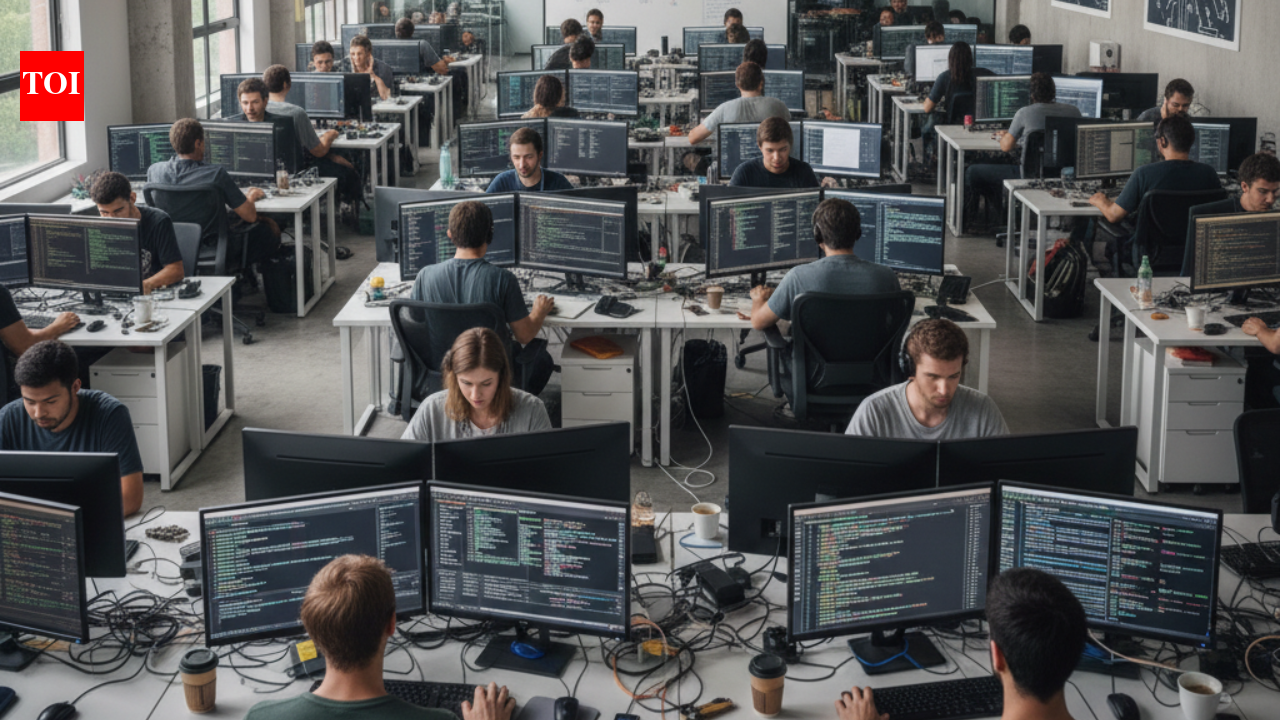
Andrej Karpathy, the OpenAI cofounder who led Tesla’s Autopilot AI for five years, has pushed back against the idea that software engineers should stop coding altogether—a stark contrast to Nvidia CEO Jensen Huang’s vision of a code-free engineering future.In a recent post on X, Karpathy admitted he’s “never felt this much behind as a programmer” but stopped short of endorsing Huang’s radical position. While Huang wants Nvidia engineers spending “zero percent of their time doing syntax” and “a hundred percent of their time discovering problems,” Karpathy’s experience tells a different story. When building his recent project Nanochat, he wrote the entire thing by hand because AI agents “just didn’t work well enough at all and net unhelpful.“The disagreement highlights a growing rift in Silicon Valley over how much engineers should actually lean on AI coding tools.
Nvidia CEO Jensen Huang’s zero-coding vision faces real-world pushback
Huang has been vocal about his “Purpose vs Task” framework, arguing that coding is merely a task while discovering and solving problems is an engineer’s true purpose. At Nvidia, every engineer uses the AI coding assistant Cursor “all day long.” In a podcast appearance, Huang said: “Nothing would give me more joy than if none of our engineers were coding at all.”But Karpathy sees the transition as far messier. He described needing to build a mental model for “fundamentally stochastic, fallible, unintelligible and changing entities suddenly intermingled with what used to be good old fashioned engineering.” His post read more like a warning than an endorsement: “Roll up your sleeves to not fall behind.”Michael Truell, CEO of Cursor—the very tool Huang champions—has also raised concerns. He told Fortune that developers who blindly trust AI to write code are “building on shaky ground.” His analogy: constructing a house without understanding the plumbing. “As you add another floor, things start to kind of crumble.”
Research suggests AI coding gains remain elusive
The productivity promises haven’t quite materialized either. A METR study found AI assistants actually decreased experienced developers’ productivity by 19%—even though participants expected a 20% boost. Bain & Company reported programming showed “unremarkable” savings despite being among the first fields to embrace generative AI.Even Boris Cherny, who created Anthropic’s Claude Code, acknowledges the gap. He said “vibe coding” works for “throwaway code and prototypes” but fails when developers need “maintainable code” where they must be “thoughtful about every line.”Google CEO Sundar Pichai and Anthropic CEO Dario Amodei have touted impressive numbers—AI writing 30% and 90% of code at their respective companies. But Karpathy’s experience suggests the gap between demo-ready AI and production-ready code remains wider than the hype suggests.
About the Author