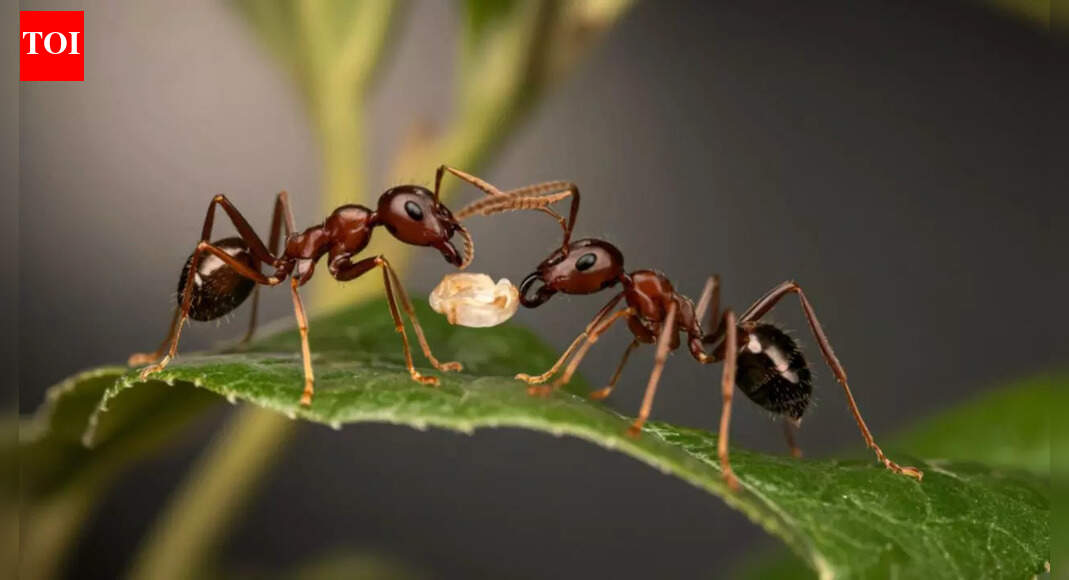
Imagine being so dedicated to your family that you would ask them to kill you to keep everyone else safe. It sounds unbelievable, but that is exactly what baby ants do when they are infected by a deadly fungus. Scientists studying the ant species Lasius neglectus found that when these young ants, known as pupae, catch a fatal infection, they send out a special chemical signal that tells worker ants to destroy them before they can spread disease. The workers then open the cocoon, bite into the pupa and spray formic acid, which kills both the fungus and the dying ant. It may sound brutal, but this extreme sacrifice helps protect the entire colony.The research is published in the peer-reviewed study Altruistic disease signalling in ant colonies in Nature Communications. It proves that the infected pupae purposely release a scent to request death, and that this scent alone is enough to trigger the workers to kill them.
How sick baby ants send a help me signal
Ant pupae cannot walk or escape the nest because they are sealed inside a cocoon. If they become infected by the fungus Metarhizium brunneum, spores can spread quickly and wipe out the entire colony. Since they cannot move to isolate themselves, they choose a different solution. They release a changed body smell that acts like an alarm, saying something is wrong.Researchers tested this by taking the scent from infected pupae and putting it on healthy ones. The worker ants instantly treated those healthy pupae as if they were infected. They opened the cocoons and killed them in the same way. This shows the scent is deliberate and meaningful, not just a random smell created by illness.
How worker ants carry out the sacrifice
Once workers detect the chemical signal, they move fast. They pull the pupa out of the cocoon, make tiny holes in the skin and spray formic acid. Ants naturally produce this acid as a powerful germ killer. It destroys the fungus before it can multiply and infect others. The pupa dies within minutes.It may seem harsh, but for ants, the survival of the colony matters more than the survival of one individual. Losing one pupa is a small price to prevent a deadly outbreak.
The ant colony works like a single living body
Scientists describe ant colonies as a superorganism because the ants behave like cells inside one giant body. Just as human immune cells kill infected cells to protect the whole body, worker ants kill infected pupae to protect the colony.From an evolutionary point of view, it also makes sense. Worker ants do not reproduce, but their close relatives do. By dying, a pupa saves its siblings, ensuring that their shared genes continue into future generations. This is why this extreme behaviour develops and remains successful.
Queen pupae never send the kill me signal
The study found an important exception. Only worker pupae ask to be killed. Queen pupae, which will grow into future egg-laying queens, do not release the signal. They have stronger immune systems and are more valuable to the colony. Losing even one queen pupa could threaten the survival of the entire nest. This shows that the self-sacrifice response is carefully targeted and only used when necessary.This research adds a new understanding to the idea of social immunity, where group-living animals work together to prevent disease. We already know ants clean each other, remove dead bodies and disinfect nests. But discovering that baby ants volunteer to die when infected is one of the most dramatic examples of teamwork ever recorded in nature.It is a powerful reminder that nature can be both beautiful and surprisingly brutal. For ants, loyalty literally means giving your life for the colony.Also read| 5 adorable reasons cows act like playful grass puppies
About the Author