

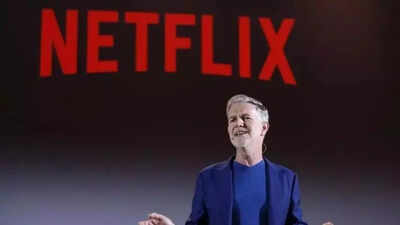
As Netflix prepares for its blockbuster $83-billion bid to acquire Warner Bros., cofounder Reed Hastings once again finds himself shaping the biggest story in global entertainment. The move, as reported by Fortune, which detailed Netflix’s plan to buy the studio behind Dune, Harry Potter, DC Universe and HBO Max, cements Netflix’s evolution from a startup challenger to a Hollywood superpower.For students and young professionals, Hastings’ life story reads like a lesson in how unconventional education choices, early work experiences, and disciplined self-reinvention can lead to industry-defining innovation.
Early lessons: A gap year, a vacuum cleaner, and the birth of customer intuition
Hastings’ earliest taste of the working world was not in tech but in sales. As Fortune noted, he spent a year after high school selling Rainbow vacuum cleaners door to door—a job he initially took as a summer gig but ended up enjoying. In a 2006 New York Times recollection cited by Fortune, Hastings said his pitch involved cleaning the carpet once with the customer’s vacuum and again with the Rainbow to demonstrate the difference.This period taught him how to read people, understand pain points and adapt quickly—instincts that would later influence Netflix’s famously user-obsessed approach. The experience also marked the first step in a career built on observing human behaviour just as closely as technological trends.
Academic pathway: Bowdoin to the Peace Corps to Stanford
Hastings did not follow a conventional academic trajectory. He graduated from Bowdoin College in 1983 with a degree in mathematics, exploring everything from leadership interests to analytical problem-solving. He briefly considered the Marine Corps before choosing a path that would deeply shape his worldview: the Peace Corps.For two years, he taught mathematics in Eswatini. Hastings has often said the Peace Corps taught him resilience, adaptability and the ability to work with limited resources—skills that proved invaluable when he later navigated the turbulent world of Silicon Valley entrepreneurship.On returning to the United States, he entered Stanford University, completing a master’s degree in computer science. Stanford provided the technical depth that allowed him to enter the rising software industry of the early 1990s.
The making of a founder: From Pure Software to Netflix
With his Stanford training, Hastings founded Pure Software in 1991, scaling it rapidly until it went public just four years later. The success—and the managerial pressures that came with it—honed his ability to lead teams, structure organisations and pursue long-term bets.The spark for Netflix came soon after. Fortune notes the widely circulated story of Hastings being charged a $40 late fee after misplacing a VHS of Apollo 13, prompting him to explore a mail-order rental model. Although the story has been debated, Fortune emphasises that the idea symbolised Hastings’ instinct for spotting friction in everyday experiences and building scalable tech solutions around them.Netflix, launched in the late 1990s, began as a DVD-by-mail service before evolving into the streaming giant that would alter global entertainment. According to Fortune, the company’s stock has risen more than 80,000% since its 2002 IPO, adjusted for splits—a trajectory matched by few tech companies.
Leadership philosophy shaped by education and world experience
Much of Netflix’s culture—defined by high performance, freedom and responsibility—reflects Hastings’ early experiences and academic background.Fortune highlights his belief in “talent density”, the idea that one exceptional performer can contribute 100 times more value than several average ones. This thinking guided Netflix’s compensation strategy and hiring philosophy, with Hastings advocating for paying above-market rates to retain standout employees.He also championed flexible work culture, including unlimited paid time off, which Fortune notes Netflix helped popularise across corporate America. Hastings has said his own habit of taking long vacations was meant to model healthier work habits and creative rejuvenation.His decision in 2023 to step back from the CEO role also reflected this philosophy. As Fortune reported, he created a co-CEO structure, elevating Greg Peters alongside Ted Sarandos—a model Hastings described as effective only when two leaders deeply trust and complement each other.
A philanthropist guiding Netflix into its next era
Hastings, now Netflix’s chairman, holds an estimated net worth of $5.6 billion, according to Fortune. Despite this, he has frequently sold shares and channelled large sums into philanthropy, particularly in education reform—an area he has long championed.If Netflix successfully acquires Warner Bros., it will be one of the most consequential media mergers in history. For Hastings, it adds another chapter to a career built on curiosity, risk-taking and a willingness to defy norms.
Why Reed Hastings’ journey resonates with students
Hastings’ path matters because it breaks the myth of linear success. Students can draw three broad lessons:Educational journeys can be unconventional: A mix of liberal arts, global service and advanced engineering contributed to his worldview.Early work matters—even if it’s not glamorous: His gap-year sales job shaped Netflix’s customer obsession more than any business school case study.Values and culture scale just as much as technology: Hastings’ leadership philosophy—rooted in trust and excellence—became a competitive advantage.
About the Author