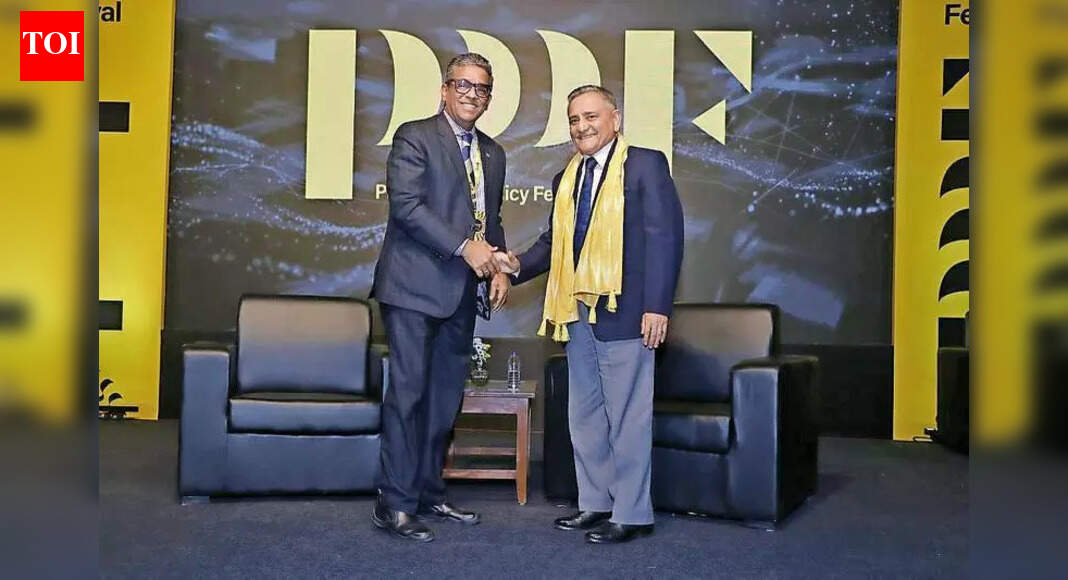

Pune: Chief of Defence Staff (CDS) General Anil Chauhan on Friday said Pakistan’s hurried military and constitutional restructuring after Operation Sindoor was a tacit admission of its serious shortcomings exposed during the conflict. Op Sindoor — launched in May 2025 after the terror attack on Pahalgam in April 2025, and described by the Indian govt as “paused, not concluded” — forced Pakistan to re-examine its higher defence organisation, command-and-control systems, and overall force structuring, Gen Chauhan said during an interaction at the Pune Public Policy Festival.
“The changes brought about in Pakistan, including constitutional amendments done in haste, are an acknowledgement that everything did not go well for them during Op Sindoor,” he said.He pointed out that Pakistan abolished the post of chairman, Joint Chiefs of Staff Committee, and replaced it with a chief of defence forces (CDF). Gen Chauhan said that according to available information, the CDF can be appointed only by the army chief — a move that runs counter to the very principle of jointness.“This resulted in an extraordinary concentration of power in a single individual who now oversees land operations, joint operations, strategic forces, and a newly created rocket force. That itself is a challenge and reflects a land-centric mindset,” he said.Gen Chauhan also noted that Pakistan’s decision to separate its conventional missile forces from nuclear assets by creating an Army Rocket Force distinct from the strategic nuclear command was a “sensible correction” aligned with global best practices. “This separation actually adds an extra rung in the escalation ladder and pushes the nuclear threshold higher. It does not reduce nuclear stability; in fact, it enhances it,” General Chauhan said.On India-China relations, the CDS said disengagement agreements reached since Oct 2024 restored patrolling rights at all points along the Line of Actual Control, with positive engagement continuing at both military and diplomatic levels. “Trust is gradually rebuilding, but given today’s geopolitical flux, nothing can be ruled out. We must remain prepared for any contingency, at any time,” he cautioned.General Chauhan said military strategy globally was undergoing a fundamental shift, with technology increasingly outweighing geography in determining outcomes. “For centuries, geography dictated warfare — from Panipat to Plassey. Today, geography is becoming less relevant, and technology is driving strategy,” he said.While future conflicts are likely to see a greater emphasis on non-contact and non-kinetic operations, the CDS cautioned that traditional land warfare cannot be wished away, particularly because of India’s unresolved borders. “Old-domain warfare is brutal, manpower-intensive, and attritional, as seen in Ukraine and Gaza. New-domain warfare is smarter and faster. India must prepare for both, but should avoid contact warfare wherever possible,” he said.Outlining the armed forces’ modernisation roadmap, General Chauhan said India was transitioning from manual, platform-centric warfare to net-centric and data-driven operations. This shift is being supported by scientific planning tools such as Operational Research and Scientific Analysis (ORSA) to improve decision-making and resource optimisation.He also defended India’s defence spending, noting that nearly 100% of capital procurement in recent years was sourced domestically.“Defence spending today is not a question of gun versus butter. It generates employment, GST revenue, and industrial growth. Moreover, the govt assured additional funds whenever operationally required,” he said.On manpower reforms, the CDS clarified that the armed forces were undergoing “rightsizing” rather than downsizing. Personnel are being reskilled and redeployed from traditional domains to emerging areas such as cyber, space, and information warfare. “We are transferring manpower from older domains, retraining them, and creating new capabilities. This is a continuous process,” he said.‘We are almost there on theatre commands’General Chauhan said all three services were on board with the creation of integrated theatre commands, calling it a key part of his mandate. “I was given an extension till May 30. We can’t do it before that,” he said, and added that the process was nearing completion. Lessons from Doklam, Balakot, and Operation Sindoor are being incorporated, particularly in higher defence organisation and inter-service coordination, he said.System to counter fake informationAdmitting that there was no robust mechanism to counter fake news during Operation Sindoor, the CDS said a dedicated real-time system is now being put in place.It would monitor social media as well as electronic media to ensure timely dissemination of verified information, after several false reports — including claims of pilots being captured and attacks on military bases — circulated during the operation, he added.
About the Author