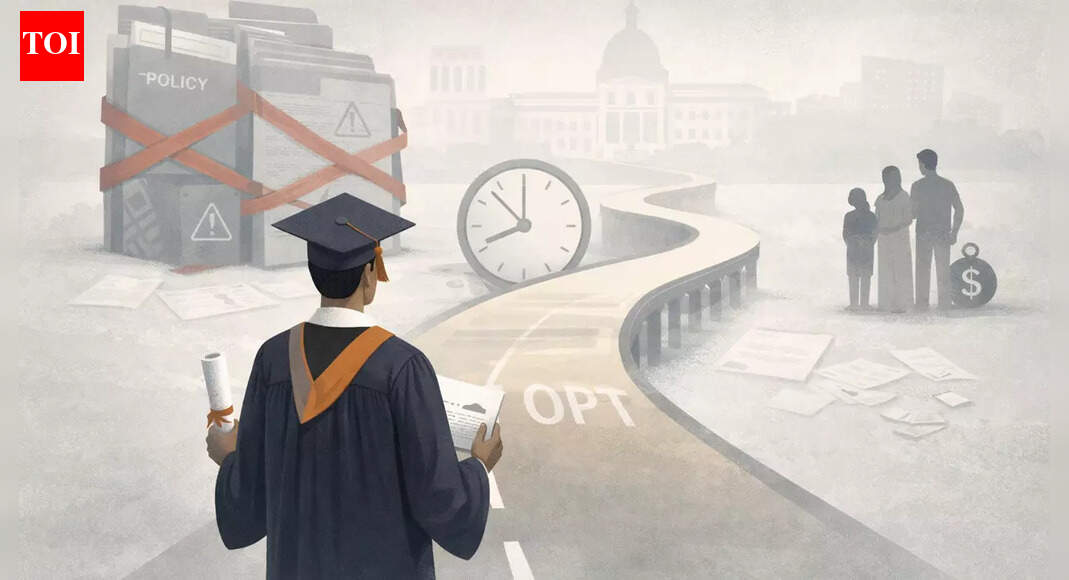

For Indian families, the US degree has rarely been just a degree. It is a sequence you pay for and plan around: Admission, visa, internship, graduation, and then a post-study runway long enough to recover costs, build a résumé, and attempt the H-1B lottery without falling off a bureaucratic cliff. That runway is Optional Practical Training (OPT).Now the runway is being described in Washington as a loophole, not a ladder. In 2025, the US debate has moved beyond generic immigration noise into something more targeted: A political and legal narrative that frames OPT as unauthorised, unfair to American graduates, and ripe for abuse. This is followed by proposals that would either terminate the programme, tax away its advantage, or convert student status from a compliance-based continuum into a clock with expiry dates. What is significant here is that OPT is being attacked simultaneously in Congress, agency memos, and in the regulatory agenda—three levers that rarely align.India sits closest to the blast radius because they have become the most invested in the OPT logic. The story, then, is not “Will America stop Indians from studying?” It is more precise, and more destabilising: Will America continue to attach a credible work pathway to the education it markets to the world?
The political narrative against OPT
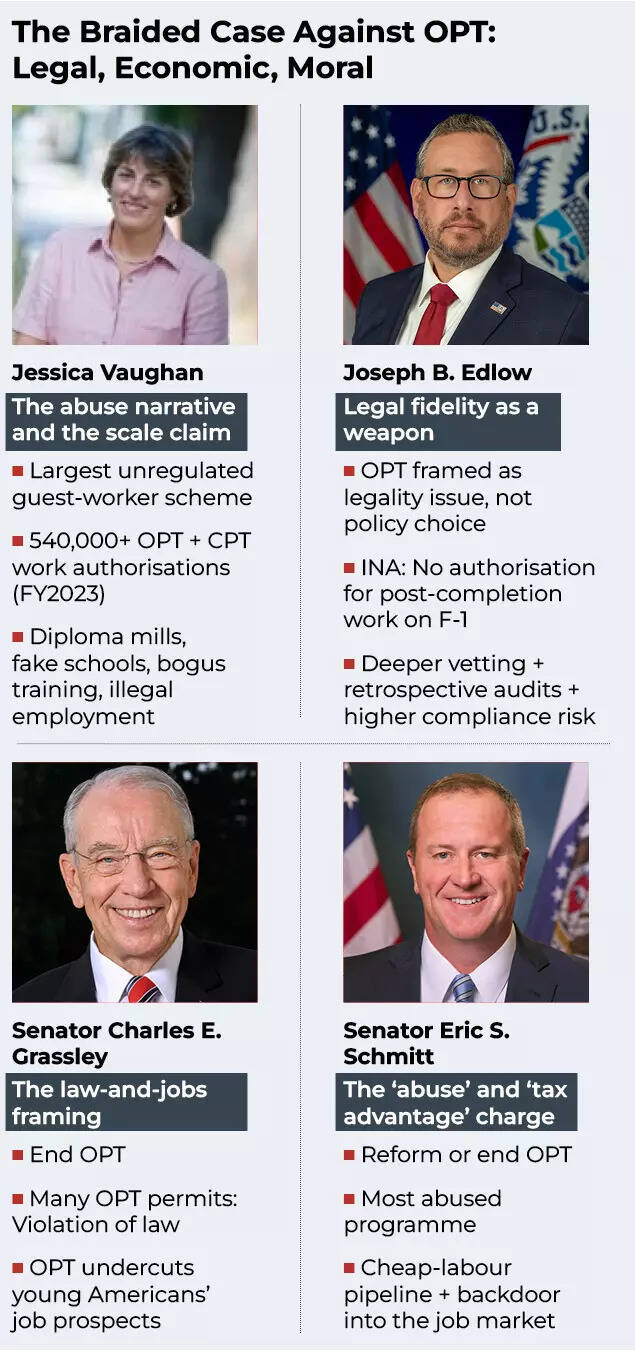
This is not a single argument. It is a braided case—legal, economic, and moral—built by officials, senators, and immigration restriction advocates. The common theme is legitimacy: Who authorised OPT, and who benefits from it.Jessica Vaughan: The abuse narrative and the scale claimIn June 2025, Jessica Vaughan, Director of Policy Studies at the Center for Immigration Studies (CIS), appeared before the House Judiciary Subcommittee with a blunt charge: OPT, she argued, has effectively become the largest unregulated guest-worker scheme in the United States. Drawing on internal datasets she said were provided by ICE and the Department of Homeland Security, Vaughan told lawmakers that more than 540,000 work authorisations were granted under OPT and Curricular Practical Training (CPT) in FY2023 alone. In her framing, this was not administrative flexibility; it was regulatory drift at scale. OPT, she said, had fuelled an ecosystem of diploma mills, fake schools, bogus training programmes, and illegal employment—a parallel market built less around learning than around visa preservation and labour substitution—while the Student and Exchange Visitor Program (SEVP) remained too under-resourced to vet the volume and complexity of the pipeline. Her sharpest point was legal-constitutional in tone: OPT is not explicitly authorised by Congress, having been created through executive rulemaking—formalised under the Bush administration and expanded under Obama—without an up-or-down vote to permit hundreds of thousands of foreign graduates to work in the US.Where her testimony lands politically is in how it converts a sprawling, messy system into a single prosecutable story: Scale plus abuse equals illegitimacy. Once OPT is narrated primarily as a work programme rather than an education-to-employment bridge, the policy debate shifts from ‘how to regulate’ to ‘whether it should exist at all’. And even if one contests her characterisation, the effect is the same: it gives restrictionists a numbers-and-oversight argument that is easier to sell than a purely ideological one.Joseph B. Edlow: Legal fidelity as a weaponJoseph B. Edlow, Director, U.S. Citizenship and Immigration Services, advances a more clinical—but no less consequential—attack on OPT. Across multiple briefings to the Senate and in internal USCIS memoranda between April and June 2025, Edlow’s argument is starkly textual. The Immigration and Nationality Act (INA), he insists, contains no statutory basis for post-completion employment for F-1 student visa holders. Student visas, in his reading, are narrowly purposive instruments—authorised for study, and study alone. Any extension into work after graduation, he argues, is not policy evolution but statutory drift.Where Edlow’s position moves from interpretation to enforcement is in his proposed recalibration of USCIS priorities. He has pushed for an expanded role for the Fraud Detection and National Security (FDNS) directorate in scrutinising OPT applicants and employers, signalling a future in which OPT operates under retrospective audits and heightened surveillance. The subtext is unmistakable here: Even without immediate abolition, OPT can be constricted through compliance, transformed from a facilitative bridge into an enforcement-heavy chokepoint.
The Case Against OPT
Senator Charles E. Grassley: The law-and-jobs framingOn September 23, 2025, Senator Charles E. Grassley, the Chairman of the Senate Judiciary Committee, wrote to Kristi Noem, Secretary of the US Department of Homeland Security, urging her to end Optional Practical Training (OPT)-style work authorisations for student visa holders. Grassley argued DHS is issuing ‘hundreds of thousands’ of such work permits “in direct violation of the law” and criticised the practice of allowing foreign graduates to remain in the US on student visas “for years after graduation” to work. He said this undercuts young Americans’ job prospects and claimed the authorisations are incompatible with the Immigration and Nationality Act, which he says limits student visas to education, not employment.Senator Eric S. Schmitt: The ‘abuse’ and ‘tax advantage’ chargeOn November 14, 2025, Senator Eric S. Schmitt (Republican, United States Senator for Missouri) wrote to Kristi Noem, Secretary of the US Department of Homeland Security, and Joseph B. Edlow, Director of US Citizenship and Immigration Services, urging them to move toward ‘reforming or ending’ Optional Practical Training (OPT). He calls OPT ‘one of the most abused’ immigration programmes and argues it operates as a cheap-labour pipeline and a ‘backdoor’ into the job market, hurting young American workers. Schmitt also stresses the programme’s tax advantage—citing payroll tax exemptions and claiming this encourages employers to hire OPT workers over US graduates. He asks DHS to conduct a ‘thorough review’ as the first step toward shutting OPT down or reshaping it.
OPT in pieces: Proposals that kill, clip, or time out the work runway
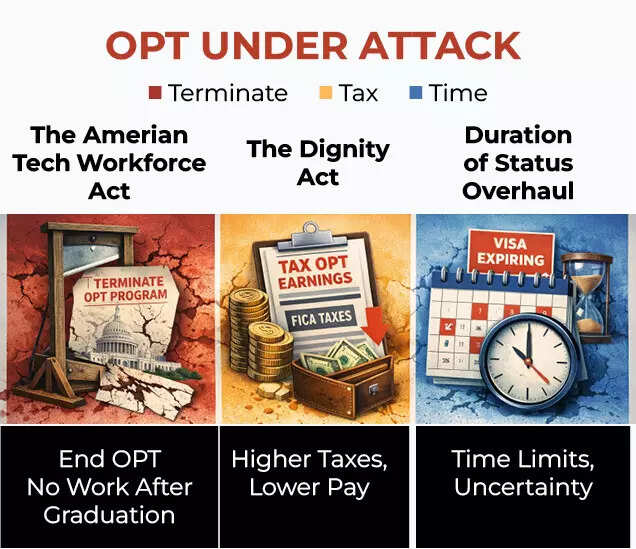
If the narrative is the pressure, the proposals are the machinery. They range from a guillotine to a slow squeeze to a procedural clock.The American Tech Workforce Act of 2025: A termination proposalThe American Tech Workforce Act of 2025, introduced in the US Senate in September and referred to the Judiciary Committee, tries to rewire the entire student-to-work pipeline: Tighten H-1B through a tougher, higher-wage logic, and then cut off the quiet bridge that feeds it—OPT. The Bill treats Optional Practical Training not as an education policy tool but as a structural loophole that Congress never explicitly authorised and now seeks to close. The language of the Bill is deliberately spare. In its Section 3—Termination of Optional Practical Training Program; employment authorization to terminate after completion of course of studies—the proposal is not to narrow eligibility or toughen oversight, but to erase the programme itself. OPT, and any successor scheme by another name, would be barred in law. Employment authorisation would end the moment an F-1 student completes their degree, collapsing the post-graduation runway to zero. Even pending OPT applications would be denied at enactment, with fees returned. The message is unmistakable here: Study may still be welcomed, but work after graduation would no longer be part of the offer.The Dignity Act of 2025: A quiet rewrite of OPT economicsThe Dignity Act of 2025, a bipartisan immigration reform Bill introduced in the US House of Representatives, proposes a broad reset of immigration rules—mixing tougher enforcement tools with new legal-status pathways and system-wide adjustments. It is not law; it remains a legislative proposal moving through the committee process, not a measure that has cleared both chambers and been signed.For international students, its most consequential move is not a headline attack on OPT, but a quiet change to its economics. The Bill proposes to end the payroll tax exemption on OPT wages by bringing those earnings under FICA—the Social Security and Medicare payroll taxes that most US workers pay through automatic deductions. Under the current framework, many F-1 students on OPT who are treated as nonresident aliens for tax purposes are generally exempt from FICA withholding; the proposal would remove that carve-out.
OPT under attack
That shift alters the post-study calculus in two directions at once. For graduates, it can mean lower take-home pay in a high-cost labour market, precisely when families expect the “recovery phase” to begin. For employers, it erodes OPT’s cost advantage, making an OPT hire marginally more expensive and therefore easier to deprioritise—especially for mid-sized firms already wary of compliance burden and policy volatility. OPT may remain legally intact, but its practical appeal rests on predictability and value. This proposal chips away at both, not by banning the bridge, but by making it less worth crossing.Duration of Status overhaul: Timing out the student-to-work transitionIn August 2025, the US Department of Homeland Security (DHS) moved to add a third instrument to the OPT squeeze—not termination, not taxation, but time. It published a proposed rule to dismantle the long-standing duration of status framework for F-1 and J-1 visa holders and replace it with fixed admission end-dates. Under the proposal, most international students would be admitted for up to four years at a time, even when their academic pathway routinely runs longer. Those who need extra time—because a dissertation slips, research expands, a dual degree stretches the timeline, illness intervenes, or a programme changes—would have to file formal extension of stay applications.For OPT holders and aspirants, this is where the policy becomes lived risk. A compliance-based continuum—stay enrolled, stay eligible—turns into clock-based survival. The campus-to-work transition would no longer be a procedural bridge; it would be a deadline race, vulnerable to processing delays, paperwork mismatches, or timing gaps between graduation, OPT paperwork, and employer onboarding. The cumulative effect is predictable: More filings, more queues, more points of failure—until OPT feels less like a pathway and more like a corridor of narrow gates.
Washington’s OPT debate: What US politics is changing for Indian students
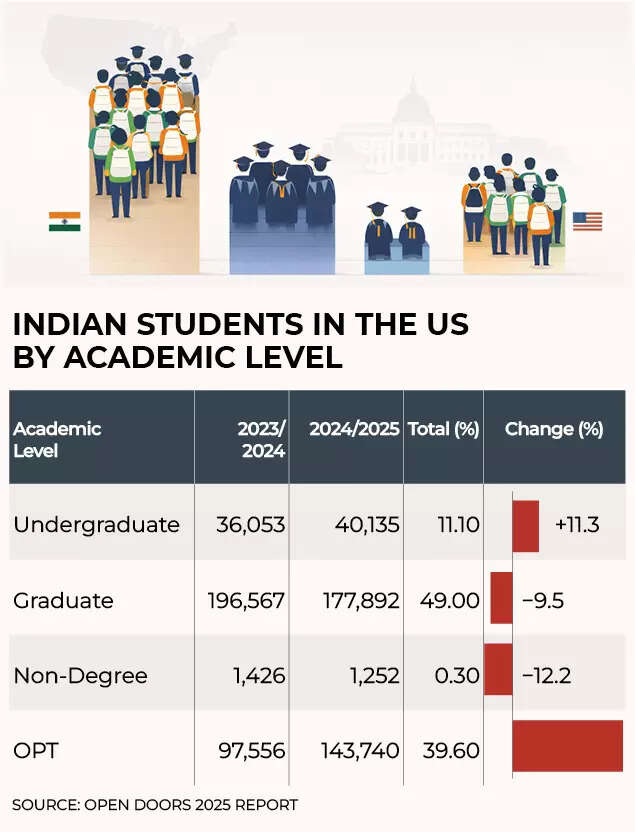
OPT is not a footnote to the US education proposition; it is its operating clause. It is the bridge that converts a high-cost Indian degree decision into a recoverable investment, and it is the bridge now being pulled into a political trade-off. That is why the Open Doors 2025 numbers matter. They should be read as a warning, not as a celebration. The report shows India’s total student count rising to 363,019 in 2024-25, from 331,602 in 2023-24 and 268,923 in 2022-23.Yet within that expansion sits a telling split: Indian graduate enrolment fell to 177,892 in 2024-25 from 196,567 a year earlier (down 9.5%), even as the overall India count climbed. The counterweight is OPT. The number of Indian students on Optional Practical Training jumped from 97,556 in 2023-24 to 143,740 in 2024-25—a 47.3% rise. The composition of the India count is shifting: OPT is growing faster than enrolment, which means the headline number is increasingly dependent on the post-study corridor.
OPT is growing faster than enrolment
This is precisely why the political tirade and the proposals will land hardest on Indians. A crackdown calibrated at OPT does not hit an edge-case; it hits the centre of India’s US value proposition—the implicit promise that the degree is paired with a credible chance to work, earn, and build employability in the same labour market. Termination proposals would collapse the post-degree runway altogether, converting graduation into forced departure, with no time buffer to stabilise finances or convert internships into jobs.A move to fixed admission end-dates would turn the OPT transition into a timing trap—degree completion, OPT approvals and employer paperwork now operating under expiry dates and extension queues, where delay is not inconvenience but status risk.And the tax-advantage attack embedded in the current political critique weakens employer appetite at exactly the stage Indian students depend on to convert education into employment experience: If OPT hires become costlier or politically ‘sensitive’, employers can simply shift to safer, simpler hiring pools. In effect, Indians absorb the sharpest end of the tightening because they are now disproportionately concentrated in the very post-study pipeline being targeted.
The OPT math America can’t ignore
If Washington tightens the Indian OPT corridor, it won’t just be trimming a post-study perk—it will be changing the plumbing of U.S. international education and a slice of the entry-level talent market that rides on it. Open Doors 2025 shows the U.S. hosted 1,177,766 international students in 2024-25, up 4.5%, even as new international enrolments fell 7.2% and classroom headcount stayed essentially flat. By normal enrolment math, totals should have slipped. Instead, the system added roughly 51,000 students—and the source is visible in the next line of the ledger: OPT rose from 242,782 in 2023-24 to 294,253 in 2024-25, an increase of 51,471, almost a perfect match.
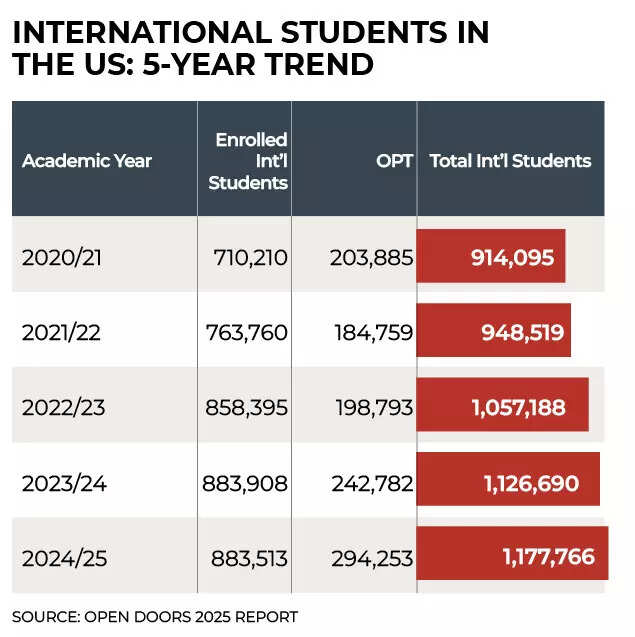
OPT rose from 242,782 in 2023-24 to 294,253 in 2024-25 in the US
That means a crackdown aimed at OPT—where Indian graduates are now heavily concentrated—doesn’t just send more people home sooner; it also thins the post-campus workforce layer that supports labs, hospitals, research units, and the employment outcomes universities sell as proof of ROI. And if the squeeze extends beyond Indians to international graduates more broadly, the risk for the U.S. is not immediate collapse but gradual dilution: Fewer global graduates embedded in American workplaces, weaker word-of-mouth signals abroad, and a less predictable supply of trained talent in precisely the sectors that have quietly relied on this pipeline.
About the Author