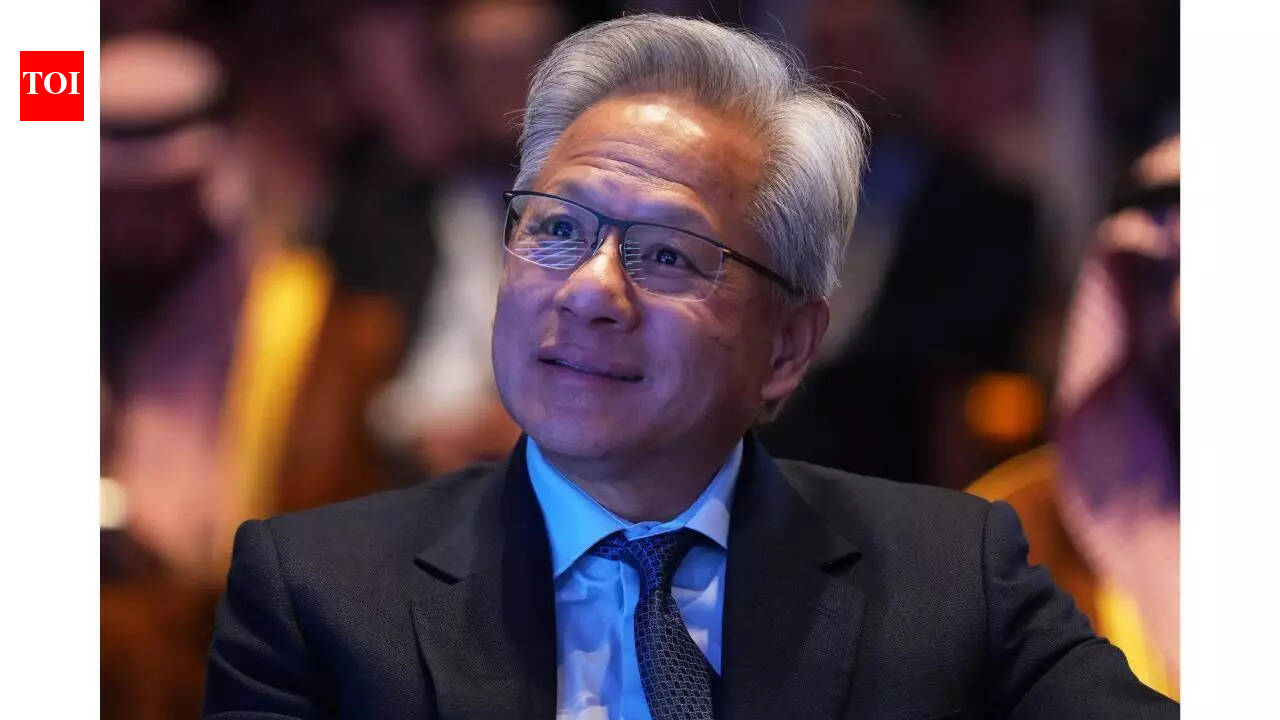
NVIDIA CEO Jensen Huang did not spend his latest CES appearance talking about AI chips, partnerships, or market dominance. Instead, he used the moment to talk about engineering itself. Huang accepted the IEEE Medal of Honor in a small room at the Fontainebleau Hotel in Las Vegas at CES. The crowd was modest. The message was personal.Standing in front of a few dozen people, Huang explained why he chose engineering in the first place and why, decades later, he still believes it is one of the most meaningful professions there is.
NVIDIA CEO Jensen Huang speaks at CES about engineering
The speech came a day after Huang delivered NVIDIA’s main CES keynote, which drew a packed audience and global attention. This time was different. There were no slides about GPUs or AI platforms. No product announcements. Just Huang, a microphone, and a reflection on the path that brought him here.“I went into engineering because it was math-heavy and it was science-heavy,” Huang said. He explained that he liked solving math and science problems, and engineering felt like a natural fit.That simple motivation set the foundation for everything that followed. At a time when many tech leaders frame their careers as carefully planned journeys, Huang was refreshingly direct. He liked the work. So he stuck with it.
Jensen Huang on choosing engineering and finding his life partner
Huang also shared a personal story that drew quiet laughs from the room. He talked about choosing Oregon State University largely because it was close to home. There was no grand vision behind the decision. No long-term strategy.That choice led him to a lab partner who later became his wife.Looking back, Huang seemed genuinely amused by how unpredictable that path was. “That’s not a game plan that you can reasonably imagine,” he said.He extended that thought even further. It was just as unreasonable, he noted, to imagine that the company he would later help build would go on to reshape computing itself. NVIDIA’s role in modern AI and high-performance computing was not something anyone could have plotted on a whiteboard decades ago.
How Jensen Huang describes engineering as problem-solving
As Huang shifted back to the profession itself, his tone became more deliberate. He described engineering as the practice of applying first principles in science and math to real problems. Not abstract ones. Real, stubborn, often messy problems.Engineering, he said, is about breaking down huge challenges into smaller parts that can actually be solved. It also requires resilience. Problems do not give up easily. Solutions take time, patience, and repeated failure.He emphasised that progress in technology rarely comes from sudden inspiration alone. It comes from steady work, collaboration, and the willingness to keep going when things do not work the first time. Or the tenth.In Huang’s view, that is what allows engineering to turn ideas that once felt impossible into everyday reality.
Jensen Huang calls engineering the most noble profession
Near the end of his remarks, Huang made his most direct statement of all. “This profession is the most noble of all,” he said.It was not delivered as a slogan or a soundbite. It sounded more like a conclusion reached after years of experience. For Huang, engineering earns that label because it creates tools that extend human capability. Tools that last. Tools that others build on.Computers, he noted earlier, have become “the single most important tool of humanity.” Engineering made that possible, even if no one could fully predict where it would lead.
NVIDIA CEO Jensen Huang praises IEEE and industry standards
Huang also used the moment to acknowledge IEEE, the Institute of Electrical and Electronics Engineers, which awarded him the Medal of Honor. He praised the organisation’s role in setting technical standards that quietly hold the tech world together.Joking about Wi-Fi standards, he said, “You have to think about IEEE when you think about 802.11.” It was the kind of line that probably would not land outside an engineering crowd. Here, it did.Huang pointed out that industrial standards are not glamorous, but they are essential. They form the basic structure on which the entire computer industry is built. Without them, innovation would be fragmented and fragile.
A quieter moment that says a lot about Jensen Huang
In a week filled with flashy demos and big promises about AI, Huang’s smaller speech stood out for a different reason. It was grounded. Personal. Almost old-fashioned.There was no attempt to impress. Just a reminder that behind every breakthrough are people who chose to work through hard problems, often without knowing where that work would lead.For students, engineers, and anyone building a career in technology, Huang’s message was simple but reassuring. You do not need a perfect plan. You need curiosity, discipline, and the willingness to keep solving problems.Sometimes, that turns out to be more than enough.
About the Author