
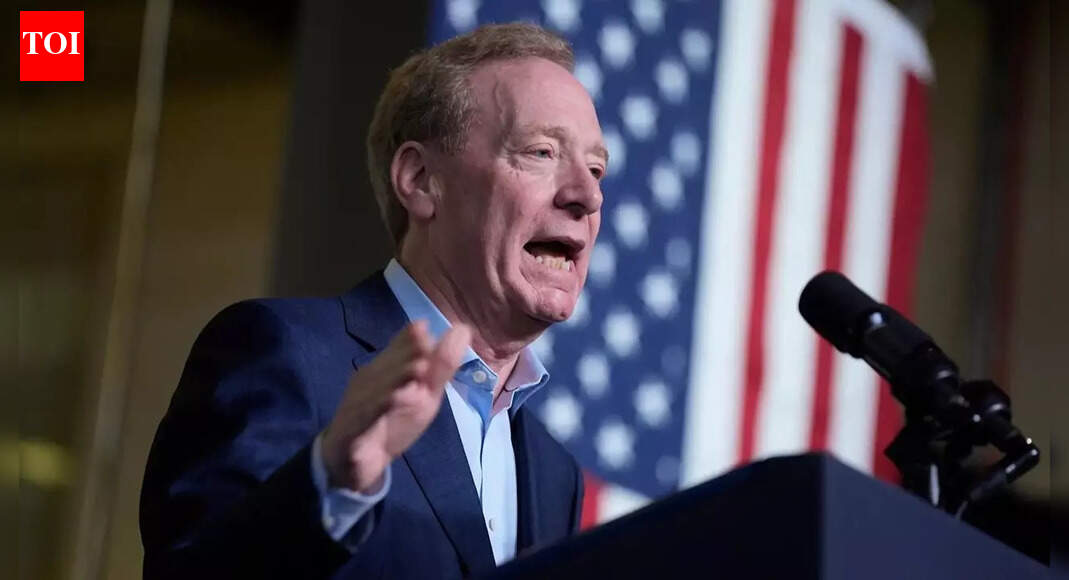

Microsoft’s president, Brad Smith, has warned US President Donald Trump that China is winning the artificial intelligence (AI) race outside America. He noted that US companies are falling behind rivals in markets outside the country. Smith explains that the Chinese government uses low-cost “open” models and large state-backed subsidies to gain an advantage in AI. He also highlighted that the rapid growth of the Chinese AI startup DeepSeek in countries such as Africa underscores the pressure American companies are facing globally.In an interview with the Financial Times (FT), Smith said: “We have to recognise that right now, unlike a year ago, China has an open-source model, and increasingly more than one, that is competitive. They benefit from subsidisation by the Chinese government. They benefit from subsidies that enable [them] to basically undercut American companies based on price.”Smith’s comments come after new research from Microsoft found that the release of DeepSeek’s R1 large language model a year ago helped accelerate the uptake of AI worldwide, particularly in the global south, due to its “accessibility and low cost”. That has also helped China overtake the US in the global market for so-called “open” AI models, which are often free for developers to use, modify, and integrate. To compare, US tech companies such as OpenAI, Google and Anthropic have instead focused on maintaining complete control of their most advanced technology, profiting from it through customer subscriptions or enterprise deals, the study claimed.
How Chinese and US tech companies are competing against each other in Africa and other countries
Based on usage data from products offered by tech companies, Microsoft’s research estimated that Chinese companies have an 18% share of the AI market in Ethiopia and 17% in Zimbabwe. Smith noted that African countries would need more funding from “international development banks” or “lending facilities” to help them build data centres and cover electricity costs.“If we rely on private capital flows alone, I don’t think that will be sufficient to compete with a competitor that is subsidised to the degree that Chinese companies often are, especially in those parts of the world,” he explained.However, Bright Simons, vice-president at the IMANI think-tank in Ghana and an AI expert, said there was no “scientifically rigorous way” to prove whether DeepSeek was really leading in Africa, but that free Chinese AI systems offered cheaper options.“Africans can’t afford very expensive solutions apart from open source, so you have to go to [Meta’s] Llama or Chinese options,” he said. He also mentioned that Africans were using their own locally-made small language models, such as Masakhane, a pan-African model, and the South African InkubaLM.Microsoft’s research also showed that in countries where American technology products are blocked or limited, DeepSeek had gained a major advantage, with a 56% market share in Belarus, 49% in Cuba and 43% in Russia.DeepSeek surprised Silicon Valley when it launched its powerful AI reasoning model, R1, last year, claiming it was built at a lower cost with less computing power. DeepSeek is expected to release its highly anticipated new AI model before the Lunar New Year holiday.Microsoft’s research even showed that AI use is currently highest in wealthier countries, with nearly a quarter of the global north using AI in the fourth quarter of 2025, compared to 14% of the global south and 16% globally.Smith said the growing gap was a “cause for concern” and warned that “if we don’t address a growing AI divide, it’s likely to perpetuate and broaden the great economic divide between north and south.”He pointed out that this was an important battleground in the US’s competition with China. He claimed that more investment was needed from private companies to build data centres and provide skills training, as well as money from governments and financial institutions.“What we do have is, as American companies, a stronger reputation for trust. We have access to better chips than the Chinese companies do . . . [but] you always have to compete on price,” Smith added.Smith also warned that ignoring AI adoption in regions like Africa, which have young, rapidly growing populations, could lead to the rise of systems that don’t support democratic values.“If American tech companies or western governments were to close their eyes to the future in Africa, they would be closing their eyes to the future of the world more broadly, and I think that would be a grave mistake,” he added.
About the Author