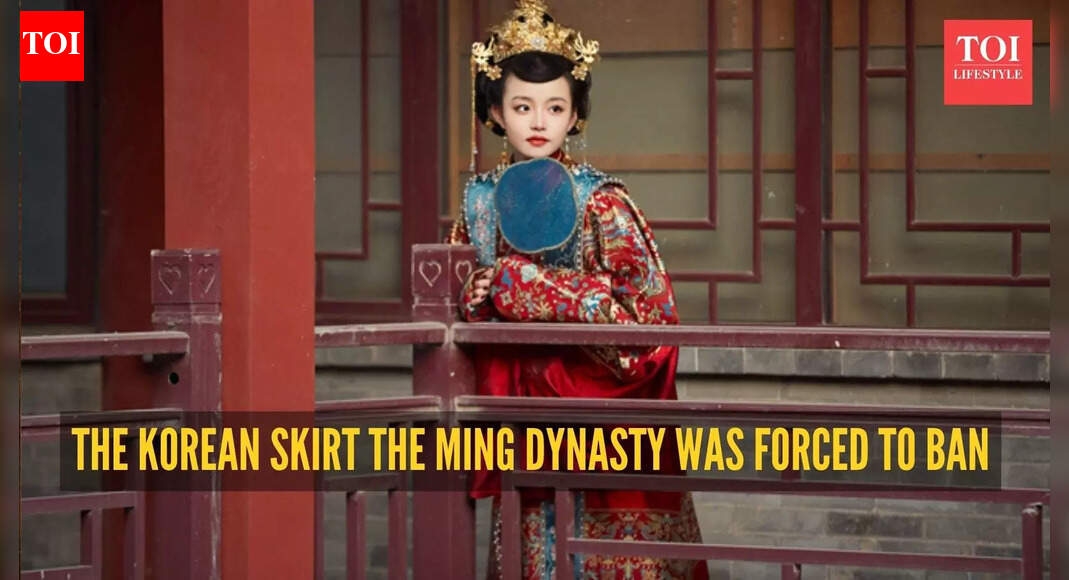

Fashion bans aren’t exactly a modern invention. Long before governments debated dress codes and trends, the Ming dynasty found itself cracking down on a surprising culprit: a skirt made of horsehair.As highlighted in a South China Morning Post (SCMP) report, the maweiqun, a stiff underskirt woven from horse tail hair, became so wildly popular in 15th-century China that it eventually alarmed officials and led to an outright ban.Yes, a skirt caused enough chaos to worry the state.
Before crinolines, there was horsehair
Most people associate voluminous skirts with Europe’s 19th-century crinolines – those dramatic, cage-like structures worn under gowns. But long before European women strutted around in hoop skirts, Asia had already experimented with similar silhouettes.
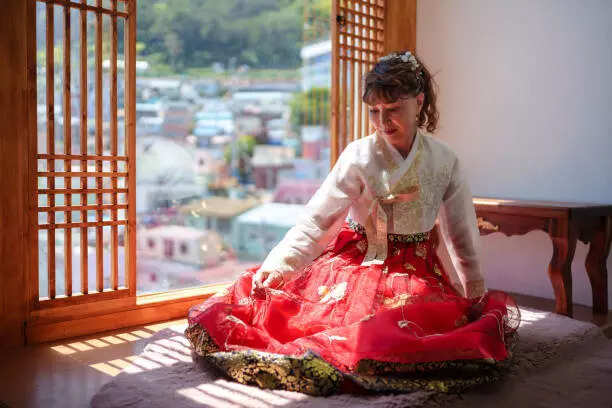
The maweiqun worked on the same principle. Worn under robes by both men and women, it created a wide, umbrella-like shape that screamed status and style. And instead of steel or whalebone, it relied on something far more unusual: horsehair.Ming dynasty writer and court recorder Wang Qi described it vividly in his writings, noting that slimmer people wore multiple layers while heavier wearers needed just one to achieve the dramatic flare.
From fashionable to problematic
At first, the skirt was exclusive. According to historical records cited by SCMP, only wealthy merchants, princesses, courtesans, and elite officials could afford it. But fashion, as it always does, trickled down, and then exploded.Soon, literati, military officers, and court officials were all jumping on the trend. Demand skyrocketed. And that’s when things took a strange turn.Horsehair became so valuable that reports began surfacing of people cutting hair off government-owned horses, and even stealing it outright, just to keep up with fashion.That was the breaking point.
When the state steps in
During the Hongzhi period of the Ming dynasty, officials began to raise red flags. One supervising secretary reportedly warned that the craze was spiralling out of control, with horsehair theft threatening state resources and order.The skirt, once just a fashion statement, was now being framed as a symbol of excess, corruption, and moral decay.Officials petitioned the emperor to ban it, and the government agreed.The maweiqun was officially prohibited, and just like that, the trend collapsed almost overnight.
A Korean connection many forget
Interestingly, the skirt wasn’t originally Chinese at all.Before it became known as maweiqun in China, it was called mamigun in Korea. Scholars widely agree that the garment originated in Korea’s Joseon dynasty and made its way into China through cultural exchange.Jeju Island, known for horse breeding since Mongol times, played a key role. With an abundance of horses, it became a hub for horsehair products, from traditional Korean hats (gat) to these structured skirts.As SCMP notes, Korean fashion enjoyed a moment of high prestige among wealthy Chinese elites during Emperor Chenghua’s reign, making the skirt both foreign and fashionable, a dangerous mix in conservative court politics.
Fashion, power, and paranoia
After Emperor Chenghua’s death, the political mood shifted sharply. Reformist officials began targeting anything associated with luxury and indulgence, and the horsehair skirt became an easy target.
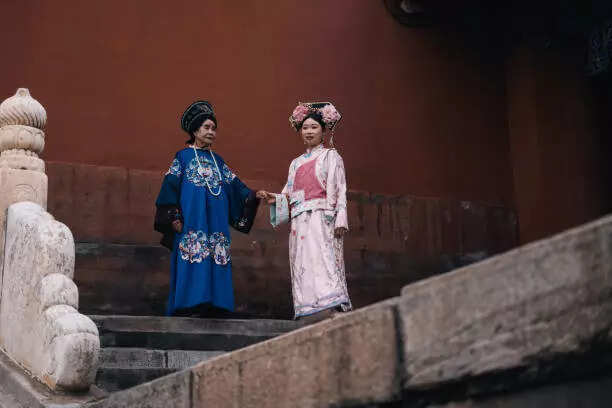
Wearing it was no longer just about style; it was seen as a sign of moral failure.One Ming official famously wore his stiff petticoat year-round. Another doubled up on layers. And those who refused to wear it were rare enough to be named in records, a reminder of just how dominant the trend had become.Which only strengthened the case for banning it.
Where did it all happen?
Historians still debate whether the skirt craze peaked in Beijing or Nanjing. Some scholars believe references to the “capital” point to Beijing, while others argue Nanjing, the original Ming capital, was the true centre of the trend.According to research referenced by SCMP, maritime routes between Jeju Island and China’s Jiangnan region may have played a bigger role than official land routes between Seoul and Beijing, quietly reshaping how fashion travelled across borders.
More than just a skirt
The rise, and fall, of the maweiqun might seem like a quirky fashion footnote today. But it reveals something bigger.It shows how deeply fashion can influence society, politics, and even state policy. It also reminds us that cultural exchange didn’t always flow through royal courts and capitals – sometimes, it travelled by sea, carried by traders, trends, and human vanity.And in this case, it travelled just far enough to get banned.
About the Author