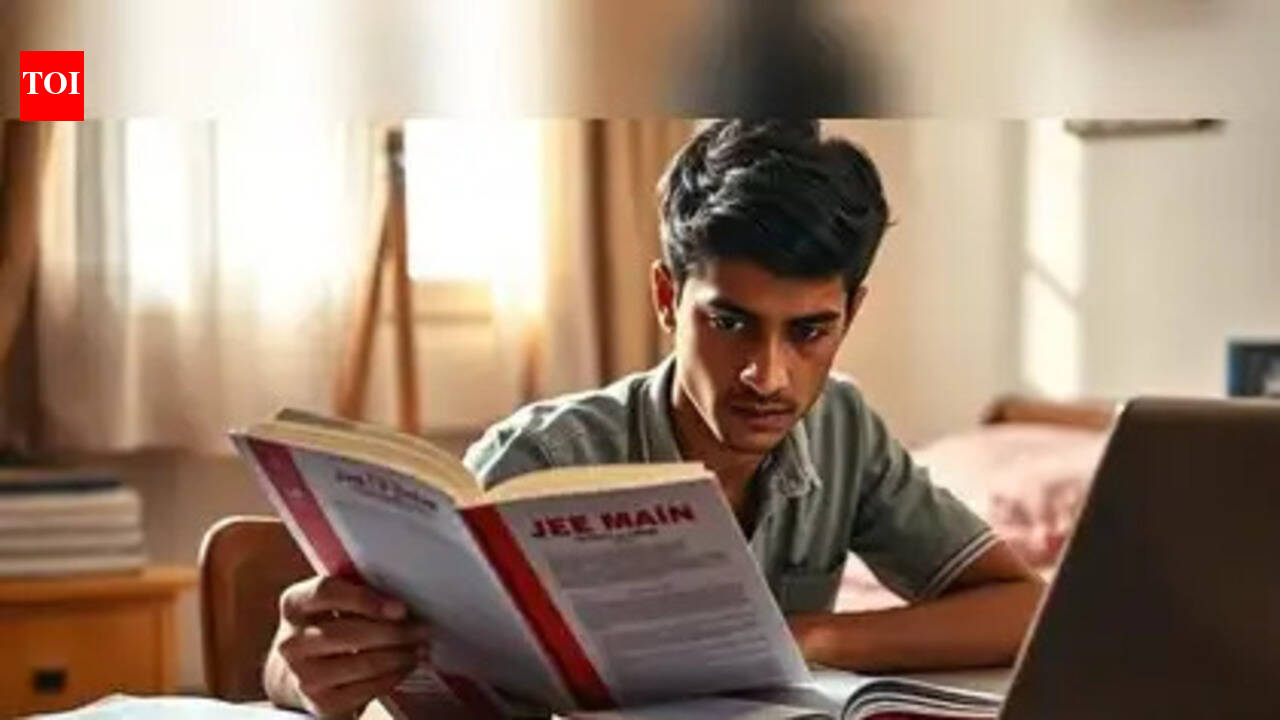
Every year the nation witnesses a plethora of students with strained brows and drooping faces. We know that it is JEE Mains exam time. The obsession and fanaticism of IIT is not only what was shown in Kota Factory but also one that is everyday lived by a plethora of students. JEE Main is not merely an entrance test; it is an exam that tests ambition. No one is unfamiliar with engineering obsession across the country. Some dislike it, some applaud it, but whatever it is, this has definitely led to a surge in competition among JEE aspirants. For 2026, JEE Main is being conducted in two sessions. The first session is scheduled from January 21 to January 29, 2026, while the second session will be held between April 2 and April 9, 2026. With lakhs of students competing across multiple shifts, the margins between success and disappointment are razor-thin.Yet, as educators repeatedly point out, the exam is no longer just about syllabus completion. It is about how students behave under pressure, how they choose questions, and how they manage their own minds in a three-hour window.Amit Mahajan, senior PhysicsWallah professor, frames this reality with striking clarity. As he puts it, “In a few hours, the syllabus won’t change, nor will your intelligence. What does change is your decision-making will. And that is exactly what the JEE Main tests.”Drawing from years of analysing question papers and student outcomes, Mahajan emphasises that damage is rarely done during preparation.“After analysing years of JEE Main papers and student performances, one thing becomes clear, that most mistakes don’t happen during the preparation; they happen inside the exam hall.” This distinction, between preparation and performance, lies at the heart of the JEE Main strategy.
Understanding the JEE Main 2026 exam pattern
The Joint Entrance Examination (JEE) Main is conducted annually for admission to B.E., B.Tech, B.Arch, and B.Planning courses across India. The exam consists of two papers. Paper 1 is for B.Tech and B.E. aspirants, while Paper 2 is meant for architecture and planning aspirants.Paper 1 is in computer-based mode, lasting three hours, whereas Persons with Disabilities candidates have to take the paper in four hours. There are 25 questions in the subjects of Physics, Chemistry, and Mathematics, respectively, consisting of two parts, 20 multiple-choice and five numerical-value questions. All 75 questions have to be attempted, totaling 300 marks. For every correct answer, the candidate gets four marks, while one mark is deducted for every incorrect answer. There is no negative marking for an unanswered question.The paper is further divided into two: Paper 2A (B.Arch) and Paper 2B (B.Plan). The B.Arch paper consists of Mathematics and Aptitude tests in online mode and a drawing test in offline mode. The B.Plan paper is a computer-based paper that consists of mathematics, Aptitude, and Planning parts. The total time given for each paper is three hours for a total of 400 marks each.While understanding the structure is essential, Mahajan argues that structure alone does not secure ranks, strategy does.
Accuracy over ambition
One of the most persistent myths surrounding JEE Main is that attempting all questions is a sign of seriousness. Mahajan dismantles this belief bluntly. “Stop chasing perfection and start chasing accuracy.” he further said, explaining that “The paper is not designed to be completed. If you walk in planning to attempt every single question, you’ve already lost time.” Students who walk in determined to attempt all 90 questions often sacrifice time and precision. As Mahajan notes, “Toppers don’t solve more. They simply waste less time and they are the ones who know what to leave.”In JEE Main, judgment outweighs brute force. “JEE Main is not a race to attempt all 90 questions. It is a test of judgment.” All you need is a good strategy, as Mahajan explains that “Every minute you spend stuck on a tough question is a minute stolen from three easier ones.”
JEE Main: Reading the paper like a map
Mahajan advises students to resist the urge to dive straight into calculations. “Use the paper like a map, not a maze,” he says, stressing that “the first 10 minutes should feel calm and not chaotic.” According to him, scanning the paper strategically, “like a chessboard,” helps students identify scoring opportunities early.He recommends prioritising “direct, formula-based questions,” “clean diagrams,” and “standard reactions or concepts,” while consciously avoiding “long algebra,” “messy calculus,” and “questions that feel tricky at first glance.”
Physics: Where errors are often self-inflicted
Despite its reputation, Physics in JEE Main is not designed to confuse students. “JEE Main Physics isn’t trying to trick you; students often trick themselves,” Mahajan observes. He urges aspirants to focus on high-yield areas such as “Mechanics,” “Current electricity,” “Optics,” and “Thermodynamics.”When calculations spiral uncontrollably, it is often a sign of a flawed approach. “If your calculation is exploding, you’ve probably chosen the wrong approach,” he cautions. In moments of uncertainty, “when memory fails, units and dimensions can save you.”
Chemistry: The emotional stabiliser
For many students, Chemistry serves as an anchor during the exam. Mahajan calls it “the confidence booster,” explaining that it can act as “your emotional stabiliser in the exam.” The reason is simple. “Because many questions are direct, NCERT-based, and conceptually familiar.”Completing Chemistry early offers more than just marks. “Finishing Chemistry early gives you something priceless, psychological breathing room,” Mahajan notes, adding that “when your mind feels calm, your accuracy improves.”
Mathematics: Control over brilliance
Mathematics, according to Mahajan, rewards discipline rather than flashes of genius. “Maths needs discipline, not drama,” he says. In JEE Main, “Mathematics is less about brilliance and more about control.”He advises students to select problems that “look structured,” “have clear steps,” and “don’t demand heavy algebra.” Crucially, “leaving a tough Maths question is not giving up. It’s choosing efficiency over ego.”
The myth of smart guessing in JEE Main exam
With negative marking in place, guessing can be costly. Mahajan is unequivocal. “Smart guessing Is a skill, not a gamble,” he says, warning that “one wrong guess can cancel out a correct answer.” His advice is clear: “Guess only when logic gives you an edge. Otherwise, silence is safer than risk.”
Managing panic in the exam hall
Even the best-prepared students experience moments of panic. Mahajan normalises this reality. “Every serious student panics at least once,” he says, adding that “the key is not to stop the panic, it’s to move despite it.” His strategy is practical: “Solve a small, easy question. Let momentum replace fear. Your brain follows your actions.”
Letting go of half-solved questions
Emotional attachment to partially solved problems can be dangerous. “A question that is ‘almost done’ feels emotionally valuable,” Mahajan explains, but “JEE Main only values final answers.” If a question consumes disproportionate time, “walk away,” he advises, because “marks don’t care about effort but only outcomes.”
Ending the JEE Main paper with calm
The final minutes of the exam are not meant for heroics. “End Calmly. Not Desperately,” Mahajan urges. According to him, those moments should be spent “checking responses,” “avoiding careless errors,” and “staying steady.” As he reminds students, “no miracles happen in the last 2 minutes. But mistakes often do.”As JEE Main 2026 approaches, Mahajan distills his message into a mindset rather than a method. “Your calm is your competitive edge,” he says. “You don’t need new formulas today. You need clarity. You don’t need more speed. You need better choices.” Preparation, he insists, has already played its part. “Your preparation has already done its job. Now, let your mindset do the rest.”In an exam where lakhs of students know the same formulas and concepts, it is composure that separates ranks. Or, as Mahajan concludes, “Walk in steady. Think sharp. Let your calm speak for your confidence.”
About the Author