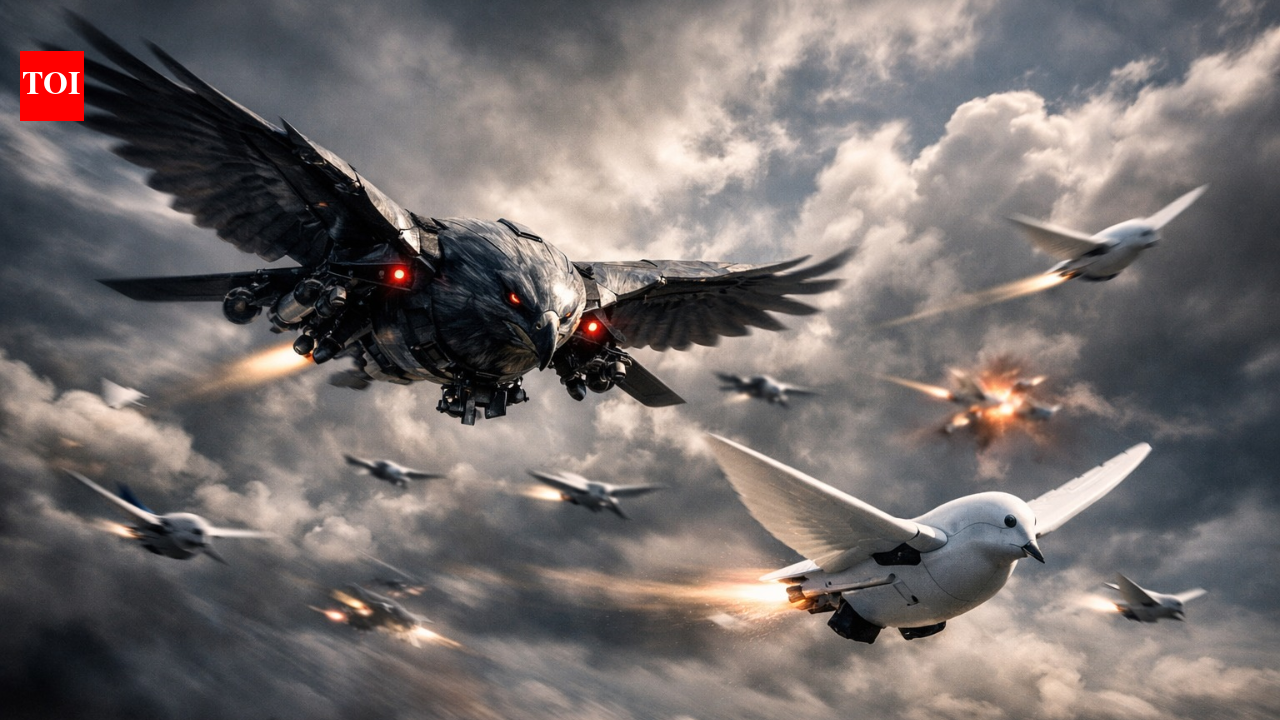
China is teaching its drones to fight like animals. Engineers at Beihang University, a military-linked school, created a system in which defensive drones mimic hawks by targeting the most vulnerable enemy drones, while attacking drones behave like doves to evade the hawks. In a five-on-five simulation, the hawks destroyed all the doves in just 5.3 seconds. The research earned a patent in April 2024 and is part of a Chinese defence institutions to using artificial intelligence to run autonomous drone swarms and other unmanned systems.The People’s Liberation Army (PLA) sees AI as a way to operate drones, robot dogs, and other robotic systems with minimal human input. Chinese military theorists have written that the AI era could be a revolution for warfighting, with unmanned systems as the main force and swarm operations as the primary combat method. They compare its potential impact to gunpowder, a Chinese invention that transformed global warfare centuries ago.Drones are already critical in modern conflicts, including Ukraine, where they serve as decoys, spies, or weapons in suicide attacks. China has an advantage in hardware production, with factories capable of making over a million low-cost drones annually, compared with tens of thousands in US at much higher costs. China has displayed weaponised robot wolves that could work with aerial swarms for collaborative combat.Experts say AI can also compensate for gaps in PLA training. “At a tactical level, for concrete missions, there’s a growing consensus [in Chinese military writings] that autonomous systems have the potential to perform better than humans,” said Sunny Cheung from the Jamestown Foundation. China’s top-down military structure and limited combat experience among commanders make autonomous drones particularly appealing.The PLA’s AI ambitions go beyond aerial swarms. Procurement documents describe mobile cognitive warfare systems capable of broadcasting deepfake videos, deploying robot dogs, and even using directed sound against targets. The technology remains in development, and experts warn of risks if systems make deadly decisions beyond human control or fail under real-world conditions, such as electronic warfare or signal jamming.China’s research also studies other animal behaviours, including ants, coyotes, sheep, whales, eagles, and fruit flies, to improve drones’ ability to act collectively. Since 2022, at least 930 patents related to swarm intelligence have been filed by Chinese military-linked institutions, compared with around 60 in the United States, reports the Wall Street Journal. The US military is also exploring drone swarms but prioritises individual drones operating alongside human soldiers. Experts note that China’s combination of AI and a vast drone supply chain could allow the PLA to overwhelm enemy defences in scenarios like a conflict over Taiwan. “You could very easily have this dense amount of firepower up there just constantly scanning and searching and making it very hard for Taiwan to conduct defensive operations,” said Stacie Pettyjohn of the Center for a New American Security.Chinese military thinkers see AI as a solution to human limitations, but some warn of the dangers. “Once an artificial intelligence weapon system produces safety hazards, the ‘algorithm black box’ may become a rationalized excuse for the relevant responsible parties to shirk responsibility,” wrote Zhu Qichao of China’s National Defense University.
About the Author