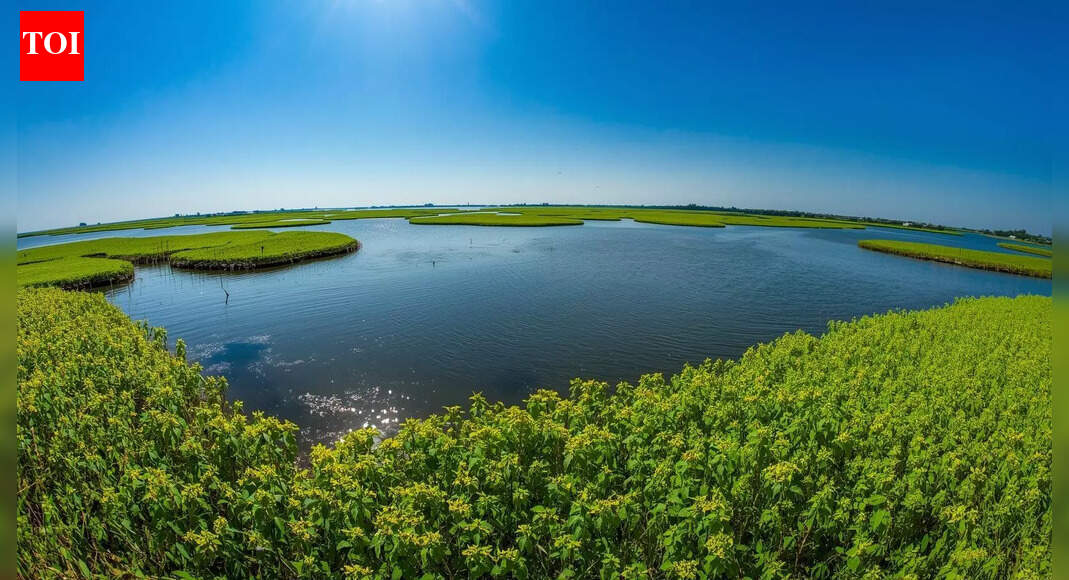
Keibul Lamjao National Park, located in Manipur’s Loktak Lake, holds a distinction unmatched anywhere else in the world. It is the only national park that rests entirely on floating vegetation, rather than fixed land. The park is formed on phumdis, thick natural mats of soil and plant matter that rise and sink with changing water levels. This unusual setting supports a fragile ecosystem and serves as the last natural habitat of the endangered Sangai deer. Though remote, the park has become a point of scientific and conservation interest due to its dependence on the health of the surrounding lake. Water management, climate patterns, and the careful balance between protection and human activity closely shape Keibul Lamjao’s future.
Keibul Lamjao: World’s only floating national park in Manipur
The base of Keibul Lamjao is made of phumdis, which are thick, layered masses of vegetation. They form naturally when plants decay and bind together with soil and roots. Over the years, these mats grow strong enough to support grasses and reeds, and eventually animals. They drift slightly with changes in water level, lifting during the monsoon and settling lower in drier months. This movement is slow, almost unnoticeable, but it shapes everything above it. Unlike solid ground, the surface feels alive. The health of the park depends on Loktak Lake itself. When water flow changes, the phumdis change too. This fragile balance is why the park is considered unique and also why it remains vulnerable to human interference beyond its boundaries.
Endangered animals depend on this floating park
The most well-known resident of Keibul Lamjao is the Sangai deer. With its slender legs and curved antlers, it moves lightly across the phumdis, almost testing each step. Once believed to be extinct, the species survived only here, hidden within the floating grasslands. Its presence is tied closely to the condition of the park. Alongside the Sangai, smaller populations of hog deer are found, as well as otters that slip quietly through the water channels. Birds arrive and leave with the seasons. Some stay; others pass through during migration. Their calls fill the early mornings, then fade by afternoon. None of these animals could exist here without the lake, and none could survive if the phumdis were to disappear.
Nature draws visitors to Keibul Lamjao National Park
People come here less for spectacle and more for atmosphere. There are watch towers where visitors stand and wait, often longer than expected. Mist moves across the lake in the early hours, hiding and revealing shapes without hurry. When a deer appears, it does not perform. It grazes, lifts its head, and moves on. Boats cut slowly through narrow channels, careful not to disturb the floating ground. The landscape feels open yet contained, quiet but not empty. There are no marked trails in the usual sense, because the land itself shifts. What stays with many visitors is not a single sight, but the sense of standing somewhere that does not quite behave like land or water, but something in between.
How and when can you visit the floating park
The park is about 45 kilometres from Imphal, the capital of Manipur. Most visitors arrive by air, then continue by road towards Loktak Lake. The best months to visit are between November and March, when the weather is cooler, and water levels are more stable. During the monsoon, the lake swells and restricts movement, making access difficult. Local guides are important here, not only for navigation but also for understanding what can and cannot be done on floating ground. Rules are strict, and for good reason. Keibul Lamjao is not built to absorb pressure. It holds together quietly, as long as it is allowed to. When the day ends, the lake settles again, carrying the park with it.
About the Author