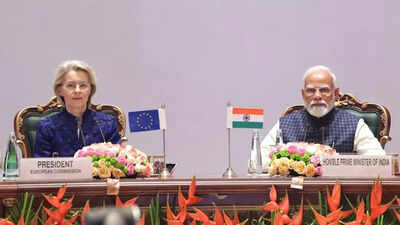
NEW DELHI: India and the European Union on Tuesday announced the conclusion of negotiations for a landmark free trade agreement (FTA), ending talks that began nearly two decades ago.The “mother of all deals” is India’s 19th trade agreement and is expected to significantly boost exports to the 27-nation EU bloc while reshaping competition for several domestic industries.
The agreement comes at a time when global trade flows have been disrupted by high US tariffs, fragile supply chains and geopolitical tensions, including the Russia-Ukraine war.India is currently facing steep tariffs from the US, while the EU is also under threat of higher American duties.
What the deal covers
- Under the FTA, duties will be cut on 99.5% of goods exported from India to the EU, including seafood and footwear.
- In return, India will reduce or eliminate tariffs on 96.6% of goods imported from the EU, including phased cuts for European carmakers and alcohol producers.
- Once implemented, the pact will create a combined market of nearly 2 billion people, spanning the world’s fourth-largest economy (India) and the second-largest economic bloc (EU).
- Indian apparel manufacturers and gems and jewellery exporters are among the biggest gainers, as EU duties on these products will be cut to zero.
- Domestic food producers will also get preferential access to the European market.
- However, Indian automakers and liquor companies are expected to face stiffer competition as lower import levies make European products cheaper.
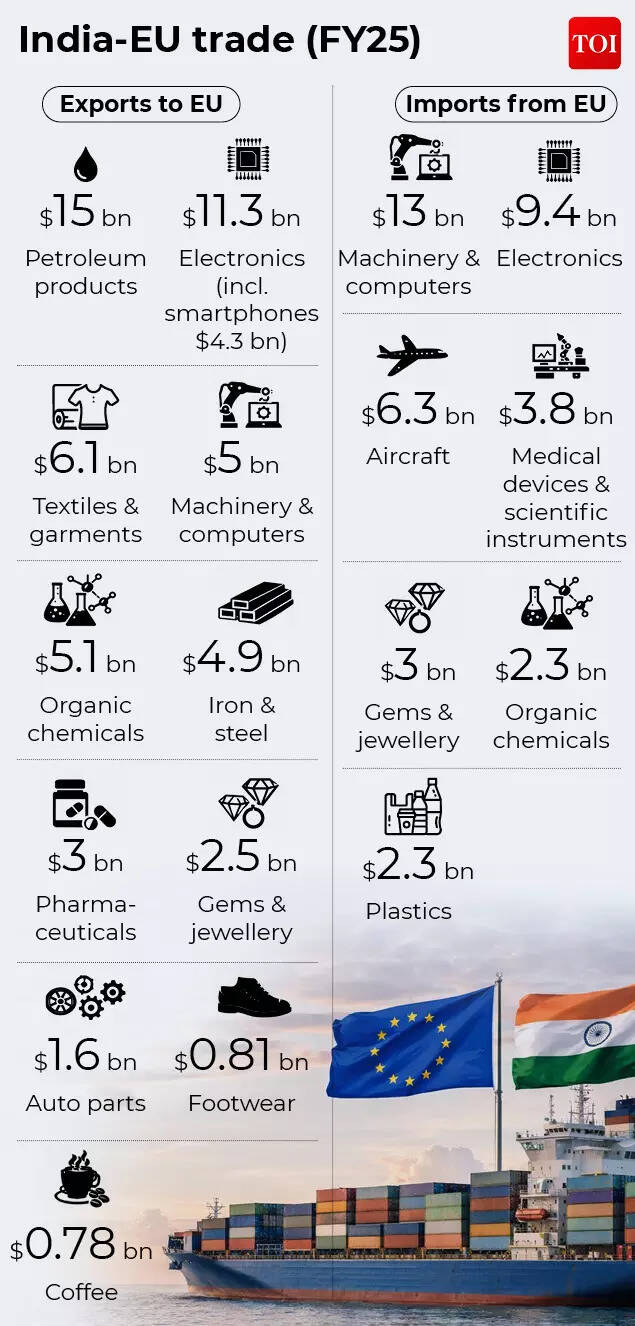
As companies await more details, here’s a look at who stands to gain and and who may lose:
Big winners
Apparel & textiles
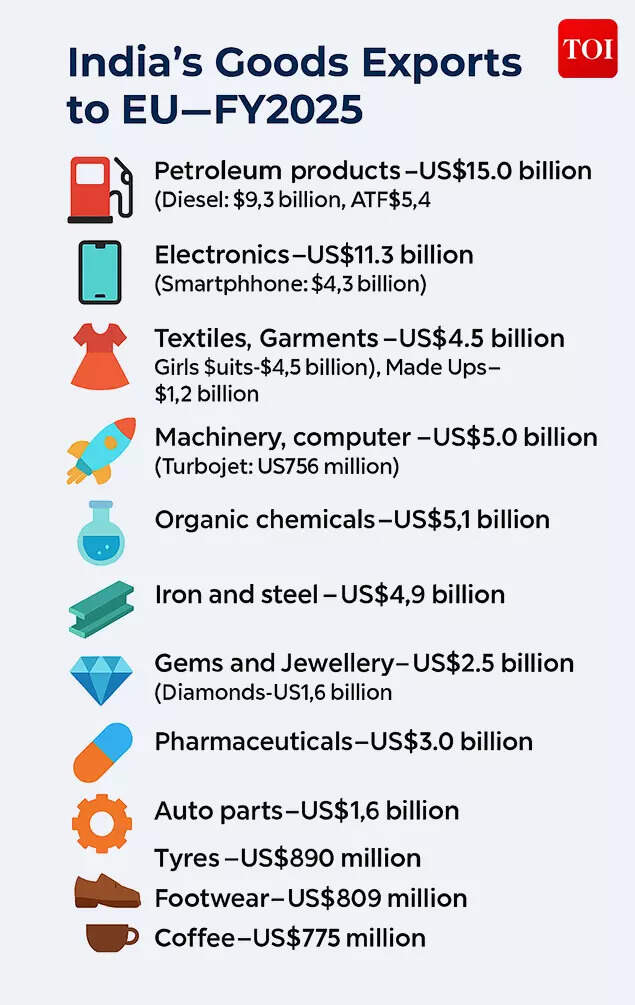
India gains immediate zero-duty access to a $263 billion European textile market. The government said tariffs on textile imports will be eliminated immediately. CareEdge Ratings called the deal “critical” for improving competitiveness, estimating India could raise its EU market share to 9% from 5%, adding nearly $4.5 billion in annual exports over the medium term.Textile stocks reacted sharply, with KPR Mill, Welspun Living, and Kitex Garments posting strong gains, Bloomberg reported.
Leather & footwear
Tariffs on leather and footwear have been slashed to zero from 17%, opening up a $100 billion EU market for Indian exporters.
Gems & jewellery
The EU has granted duty-free access to Indian gems and jewellery. Kirit Bhansali, chairman of the Gem & Jewellery Export Promotion Council, said bilateral trade could double to Rs 910 billion in the next three years.“This timely pact will help Indian exporters salvage lost ground,” he said, noting that exports to the US have fallen sharply.
Food products & seafood
Indian exporters of shrimp, frozen fish and value-added seafood products will get preferential access to the EU market. Producers of tea, coffee, spices, grapes and processed food will also benefit, while safeguards remain in place for sensitive sectors like dairy and poultry.
Benefits for India
- Preferential access across 97% of tariff lines, covering 99.5% of trade value.
- Immediate duty elimination for labour-intensive sectors such as textiles, leather, gems and jewellery.
- Zero-duty entry for $33 billion worth of exports currently facing EU tariffs of 4–26%.
- Sensitive sectors like dairy, cereals and poultry are protected.
Losers
Trade without Trump
The “mother of all deals” comes at a critical moment for the global economy, which has been unsettled by the unpredictable trade and tariff policies of US President Donald Trump.The landmark India–EU trade pact is expected to reduce both sides’ dependence on the United States and China.Negotiations, which began nearly two decades ago, gained momentum after tariffs imposed by the Trump administration on Indian and European goods disrupted global trade flows.The Trump administration has openly criticised the agreement. Earlier, US Treasury Secretary Scott Bessent alleged that Europe was effectively bankrolling the Russia-Ukraine war by purchasing energy products routed through India.He argued that European countries were weakening their own security by importing refined fuel from India that originates from Russian crude oil, while Washington imposed steep tariffs on Indian exports over New Delhi’s energy ties with Moscow.“We have put 25 per cent tariffs on India for buying Russian oil. Guess what happened last week? The Europeans signed a trade deal with India,” Bessent said.However, Commerce Minister Piyush Goyal has dismissed suggestions that US tariffs played a role in pushing the deal forward, saying, “I don’t think we even discussed this.”
Liquor makers
India has sharply cut tariffs on European alcohol. Duties on wine have been reduced to 20%, spirits to 40% (from as high as 150%), and beer to 50%.This is expected to intensify competition for Indian liquor firms. “It’s a negative for Indian liquormakers,” said Karan Taurani of Elara Securities. Shares of Sula Vineyards, United Breweries, and Radico Khaitan fell after the announcement.
Indian carmakers
The pact allows up to 250,000 European vehicles to enter India at preferential rates, with tariffs gradually dropping from 110% to as low as 10%. Duties on auto components will also be scrapped over 5–10 years.Shares of Mahindra & Mahindra and Tata Motors Passenger Vehicles slipped following the news.
Why the deal matters
Signed after nearly two decades of negotiations, the agreement marks India’s most ambitious trade pact so far and is set to reshape supply chains, pricing power and growth prospects across sectors. “Textiles, gems and jewellery, leather, pharma, and high-tech engineering” will benefit from the deal, Munjal Almoula, managing partner for Tax & Regulatory Advisory at BDO India told Bloomberg.India’s goods trade with the EU stood at $136.5 billion in 2024-25, making the bloc its largest trading partner. The FTA is expected to be signed later this year, following legal vetting and approval by the European Parliament.
About the Author