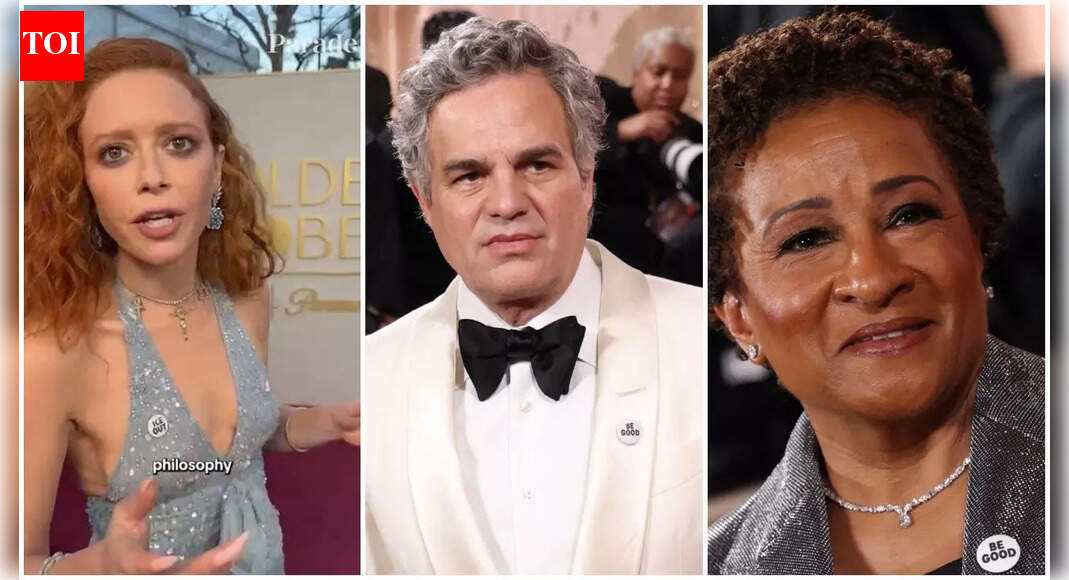
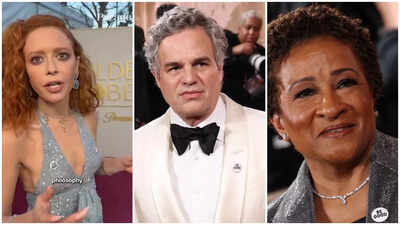
Hollywood’s biggest night came with an unexpected accessory, and that was the celebrities, who donned anti-ICE pins at the Golden Globes on Sunday in tribute to Renee Good, who was shot and killed in her car by an Immigration and Customs Enforcement officer this week in Minneapolis.The black-and-white pins displayed slogans like “BE GOOD” and “ICE OUT,” introducing a political angle into the awards show after last year’s relatively apolitical ceremony.
Mark Ruffalo, Wanda Sykes and Natasha Lyonne wore the pins on the red carpet, while Jean Smart and Ariana Grande donned them once inside the ballroom. Smart had the pin on her dress as she accepted the award for best performance by a female actor in a musical or comedy series. Since the shooting Wednesday, protests broke out across the country, calling for accountability for Good’s death as well as a separate shooting in Portland where Border Patrol agents wounded two people. Some protests resulted in clashes with law enforcement, especially in Minneapolis, where ICE carried out its largest immigration enforcement operation to date. “We need every part of civil society, society to speak up,” said Nelini Stamp of Working Families Power, one of the organisers for the anti-ICE pins.The Trump administration doubled down in defending the ICE officer’s actions, maintaining that he was acting in self-defence and thought Good would hit him with her car. A week before Good was killed, an off-duty ICE officer fatally shot and killed 43-year-old Keith Porter in Los Angeles. His death sparked protests in the Los Angeles area, calling for the officer responsible to be arrested. The idea for the “ICE OUT” pins began with a late-night text exchange earlier this week between Stamp and Jess Morales Rocketto, the executive director of a Latino advocacy group called Maremoto. Every actor was talking about the ICE attack but what about Iran, where thousands are protesting against dictatorial government.The Hollywood couldn’t bother to address the matter at Sunday’s Golden Globes telecast. Some predicted that sorry state of affairs.This is complete strange, as an Iranian director Jafar Panahi’s “It Was Just An Accident,” a thriller about victims of Iranian political torture, was nominated for the best film and he was present there but still Hollywood missed to mention Iran in their speeches. However, on Iran, apart from a few honourable exceptions such as JK Rowling, or Pop singer Pink, everyone thought to ignore to discuss the place, where about 2,000 people were killed.But why no noise in Golden Globe?There could be two reason, one was that it was “a symptom of the chronic Trump Derangement System that is still endemic in Hollywood”. Spectator referred to “Reports of Iranians naming streets after the US president and seeing him as their best hope of liberation”, and said this “may have given the red-carpet brigade pause”. The report added: “Anything that would involve being seen to be on the same side as the Donald is, at the very least, problematic.”The second possibility, it said, was “the sheer banality and vacuousness of celebrity activism, which is founded on a simplistic overdog/underdog paradigm”, adding that “Events in Iran have never quite aligned with this worldview.”On Israel, the story said “things are simpler”, describing Israel as “an ally of the US” with “money, weapons, power” that “tends to win its battles”. It said “The people of Gaza appear at least to be helpless and defenceless, demoralised and destitute.” It added that “Siding with the Palestinians, if you ignore all the inconvenient details and nuance, feels emotionally satisfying, and comes without cost.”According to the report, Iran was “more complicated” and that “The mullahs can draw on a narrative of Western oppression and exploitation that disarms or at least confuses, the standard celebrity activist.” It also said: “After all, they did overthrow the Shah and he was a brutal Western-backed dictator, wasn’t he? And didn’t we steal their oil for decades?”Even when Hollywood portrayed the Iranian regime “at its brutal worst”, including in the 2012 film Argo, “the producers felt the need to offer an explanatory and partially exculpatory prologue outlining the west’s abuse of the country (the 1953 coup).” It added: “It was as if they were slightly embarrassed to be taking on the subject at all.”
About the Author