

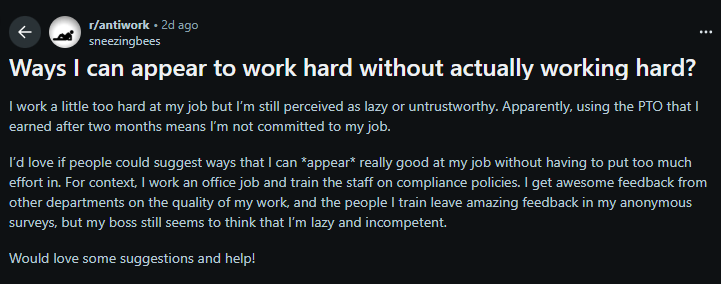
A few weeks into a new job, an office worker did something radical. They took paid leave.Not unpaid leave. Not an emergency day. Not a sick day masked with half‑hearted Zoom check‑ins. Just paid time off—earned, approved, and technically encouraged by corporate policy.Despite delivering quality work, earning stellar feedback from trainees, and being praised across departments, the manager began to shift in tone. Casual check‑ins felt clipped. Opportunities slowed. Commitment was questioned.So the employee turned to Reddit with a blunt question: How do I look like I work hard without actually working hard?It’s a cynical question, but also a logical one given the corporate landscape many professionals inhabit today.In countless organisations, effort is judged not by output, but by visibility. And rest, especially when visibly taken, is often interpreted as disinterest.
The optical illusion of effort
Imagine two employees with identical outputs: one clocks in early, replies to messages at night, schedules too‑many meetings; the other delivers results during core hours and takes earned leave. Only one might be viewed as “committed.”This isn’t just office gossip or anecdote. The phenomenon reflects what researchers call presenteeism—when employees are physically at work, or constantly online, but are not actually performing at full capacity. In other words, employees are “there” without actually being fully productive—often because being seen working has become more important than the work itself. Harvard Business Review points out that this kind of behaviour, driven by organisational pressure and cultural expectations, traps employees in a cycle of constant presence. Known as presenteeism, it can reduce real productivity and increase stress, because the focus shifts from doing the job well to simply appearing busy. HBR research shows that chronic presenteeism fuels burnout and ultimately harms performance. It highlights a basic problem in many workplaces: just being visible is often mistaken for being valuable.
Paid leave: A right misread as a risk
Paid time off is meant to be a benefit. In reality, using it can carry social penalties.Employees often think twice before using their full PTO entitlements—especially early in a job—because they fear being perceived as disengaged or unserious. This fear is not unfounded. Managers subconsciously judge employees based on apparent availability rather than quality of contribution. Anecdotal evidence from workplace culture discussions is supported by broader engagement trends.Gallup’s State of the Global Workplace report finds that only 21 percent of employees worldwide are engaged in their work, meaning most workers are not fully involved or enthusiastic about their roles.Globally, this disengagement has real economic costs. A recent Gallup analysis estimated that a decline in engagement in 2024 cost the world economy an estimated USD 438 billion in lost productivity.In other words, employees are doing work—but the mix of disengagement, presenteeism, and misaligned incentives is costing companies dearly.
Performing work instead of doing work
Faced with cultures that reward visibility, employees adapt. Not by improving efficiency, but by performing effort.Consider the behaviours that are now commonplace:
- Responding to emails at midnight
- Overbooking calendars to appear indispensable
- Staying online long after meaningful work is done
- Recasting routine tasks as heroic efforts
These are not signs of strong performance—they are camouflage.What’s ironic is that this busywork doesn’t necessarily improve outcomes. Productivity isn’t simply a function of time spent or effort shown. It is about output relative to input. Here is where macroeconomic data helps illuminate the disconnect between ‘busy’ and ‘productive’:Research from the OECD shows that working longer hours doesn’t automatically make you more productive. What really matters is how much output you generate per hour, not how many hours you spend at your desk.If hours spent (or hours visible) were the true engines of productivity, we would expect robust gains whenever employees work more. Instead, the OECD data show that efficiency—output per hour—is the critical determinant, not hours logged.
The cost of misreading commitment
When workplaces equate busyness with seriousness, everyone pays a price:
- Employees burn out trying to signal dedication rather than deliver results.
- Organisations invest in visibility, not value, missing true performance signals.
- Engagement suffers as workers feel undervalued or misunderstood.
Gallup’s data reinforce this: despite engagement being an important driver of productivity and organisational performance, only a minority of employees globally feel deeply engaged at work.Researchers and organisational psychologists have repeatedly shown that autonomy, trust, and meaningful evaluation metrics—things like clear goals, fair feedback, and results‑focused assessments—support both engagement and performance. Yet when organisations lean on superficial indicators like hours online or uptake of leave as signals of commitment, they erode those very elements.
The real question
The Reddit post asked how to appear busy without working hard. But the deeper issue is this:Why do so many employees feel they must perform productivity rather than actually be productive?Harvard Business Review, Gallup, and OECD research converge on a clear insight: productivity thrives where output is measured fairly and employees feel trusted to balance effort with rest. When organisations conflate visibility with seriousness, they undermine productivity rather than improve it.Until corporate culture shifts toward valuing real work over the performance of work, many employees will continue to feel pressure to appear busy—even at the expense of their wellbeing and actual performance.
About the Author