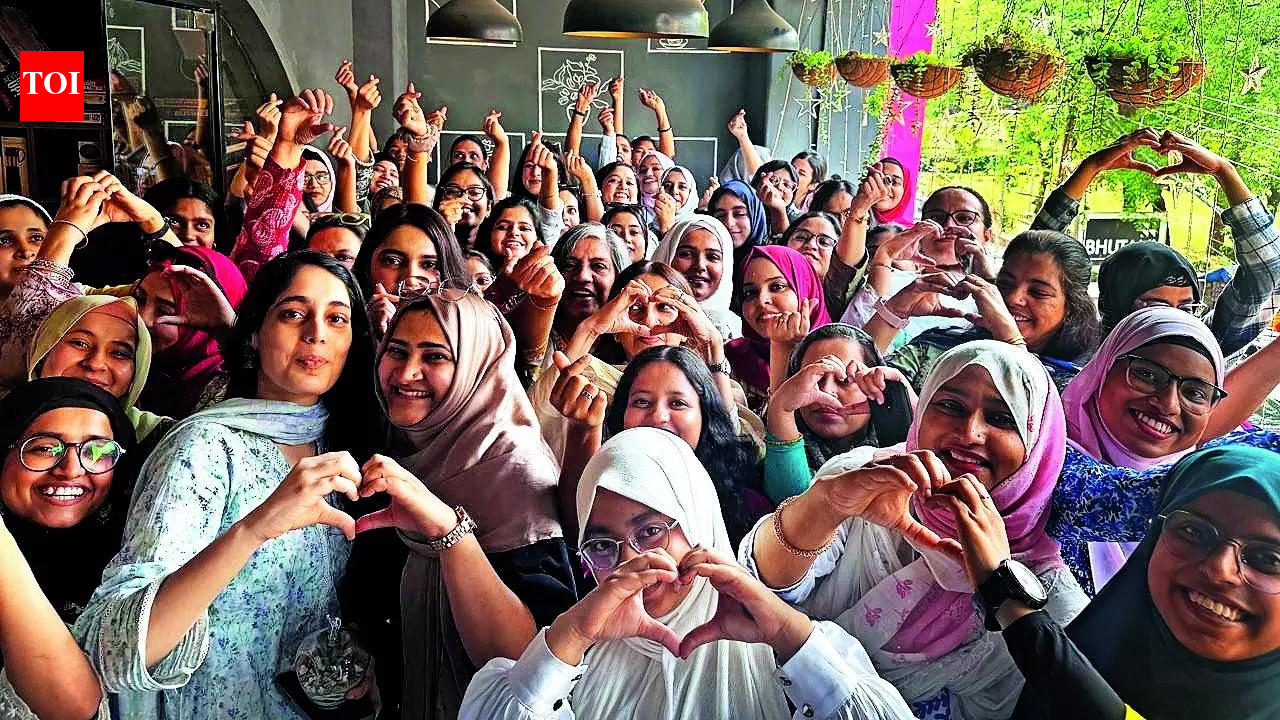
NEW DELHI: On most evenings in New York, or Delhi-NCR, Ruha Shadab sits across a laptop screen, explaining professional etiquette to a roomful of Muslim women. Some wear hijabs. Some don’t. What unites them is not appearance. They are learning how to enter professional spaces that were never designed with them in mind. The session is about LinkedIn summaries, interview posture and how to talk about ambition. Many are the first in their families preparing for formal work. Far away in Jharkhand’s Garhwa, Nadim Iqbal Khan scans stock-market data on his phone. He’s checking which listed companies pass a religious test: No alcohol. No gambling. Limited debt. No interest-heavy income (Riba). Mohd Sufyan’s AzanGuru in Delhi beams Quran tutors into iPads — a technology-led learning app for modern learners.And in Mumbai, Nidah Merchant devises “modest” outfits, empowering women to enter public pools or gyms without constant self-surveillance, even as Mohammad Saif Nadeem in Pune manages Qurbani bookings over WhatsApp.None describe what they are building as “political” or as “resistance”. They’re solving ordinary problems — how to work, invest, dress, marry and practise faith in an urban, app-mediated life.
Muslim-led startups filling gaps in India’s economy
Muslim aspiration in India is usually framed through “lack” — less education, fewer jobs, lower incomes. That’s slowly changing. According to Periodic Labour Force Survey, India’s female labour force participation stood at about 31.7% in 2023–24. For Muslim women, it was around 21%, up from about 15% in 2021–22, according to ministry of minority affairs. These numbers shape decisions.When Ruha Shadab returned to India after studying abroad, she often found herself the only Muslim woman in professional rooms. Being Muslim in Saudi Arabia was not a distinguishing feature. Here, it shaped first impressions. The contrast stayed with her. “I realised quickly that I was being read before I was being heard,” she told TOI. She said she sometimes detected a hiring bias.In 2019, while studying at Harvard University, Shadab founded Led By, to help Muslim women transition from education to employment. The programme focuses on women aged 18–30, college students or graduates from lower middle-income households. About 1,200 women have completed Led By’s programmes and over 50,000 have been supported. Many are first-generation professionals. Economic participation also depends on money. For decades, many Indian Muslims kept their distance from stock markets. Interest-based income raised religious doubts. Trading felt uncomfortably close to speculation. Nadim Iqbal Khan, 29, said, “People don’t call me asking how to get rich. They call asking if something is halal.” The questions are about permissibility, not profits.Since Covid-19, volume of queries has multiplied. He explains investing as “shared ownership” in a business, where both profit and loss are borne, making the income permissible within Islamic frameworks. And follows Sharia-compliant screening frameworks used globally. Roughly half of India’s listed companies qualify, he says. Indices such as the Nifty Shariah and BSE Shariah already track them. “Muslims have stayed behind financially because of lack of guidance. That gap can be fixed.”If money has moved into markets, marriage has moved into apps. As families became more nuclear, traditional “rishta networks” thinned. In 2019, Delhi-based entrepreneur Hammad Rahman launched NikahForever, a Muslim matrimony platform designed for marriage, not dating. Users wanted cultural familiarity, privacy and clear intent. Families wanted safeguards. NikahForever built its platform around these expectations. Today, it has over 2 million registered users in India and away.Clothing carries similar negotiations. For Mumbai’s Nidah Merchant, modest fashion was never a statement. It was logistical. Gym wear. Swim wear. Travel clothes. Constant adjustment. When modest fashion gained visibility on social media, Merchant realised this struggle was widely shared. The need, she says, was functional, not ideological. She launched Némah, a modest activewear and swimwear brand for women in 2020 to design clothes suited to Indian conditions. Education completes the picture. During the pandemic, Quran learning moved online but remained fragmented. AzanGuru, founded by Muhammad Sufyan Saif and Mohammed Imran in 2022, sought to digitise Quran learning. The platform has crossed 5 lakh downloads. Taken together, these ventures form an economy shaped less by ideology than by need, filling gaps where the mainstream falls short.
About the Author