


The US Citizenship and Immigration Services (USCIS) has announced an increase in premium processing fees for several immigration benefits, including the widely used H-1B visa. The revised fees will take effect from March 1, and will apply to requests postmarked on or after that date. This is as per a press release by the US Citizenship and Immigration Service.USCIS said the increase reflects inflation covering the period from June 2023 through June 2025. Premium processing allows applicants and employers to receive faster adjudication of certain immigration filings by paying an additional fee, a service widely used for employment-based and non-immigrant petitions.
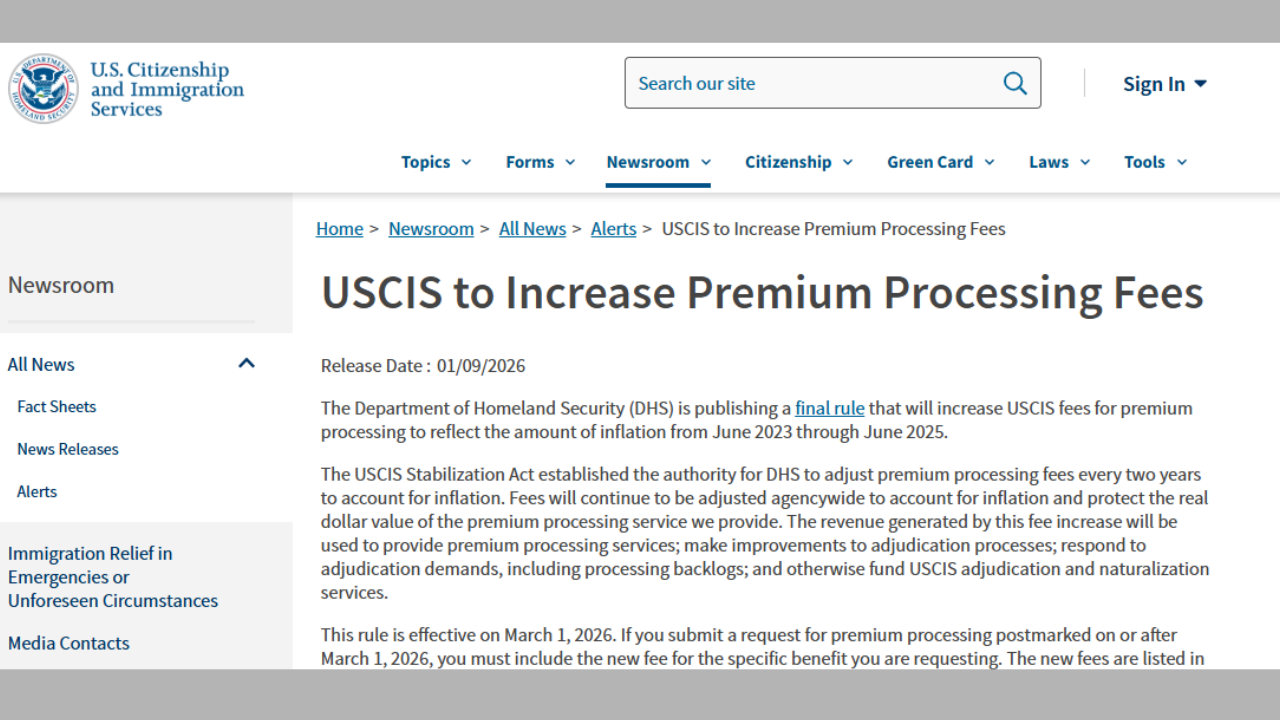
The changes will affect several key filings relied upon by foreign professionals and students working or studying in the United States, including a large number of Indian nationals, who make up a significant share of employment-based visa applicants.Under the revised fee schedule, the premium processing fee for Form I-129 petitions seeking H-2B or R-1 non-immigrant status will increase from $1,685 to $1,780.Read more: “Having no visa application is better than having a rejection”: Inside a US B1/B2 refusal in MumbaiFor all other available Form I-129 classifications — including H-1B, L-1, O-1, P-1, and TN visas — the premium processing fee will rise from $2,805 to $2,965, according to USCIS.$2,965 premium processing fee will also apply to Form I-140 immigrant petitions for alien workers across employment-based green card categories, up from the earlier $2,805.

Premium processing fees are also being increased for certain applications to extend or change non-immigrant status. For Form I-539 applications covering F-1 and F-2 students, J-1 and J-2 exchange visitors, and M-1 and M-2 vocational students, the fee will increase from $1,965 to $2,075.Applicants seeking faster decisions on employment authorization will also see higher costs. USCIS said the premium processing fee for Form I-765 applications — including Optional Practical Training (OPT) and STEM-OPT classifications — will rise from $1,685 to $1,780.USCIS emphasized that the additional revenue generated from the fee hike will be used to support the agency’s operations. “The revenue generated by this fee increase will be used to provide premium processing services; make improvements to adjudication processes; respond to adjudication demands, including processing backlogs; and otherwise fund USCIS adjudication and naturalization services,” the agency said in its notice.Read more: “I did not feel safe”: Indian woman recounts her experience after being denied entry in Russia despite having a valid e-visaThe changes are expected to have a direct impact on Indian professionals, students and employers, who account for a substantial portion of H-1B, L-1, employment-based green card and OPT filings. Indian nationals are the largest beneficiaries of U.S. employment-based visas, particularly under the H-1B programme, and also make up a significant share of the employment-based green card backlog.Premium processing is often used by employers and applicants seeking quicker adjudication for job changes, visa extensions, travel planning and greater certainty about immigration status. For many Indian students graduating from U.S. universities, OPT and STEM-OPT extensions serve as a critical bridge to longer-term work visas such as the H-1B, making the increased fees particularly consequential.
About the Author