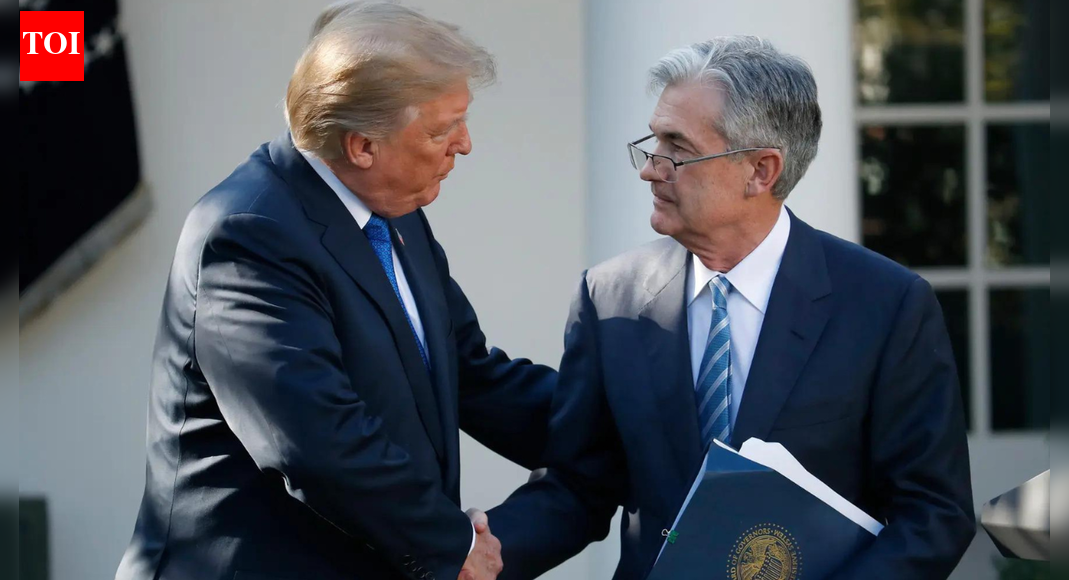
The TOI correspondent from Washington: US President Donald Trump is on the warpath against Venezuela, Cuba, Iran, Greenland — and the Federal Reserve. In a move that has rattled financial markets and political circles alike, the Trump administration’s Justice Department has launched a criminal investigation into Federal Reserve Chair Jerome Powell, marking an unprecedented clash between the executive branch and the nation’s central bank. The probe, confirmed late Sunday by Powell himself, centers on statements he made during June testimony before the Senate Banking Committee about cost overruns on a long-running renovation of the Federal Reserve’s headquarters in Washington, DC, which Trump has characterized as a scandal. This development comes as the President has repeatedly expressed frustration with the Fed’s reluctance to slash interest rates, a policy he claims is stifling economic growth.
The investigation, which Powell says began with grand jury subpoenas served to the Federal Reserve, threatens the chair with potential criminal charges—a move he described in a video message as “unprecedented” and a threat to the independence of the Federal Reserve. He insisted that the subpoenas are being used as a tool of political pressure, not because there is credible evidence of wrongdoing. The controversy has its roots in a multi-year project to renovate the nearly 90-year-old Marriner S. Eccles Building and adjacent offices, a project first approved by the Fed’s board in 2017. Originally projected to cost about $1.9 billion, the current estimate stands near $2.5 billion, reflecting inflation, supply chain disruptions, asbestos abatement, and unforeseen construction challenges.Trump, who appointed Powell in 2018 and whose second term began in January 2025, has repeatedly assailed the Fed for its refusal to cut interest rates as aggressively as he desires. Lower interest rates are widely popular with investors and borrowers because they reduce borrowing costs and can stimulate economic growth—a key element of Trump’s economic strategy. But the Fed, tasked with controlling inflation and maintaining long-term economic stability, has kept rates at levels it deems appropriate given lingering inflationary pressures.Trump’s criticism of Powell intensified over the renovation costs after he took office last January. He has publicly derided the project as excessive and has even joked about firing Powell over it—though legally, the Fed Chair can only be removed “for cause,” and not at the president’s whim. Powell, in turn, has corrected the president’s public statements about the project’s costs, noting that Trump has, on occasion, overstated figures or conflated unrelated expenditures. Trump himself is splurging up to $ 400 million – from an initial estimate of $ 200 million – on a new ballroom attached to the White House, which critics say is over-the-top. The criminal inquiry was reportedly authorized last November by US. Attorney Jeanine Pirro, Trump’s appointee in the District of Columbia, and involves a review of Powell’s public testimony and internal spending records. Officials familiar with the matter say prosecutors have contacted Fed staff seeking documents related to the renovation.The legal escalation has galvanized lawmakers across party lines, including some from the GOP. Republican Senator Thom Tillis, a member of the Senate Banking Committee, vowed to block all Fed nominations—including Powell’s potential successor, possibly Trump surrogate Kevin Hassett—until the investigation concludes, warning that the move undermines both Fed and Justice Department independence. Some Democratic lawmakers and economists have drawn parallels to historical assaults on central bank autonomy, cautioning that politicizing the Fed could erode market confidence and destabilize the broader financial system.Markets reacted swiftly. US. stocks fell sharply, with the S&P 500 sliding more than 1 percent on Monday before recovering, as investors grappled with the uncertainty. The US dollar weakened, and gold prices surged to record highs above $4,600 an ounce, a traditional safe haven during times of institutional stress. Analysts warn that any perceived encroachment on the Fed’s independence could inject long-term volatility into stocks, bonds, and currencies.Supporters of the investigation, particularly among segments of Trump’s political base, argue that Powell should be held accountable if he indeed misled Congress or mismanaged federal resources. Conservative commentators have characterized the central bank as an unaccountable “fourth branch” of government, and some have cheered Trump’s willingness to challenge it.But critics—ranging from mainstream economists to former Treasury officials—say the probe risks undermining the very foundation of US monetary policy. The Federal Reserve’s independence, established by law and respected by both Democratic and Republican administrations for decades, is widely credited with enabling policy decisions insulated from short-term political pressures. Eroding that independence could complicate efforts to tame inflation or respond to future recessions, with repercussions across the globe. Powell, whose term as Fed Chair is set to expire in May 2026, has vowed not to resign and to continue fulfilling the Fed’s dual mandate: price stability and maximum employment. “Public service sometimes requires standing firm in the face of threats,” he said, defiantly pushing back against Trump. As Washington wrestles with this extraordinary confrontation between the executive branch and a cornerstone of the economic establishment, investors and policymakers alike are watching closely. What began as a dispute over interest rates and construction costs has ballooned into a national debate over institutional independence, democratic norms, and the future of US. economic governance.
About the Author