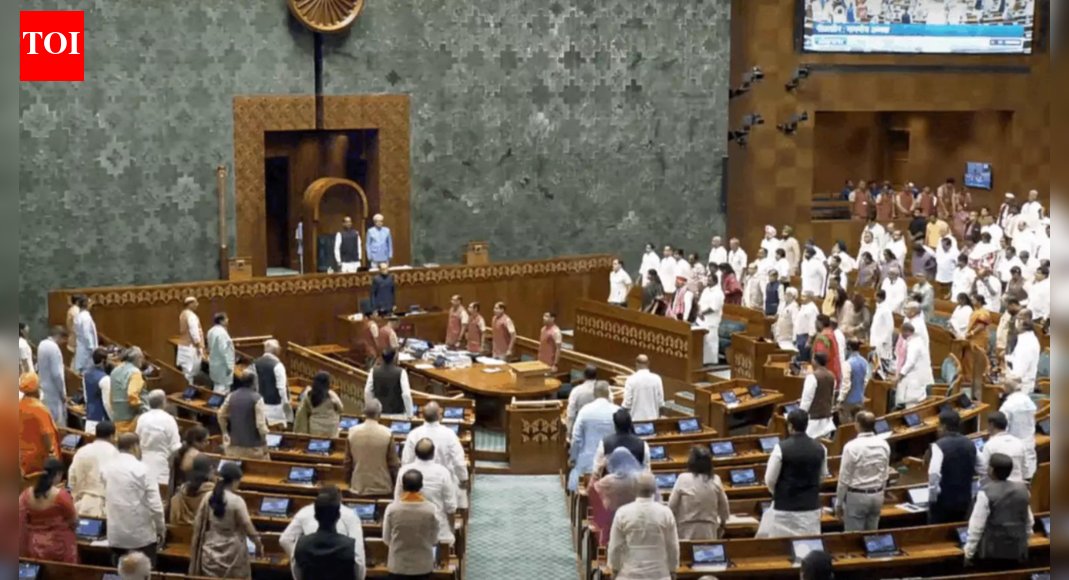
The Winter Session of Parliament began on December 1, and among the key legislative proposals listed for introduction is the Higher Education Commission of India (HECI) Bill 2025. The legislation marks a renewed push to reshape India’s higher-education regulatory structure, building on reforms outlined in the National Education Policy (NEP) 2020.According to the official Lok Sabha bulletin, the Bill seeks to replace the University Grants Commission (UGC) and bring under one umbrella the core regulatory functions currently handled by the All India Council for Technical Education (AICTE) and the National Council for Teacher Education (NCTE). If introduced this session, it would signal the Centre’s most serious move yet toward creating a unified higher-education regulator.
A long-pending overhaul: What the Government is proposing
The proposed law follows the blueprint laid out by the National Education Policy (NEP) 2020, which argued that India’s existing regulatory architecture “needs a complete overhaul.”The draft legislation aims to collapse three statutory bodies into a single, centralised regulator:
- UGC: Regulates non-technical universities
- AICTE: Supervises technical and professional institutions
- NCTE: Sets standards for teacher education
Under the forthcoming bill, HECI will focus on regulation, accreditation, and professional standard-setting across India’s sprawling higher-education network. Medical and legal education will remain outside its purview, while funding powers will stay with the administrative ministry, mirroring NEP’s insistence on separating academic oversight from financial control.
Why now? The historical build-up behind the reform
The idea of a unified regulator has been circulating for years. A draft HECI Bill was floated in 2018, proposing the repeal of the UGC Act. But the plan encountered turbulence almost immediately.What happened to the 2018 Bill?
- It proposed replacing only the UGC, not the AICTE or NCTE.
- The commission would comprise a chairperson, vice-chairperson, and 12 members appointed by the Centre.
- Funding powers remained with the then
HRD Ministry .
An advisory council headed by the HRD Minister raised concerns about centralisation of authority.Stakeholder pushback over fears of overregulation and loss of institutional autonomy stalled the process.The government withdrew the bill and recalibrated its strategy, aligning it with NEP 2020’s four-vertical design. Since 2021, Education Minister Dharmendra Pradhan has revived the push to introduce comprehensive, second-generation HECI legislation, one that integrates technical and teacher education oversight for the first time.
What exactly will the new HECI look like?
Officials indicate that the Bill mirrors NEP 2020’s recommended structure, with HECI expected to consist of four verticals:
National Higher Education Regulatory Council (NHERC)
The primary regulator for all higher education—except medicine and law. It will replace UGC/AICTE/NCTE functions related to approvals and oversight.
National Accreditation Council (NAC)
A revamped accrediting body to grade institutions and ensure uniform benchmarks.
General Education Council (GEC)
Responsible for academic frameworks, curriculum standards, and learning outcomes.
Higher Education Grants Council (HEGC)
To manage funding norms, but not actual fund disbursement, which stays with the ministry. The architecture signals a clear shift toward functional separation: regulate, accredit, set standards, and fund, each by a distinct vertical within a single umbrella authority.
The rationale: What problems is HECI trying to solve?
India’s higher education system is vast, over 1,100 universities and nearly 45,000 colleges, but its regulatory oversight has long been criticised for:
- Overlapping jurisdictions between UGC and AICTE
- Slow, cumbersome approvals
- Inconsistent accreditation
- Weak enforcement of academic standards
- Ambiguity in institutional autonomy policies
A single regulator, the government argues, can reduce duplication, streamline decision-making, and introduce clarity. NEP 2020 noted that without structural reform, the system would struggle to “thrive and innovate.”
Potential impact: What will change for universities?
Faster approvals and simplified governanceInstitutions currently navigate multiple regulators depending on course type. HECI promises a one-window mechanism, reducing bureaucratic friction.More coherent standards across disciplinesFrom engineering to teacher education, uniform benchmarks could enhance credibility and strengthen India’s global academic reputation.Clear division between funding and regulationBy separating financial decisions from regulatory powers, the Bill aims to safeguard institutional autonomy while maintaining accountability.Academic freedom, with stricter quality oversightUniversities may gain more space for innovation, but compliance requirements could become more demanding.A complex transition periodInstitutions familiar with UGC and AICTE norms may find the switch challenging. Regulatory migration, staffing, and new compliance protocols could take years to stabilise.
The concerns: What experts are already flagging
While the Bill represents a sweeping reform, caution voices persist:
- Centralisation of power under one commission could raise governance concerns.
- Accreditation and regulatory independence may hinge on how members are appointed.
- Federal tensions could surface if states perceive diminished authority over their institutions.
- Transition burdens, from re-accreditation to re-registration, may stretch institutional capacities.
For now, the government maintains that HECI will be a “light but tight” regulator, balancing autonomy with strict quality norms.
A defining moment for Indian Higher Education
Five years after NEP 2020 sketched the vision of a unified regulator, the Centre is finally ready to put legislative force behind it. The HECI Bill 2025 represents the most ambitious restructuring of India’s higher-education oversight in independent India, a reform with the potential to streamline governance, sharpen academic standards, and reshape the future of universities.Whether HECI becomes the instrument of transformation its architects hope for, or confronts the same bottlenecks that derailed earlier attempts, will depend on the political negotiations, institutional will, and regulatory design that unfold once the bill reaches Parliament.
About the Author