

MUMBAI: Citi expects a repeat of, or potentially a new record, equity IPO issuance in India in 2026, with total fund-raising of $15-20 billion, while a sharp pickup in external commercial borrowings (ECBs) could follow if proposed regulatory changes are implemented. Net foreign portfolio investor (FPI) inflows into equities, however, are likely to turn decisively positive only if valuations remain attractive, senior executives said at a Citi capital markets outlook webinar.
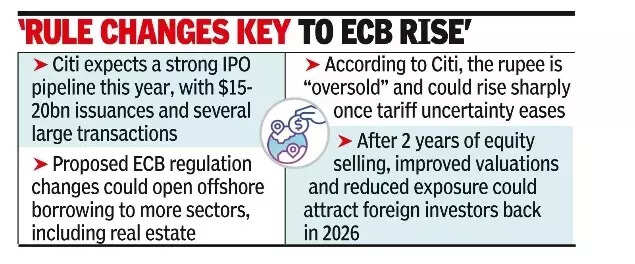
“On equity capital markets, our view is that India’s IPO market will remain very strong in 2026,” said Rob Chan, head of equity capital markets syndicate for Asia. “We expect IPO issuance in the range of $15-20 billion.” He added that Citi expects several large transactions to come to market, even if it is “too early to name them.” India’s IPO market in 2025 raised about Rs 1.95 lakh crore across 360-plus issues, led by Tata Capital, HDB Financial Services and LG Electronics offerings, reflecting strong domestic participation despite foreign selling in secondary markets.The outlook for equity fundraising is being underpinned by earnings growth and macro stability, executives said. “This combination of strong equity markets and relatively stable currencies gives us confidence that equity capital raising across these markets will remain healthy,” said Kaustubh Kulkarni, co-head of investment banking (APAC). On the debt side, Citi sees regulatory change as a potential trigger for higher offshore issuance. “A key inflection point for India could be changes to the ECB guidelines,” said Nitesh Dugar, head of debt capital markets for South and Southeast Asia. “If the draft proposals are implemented, they could open the bond market to a much broader set of issuers, including segments such as real estate that have historically been constrained.” “The rupee appears somewhat oversold,” Dugar said. He added that tariff-related uncertainty has weighed on sentiment and that “if that overhang lifts, the rupee could rebound sharply.”Looking ahead, “the combination of more attractive secondary-market valuations and the fact that foreign investors have already reduced exposure could become important,” Kulkarni said, with any reversal potentially reshaping market dynamics in 2026.
About the Author