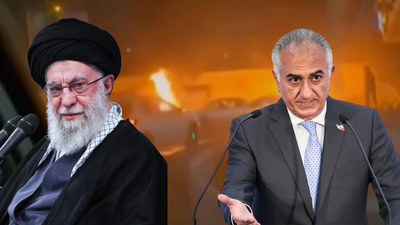
On January 16, 1979, Mohammad Reza Pahlavi boarded a plane and left Iran. Officially, it was a “temporary” departure; in reality, it marked the end of a monarchy already hollowed out by mass protests, economic anger and political repression. Nearly half a century later, Iran finds itself confronting a hauntingly familiar moment. Once again, protests have erupted from the bazaars and universities, driven initially by a collapsing currency, soaring prices and daily economic desperation. And once again, anger over livelihoods has quickly spilled into something deeper: open defiance of the political order itself. Chants once aimed at prices now target the very foundations of clerical rule.
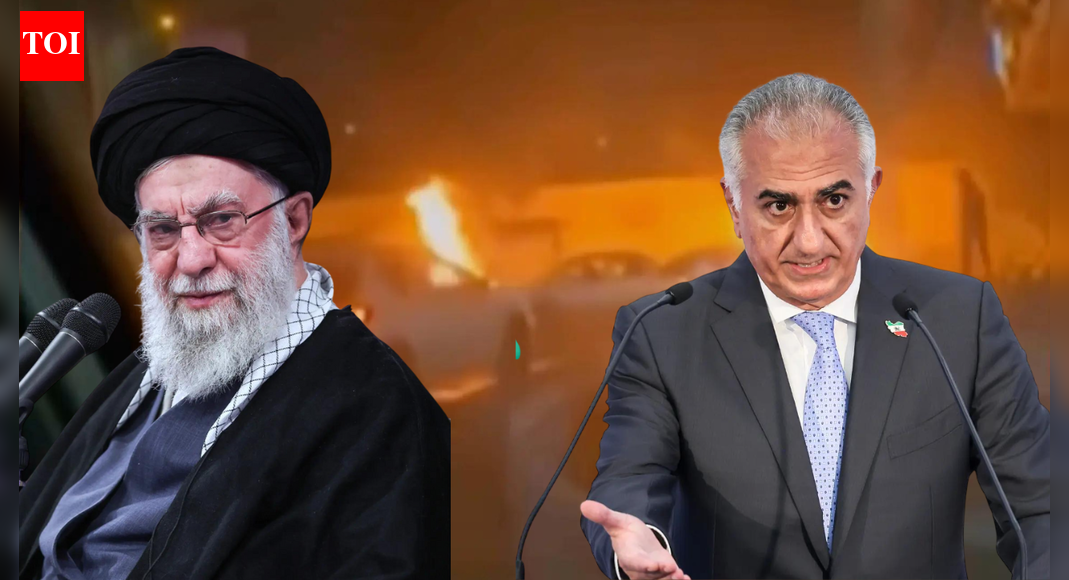
In 1979, the Shah’s absence created a vacuum that would be filled not by liberal reformers or secular nationalists, but by clerics led by Ayatollah Ruhollah Khomeini. The revolution that followed swept away one authoritarian system and replaced it with another — a theocracy that, over time, concentrated power in the hands of a single Supreme Leader. Today, that system is embodied by Ayatollah Ali Khamenei.
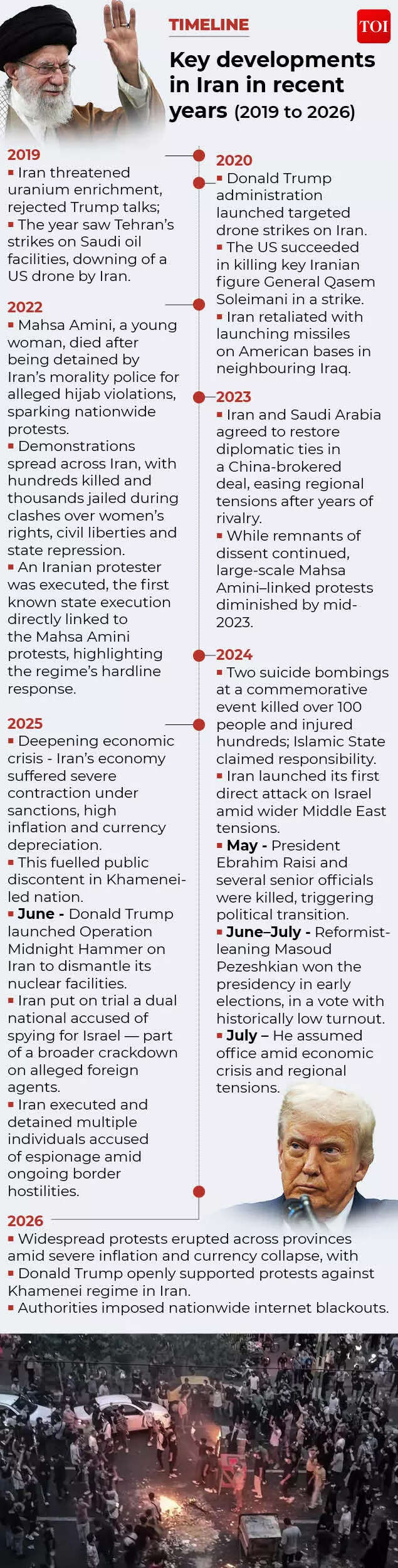
Now, Iran is out protesting and the echoes of 1979 are growing louder. History may not be repeating itself exactly, but for the first time in decades, it appears to be circling back.
1979: The revolution that remade Iran
By the late 1970s the Shah’s oil-fuelled boom had created winners and losers. Urban construction boomed, but prices and inequalities were rising. Political dissent was ruthlessly suppressed. In 1978–79 all these grievances coalesced in a popular uprising. Crucially, it united secular modernizers and religious activists alike. Leftists, bazaar traders, students and clerics marched together to overthrow what they saw as the Shah’s autocracy and undue Western influence. Ruhollah Khomeini – the charismatic clerical leader returned from exile in February 1979 – became the symbol of the revolution. His call for velayat-e faqih (rule by Islamic jurist) resonated widely.
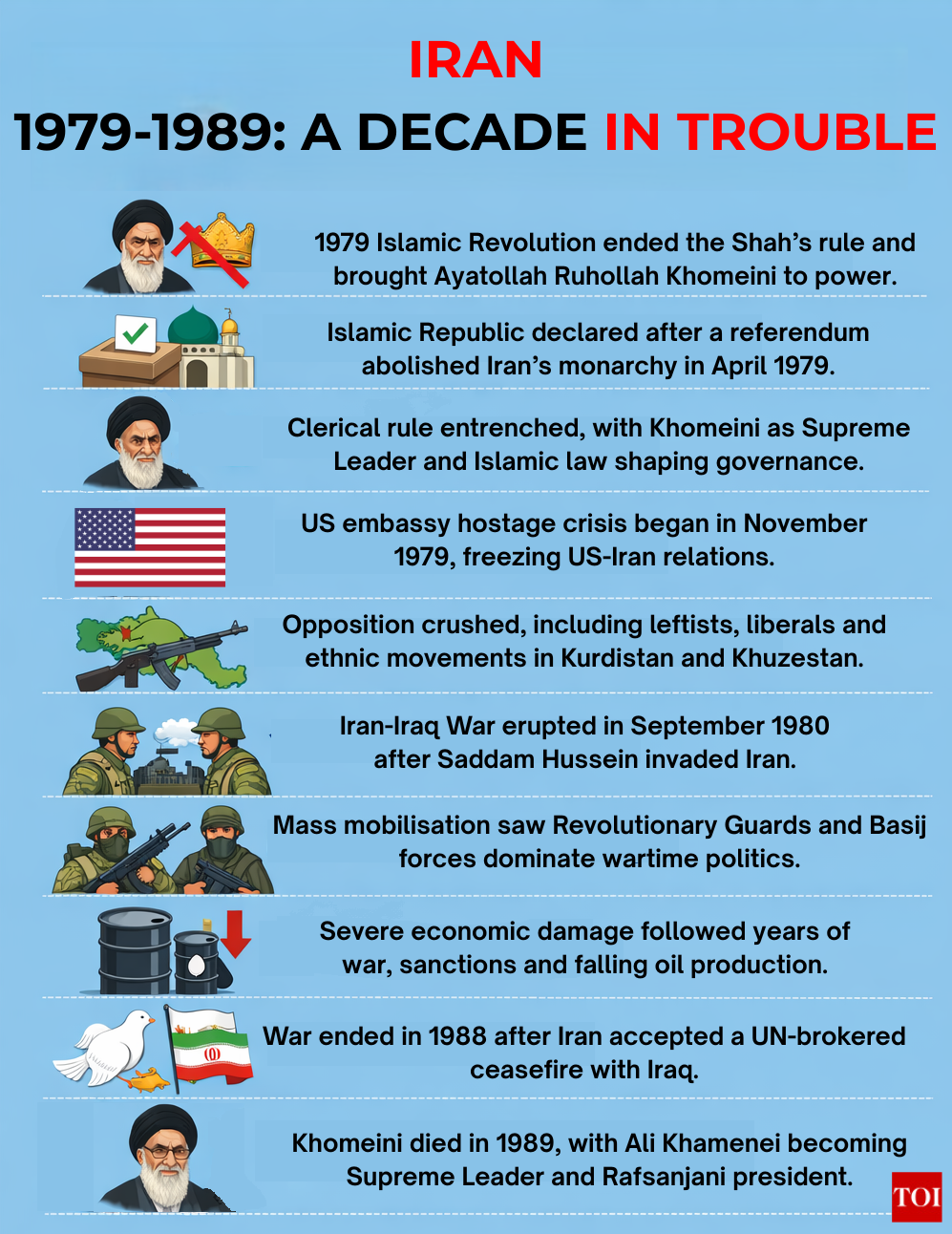
In the revolution’s aftermath, the Pahlavi monarchy was swept away. Iran’s political map was redrawn: the country became an Islamic Republic led by the clergy. Secular parties were sidelined; a theocratic constitution enshrined the role of a Supreme Leader above the elected government. Khomeini consolidated power quickly. The broad revolutionary coalition soon fractured as radicals and conservatives vied for influence, but at first the regime’s legitimacy rested on its success in ousting the hated Shah and asserting Iranian independence from the US
How one man inherited – and hardened the system
After Khomeini’s death in 1989, Iran’s leadership passed not to an elected successor but to another cleric: Ayatollah Ali Hosseini Khamenei. Khamenei had been a deputy to Khomeini and served as president from 1981–89. He stood at the heart of the Islamic Republic since the 1979 revolution, playing a pivotal role in the consolidation of near-absolute authority as Supreme Leader. Within weeks of Khomeini’s death, Khamenei was controversially chosen as the next rahbar (leader) despite lacking the senior clerical rank normally required. The constitution was quickly amended to allow a younger cleric to serve, abolishing the prime minister’s post and strengthening the presidency while vesting broad oversight in the Supreme Leader.
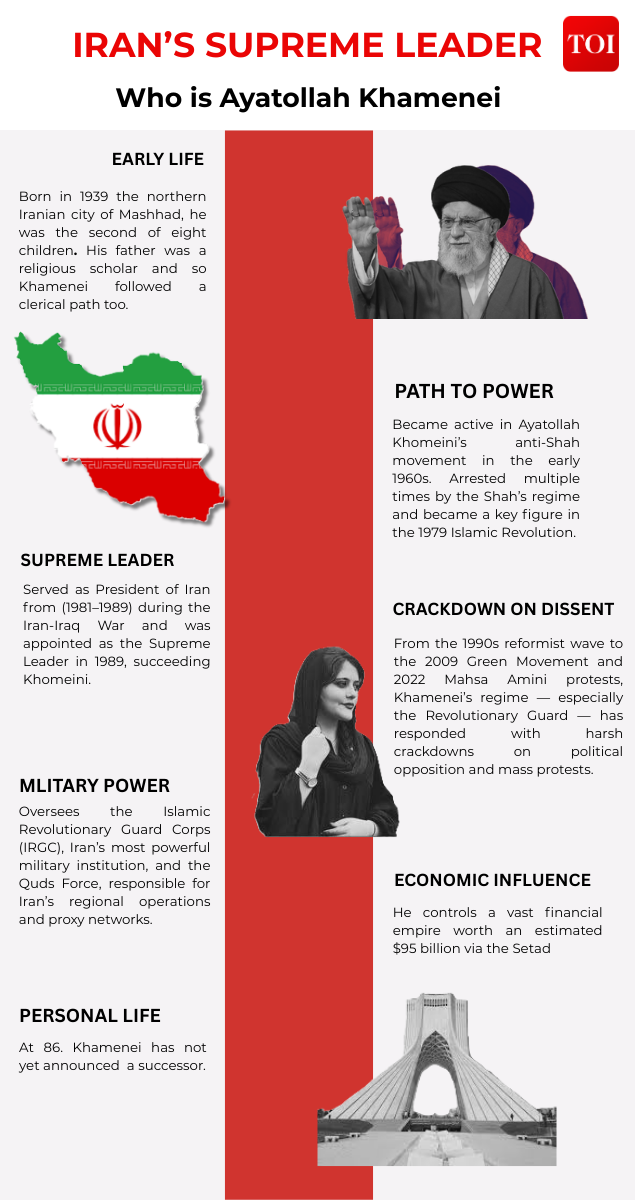
Over four decades Khamenei has centralised power around himself and his closest allies. He cultivated the Islamic Revolutionary Guard Corps (IRGC) as a personal power base, “shaping it into an instrument of control and regional influence”. Under his watch Iran pursued nuclear capability as a security strategy – “making Iran’s nuclear capabilities central to its strategy for national security and deterrence”. Khamenei’s rule has been marked by a balancing act: he sidelined reformists and leftists, purged political rivals, and emphasized loyalty to the clerical elite. In public life there were elections, but the range of permissible candidates steadily narrowed. In short, he has “shaped Iran’s revolutionary regime in his image” by fusing the Islamic Republic’s institutions around the Supreme Leader’s will.
Four decades of confrontation
The 1979 revolution also radically upended Iran’s relations with the world, especially the United States. Where the Shah had been a Western ally, the Islamic Republic became an implacable US foe. Early flashpoints included the 1979–81 American hostages crisis, followed by the Iran–Iraq war (1980–88) in which the US tacitly backed Saddam Hussein’s Iraq against Tehran. In later decades, the central grievance became Iran’s nuclear program and regional policies. The 2015 Joint Comprehensive Plan of Action (JCPOA) negotiated by President Hassan Rouhani’s administration had Iran curb its uranium enrichment in return for sanctions relief. But in 2018 President Donald Trump unilaterally withdrew the US from that deal, branding it “not far enough”, and reimposed crippling sanctions. This “maximum pressure” campaign choked Iran’s oil exports and foreign investments. More recently, Western powers have moved to renew penalties: in September 2025 Britain, France and Germany formally triggered the JCPOA’s “snap-back” mechanism, restoring UN sanctions on Iran’s nuclear and missile activities. In short, the economic and diplomatic isolation imposed by Washington and its allies has significantly worsened Iran’s economic troubles, even as it deepened Iranian mistrust of the West.Regionally, Tehran’s support for allied militias, Lebanese Hezbollah, Syrian regime, Palestinian factions, Houthi rebels and its rivalry with Israel and Sunni Arab states have kept Iran embattled. At home, these foreign commitments have become increasingly unpopular with citizens who see Iran’s government spending vast sums abroad while inflation bites at home.This sense of disconnect between government priorities and domestic needs is one of the factors rekindling public anger.
The breaking point
By 2025 Iran’s economy was in dire shape. After years of sanctions and mismanagement, ordinary Iranians faced steep price hikes and shortages. The rial currency plunged to record lows: Reuters reported that in 2025 it “has lost nearly half its value against the dollar”, and UK analysts note it halved in value over mid-2024 to early 2025. Consequently inflation surged – Reuters cited December 2025 inflation at 42.5% (year-on-year), and the British Parliament briefing reports food price inflation above 70% in 2025. A World Bank forecast warned Iran’s economy would shrink in 2025–26 as sanctions bite further. Throughout 2025 the people saw wages and savings evaporate: “high prices and corruption” had “led people to the point of explosion,” one economist wrote on social media, and protestors warned unrest could spread.In part this slump stems from external pressures: nearly all oil revenue is handicapped by US and UN sanctions. President Trump’s 2018 withdrawal from the 2015 nuclear deal saw many companies flee Iran, and by late 2025 even revived UN sanctions targeted Iran’s core industries. At home, government policies have exacerbated hardship. Successive Iranian presidents have struggled with wasteful subsidies and an overlarge public sector, while the Revolutionary Guards control vast economic enterprises. The result is broad discontent. As one protest slogan put it, “The collapse is not just of the rial, but of trust”. In practical terms, bread, rice, utilities, even water and fuel became unaffordable for many, especially given stagnating incomes. These economic grievances – far more than theology – are what drove the latest uprising.
A familiar pattern, a different generation
The new round of protests began on December 28, 2025, and by early January 2026 had spread across Iran. It started in the bazaars of Tehran – especially the Grand Bazaar – where merchants began striking and marching against the collapsing currency and high inflation. From there, thousands of young men (more than women, unlike the 2022 women-led protests) joined in. Demonstrators carried the old pre-revolution flag – the lion-and-sun emblem of the Shah’s Iran and chanted virulent slogans, from calls for “death to Khamenei” to “bread, freedom, or death”. Rights groups say dozens have died in the crackdown – by early Jan. 2026 HRANA and Iran Human Rights reported on the order of 50–60 killed and thousands detained.This is described as the largest protest movement since the “Women, Life, Freedom” marches of 2022–23, and even Russian-based monitors see it as bigger than unrest in 2009 or 2019. The government’s reaction has been harsh: security forces deployed tear gas and live ammunition, and a nationwide Internet blackout was imposed to try to stifle the spread of information.From the outset, political demands quickly emerged alongside economic ones. In Tehran and other cities, chants were explicitly anti-clerical. Students and bazaaris broke with previous norms: they ripped hijabs from women (many refusing to wear them now), and scrawled slogans on walls. This time, protestors even turned on Iran’s foreign policy. A Reuters reporter quoted a 25-year-old in Lorestan saying, “I just want to live a peaceful, normal life… Instead, [the rulers] insist on a nuclear program, supporting armed groups… Those policies may have made sense in 1979, but not today”.Others openly mocked Iran’s military priorities. Chants of “Not Gaza, not Lebanon, my life for Iran” rang out, rejecting Tehran’s spending on regional proxies while people starved. One young man in Isfahan told Reuters “we are poor, isolated and frustrated… We want peace and friendship with the world – without the Islamic Republic.” Internationally, the uprising drew mixed responses. Western governments UK, France, Germany urged Tehran to exercise restraint, while the US and Israel publicly voiced support for the demonstrators. US President Trump warned of strikes if Iran’s security forces killed protesters, and even put troops on alert. Iran’s leaders, however, portrayed the unrest as foreign-instigated. State TV blamed “terrorists” and spies from the US and Israel. Foreign Minister Araghchi dismissed Washington’s and Jerusalem’s statements as “delusional”, accusing them of fomenting the protests. In any case, the regime drew from its 1979 playbook: Supreme Leader Khamenei denounced the crowds as “vandals” and vowed not to yield, while Basij militias were ordered to patrol the streets. The regime’s dual strategy was now public: offer token “dialogue” on economic issues at home, but paint dissenters as traitors manipulated by foreign enemies abroad.
A name from the past, a role in the present
A notable figure on the sidelines has been Reza Pahlavi, son of the late Shah. He has long been a focal point for the Iranian diaspora and monarchist opposition. In recent weeks he has actively sought to rally the protests. In late December he posted videos from the US praising the protesters’ “courage and resilience” and urging continued strikes and demonstrations. On January 6 he called for nationwide chants and strikes at a set time, framing the unrest as a mass movement . In a January 10 video he even announced that “our goal is no longer just to take to the streets. The goal is to prepare to seize and hold city centers”, and hinted at an imminent return to Iran (“I am preparing to return to my homeland”). However, Pahlavi’s actual power is highly limited. He was only 19 when his father fell and has lived in exile ever since. Inside Iran he has no official role and modest support. Many major opposition factions – reformists, leftists, nationalists and even elements of the clergy – do not back a return of the Shah’s son. Still, his prominence as a media presence gives the regime nervousness (the timing of the internet cut-off on January 8, for instance, roughly coincided with one of his protest calls). Reza Pahlavi’s interventions underscore the regime’s dilemma: no heir or second tier in the theocracy has emerged with his visibility, so even an ex-Shah’s son commands a spotlight.
Revolution, repression, or rupture
Iran in January 2026 looks, in many ways, like Iran of January 1979. A broad, spontaneous revolt driven by economic despair and political grievances has challenged a rigid, authoritarian system. Both revolts were born in the bazaars and schools, and both quickly politicised into demands for regime change. Both saw the flag of the pre-regime era reappear as a symbol.Whether this moment ends in reform, repression, or rupture remains unknowable. Iran’s rulers have survived repeated crises by relying on coercion, fragmentation of opposition, and the absence of a single unifying alternative. They may yet do so again.What makes this moment different is not nostalgia for 1979, but exhaustion with what followed. For a generation that has known only sanctions, isolation and clerical rule, the promises of the Islamic Republic ring hollow. The slogans on the streets are no longer about ideology or faith, but dignity, normalcy and choice. In that sense, the protestors are not trying to revive the past, but to escape it.Iran stands at an uneasy crossroads between endurance and erosion. The system built after the Shah’s fall was designed to prevent sudden collapse, yet its rigidity has left little room for renewal. History may not be repeating itself, but it is closing in, testing how long any system can endure once fear outlives belief and pressure outpaces control.
About the Author