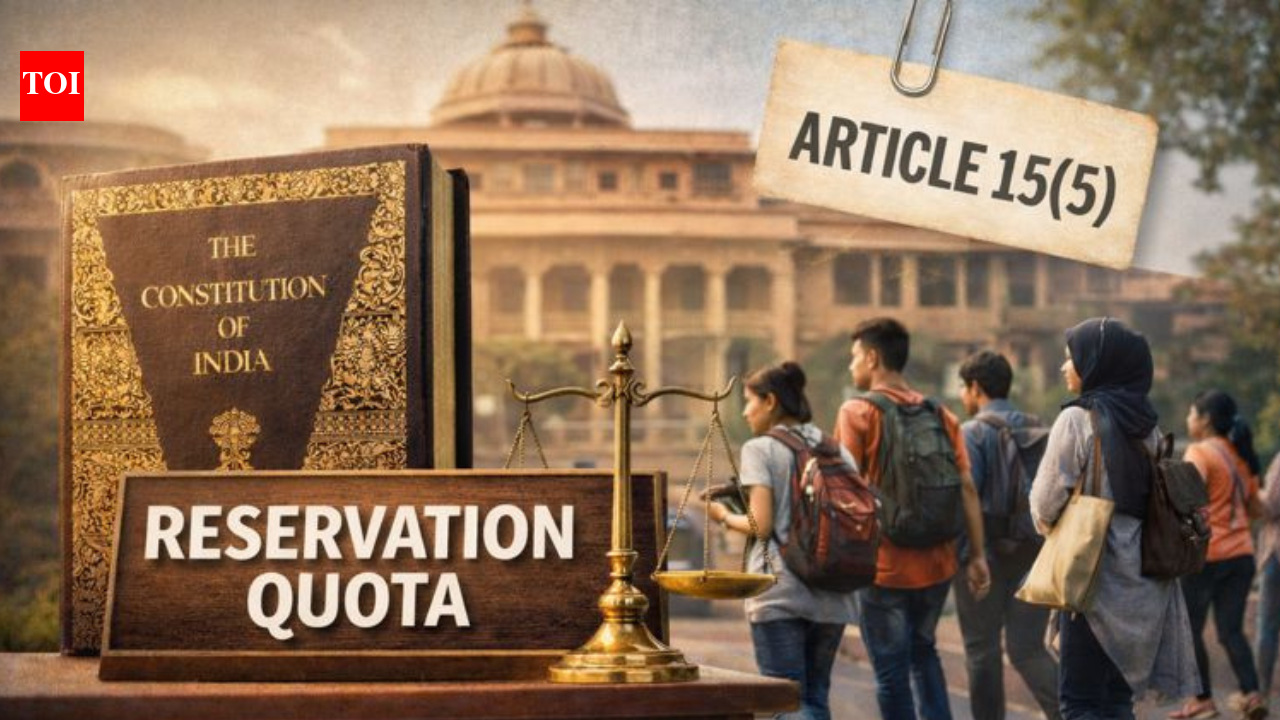
Sometimes anniversaries are meant for celebration. Sometimes they are reminders of unfinished work. On January 20, as Article 15(5) of the Constitution completed twenty years, Congress leader Jairam Ramesh used the moment to reopen a larger question about who India’s higher-education system is really serving. In a post on X, he argued that any new regulator for higher education must be explicitly mandated to enforce Article 15(5) — the constitutional provision that allows the government to mandate reservations for SC, ST and OBC students, including in private institutions.It was not just a political statement. It was a nudge to remember why the amendment was introduced in the first place — and why its most ambitious promise still remains largely unfulfilled.
What Article 15(5) was meant to fix
Article 15(5) did not arrive quietly. It was inserted through the 93rd Constitutional Amendment, passed by Parliament during the first Manmohan Singh government and brought into effect on January 20, 2006. The intent was straightforward but far-reaching: to empower the State to extend reservations beyond government-run institutions into the fast-growing private higher-education sector.By the mid-2000s, India’s education landscape had begun shifting decisively. Engineering colleges, management institutes, medical colleges and universities were increasingly private. Without constitutional backing, the government’s ability to ensure social inclusion in these institutions was limited. Article 15(5) was meant to close that gap.The amendment explicitly allowed the State to make special provisions for the admission of students from Scheduled Castes, Scheduled Tribes and Other Backward Classes in educational institutions — including private, unaided ones, barring minority institutions protected by the Constitution.In other words, it recognised a simple truth: if access to quality education is moving into private hands, social justice cannot stop at the gates of government campuses.
What changed and what didn’t
The amendment reshaped public institutions quickly. Using Article 15(5) as its constitutional backbone, the government implemented a 27 per cent reservation for OBC students in centrally funded institutions such as IITs, IIMs, NITs and central universities. Over the years, this wasn’t just a policy on paper, it translated into very real firsts: The first person in a family to walk into an IIT classroom, the first to sit for a corporate internship interview, the first to imagine a life that does not begin and end with the limits of caste and locality.But the story breaks midway.The part that was supposed to apply to private colleges — where a large chunk of India now studies — never really took off. Even after the Supreme Court upheld Article 15(5) in 2014 and made it clear that reservations in private institutions are constitutionally valid, Parliament did not build the legal machinery to make it happen. So the system split in two: Public institutions with enforceable quotas, and private institutions where inclusion is mostly optional, patchy, or missing altogether.
Why the question is resurfacing now
Ramesh’s intervention is tied to a moment of institutional change. The government is considering a new, overarching regulator for higher education through the Viksit Bharat Shiksha Adhishthan Bill, 2025, which seeks to consolidate regulatory oversight across universities and colleges.His argument is blunt: a powerful regulator that standardises degrees, accredits institutions and governs funding, but remains silent on constitutional obligations, risks hollowing out the idea of inclusive education. Without an explicit mandate, Article 15(5) risks becoming symbolic, present in textbooks, absent in classrooms.A Parliamentary Standing Committee on Education has already warned that representation of SC, ST and OBC students in private higher-education institutions remains unacceptably low. As private colleges increasingly dominate professional education, the absence of enforceable inclusion mechanisms becomes harder to justify.
Why reservation still matters, uncomfortable as it may be
Reservation remains an uneasy conversation in India, especially in elite academic spaces. Critics argue about merit, autonomy and competitiveness. Supporters point to history, data and lived reality.In a society shaped by caste hierarchies, access to education has never been neutral. Schools, coaching, networks and confidence accumulate unevenly. Reservation is not a shortcut, it is a corrective, an attempt to level a playing field that was never flat to begin with.Two decades after Article 15(5), the question is no longer whether such provisions are constitutionally valid. That debate has been settled. The real question is whether India is willing to enforce social justice where power has shifted into private classrooms, private campuses, and private institutions shaping public futures.
About the Author