
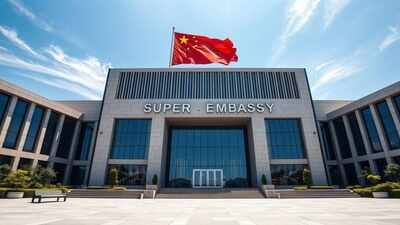
China is eagerly waiting for United Kingdom Prime Minister Kier Starmer’s approval for the ‘Super embassy’ in London, but they are also quietly planning something far more subterranean. A Telegraph report uncovered a hidden chamber built alarmingly close to Britain’s most sensitive communication cables.The Telegraph said the plans were redacted in all publicly available versions and could be revealed only because it uncovered the unredacted documents. It reported that the drawings showed a single concealed chamber sitting directly alongside fibre-optic cables transmitting financial data to the City of London, as well as email and messaging traffic for millions of internet users.The newspaper reported that the same hidden room was fitted with hot-air extraction systems, possibly suggesting the installation of heat-generating equipment such as advanced computers used for espionage. It said the plans also showed that China intended to demolish and rebuild the outer basement wall of the chamber, directly beside the fibre-optic cables. The disclosures, it said, would reignite fears that Beijing could be seeking to spy on information carried through the network, potentially gaining access to state and financial secrets.Alicia Kearns, the shadow national security minister, claimed that granting approval would hand China “a launchpad for economic warfare at the heart of the central nervous system of our critical national infrastructure”.She added: “The unredacted plans reveal a concealed room running immediately alongside the fibre-optic cables critical to the City and Canary Wharf. Telegraph readers don’t need me to spell out the obvious threats posed, nor China’s subterfuge – so why does the Labour Government?”The Telegraph reported that other areas obscured by redactions included emergency back-up generators, a sprinkler plant, new lift shafts and communications cabling. It said the plans also concealed bathrooms and showers, potentially allowing officials to remain underground for extended periods.Covering 22,000 sq m on the site of the former Royal Mint, the embassy would be the largest Chinese diplomatic mission in Europe, according to the report.The Telegraph said the project was mired in controversy since Beijing first sought planning permission under the previous Conservative govt, not least because of its proximity to sensitive communications infrastructure. It reported that Dominic Cummings, Boris Johnson’s former chief adviser, claimed that MI5 and MI6 warned him China was “trying to build a spy centre underneath the embassy”.It said most of the planning documents submitted to Tower Hamlets council were heavily redacted for what China described as “security reasons” a move that led Angela Rayner, then housing secretary, to delay approval and demand clarification. The Telegraph said it could now reveal the unredacted plans, offering what it described as the clearest insight yet into China’s intentions for the hidden areas of its new diplomatic headquarters.Of the 208 rooms exposed by The Telegraph, it said the most striking lay beneath the Seamen’s Registry building on the north-west corner of the former Royal Mint site. It reported that the exterior wall bordered Mansell Street, a busy artery at the Tower Hill interchange.The Telegraph said plans showed a triangular underground chamber measuring up to 40m across and 2-3m deep, and indicated that the outer basement wall facing Mansell Street would be demolished and rebuilt.It reported that it was not yet known which company China would appoint as contractors to build its planned new embassy, or who would be responsible for demolishing and rebuilding the Seamen’s Registry basement wall. However, it said the construction work would place Chinese officials just over one metre from the fibre-optic cables running beneath the pavement, raising the prospect that they could be tapped.Telecoms cable plans seen by The Telegraph showed the fibre-optics belonged to companies including BT Openreach, Colt Technologies and US telecoms giant Verizon Business, the report said.The Telegraph said options for spying on the data could include diverting cables, inserting a wire tap or placing a device directly on top of the cables. It said the fibres could even be bent so that light leaked through their casing, allowing it to be read by specialised equipment.The Telegraph reported that plans also showed proposals for flats within the Embassy House building on the eastern side of the site. It said detailed layouts suggested luxury accommodation for senior diplomats, alongside smaller studio-style units, and that there was no obvious evidence of the detention facilities feared by some critics.It reported that basement drawings revealed further living infrastructure, including toilets and showers at the southern end of Embassy House. Adjacent rooms varied in size, with the largest suitable for a gym, it said, while others, smaller and more secure, lay behind winding corridors and multiple doors.The Telegraph said the plans also showed lift shafts, power and communications ducts, and a tunnel linking the Seamen’s Registry to a vast car park beneath the complex. Utility drawings, it said, indicated rooms for high-voltage electricity, water supply and the embassy’s official telecoms connections. At the northern end, it reported, was a large space apparently designated for emergency generators, confirmed by a ground-floor drawing marked “New emergency generator ventilation”.There are also reports that Starmer might approve the embassy before a visit to China later this month, when he was due to meet Xi Jinping, the Chinese president.
About the Author