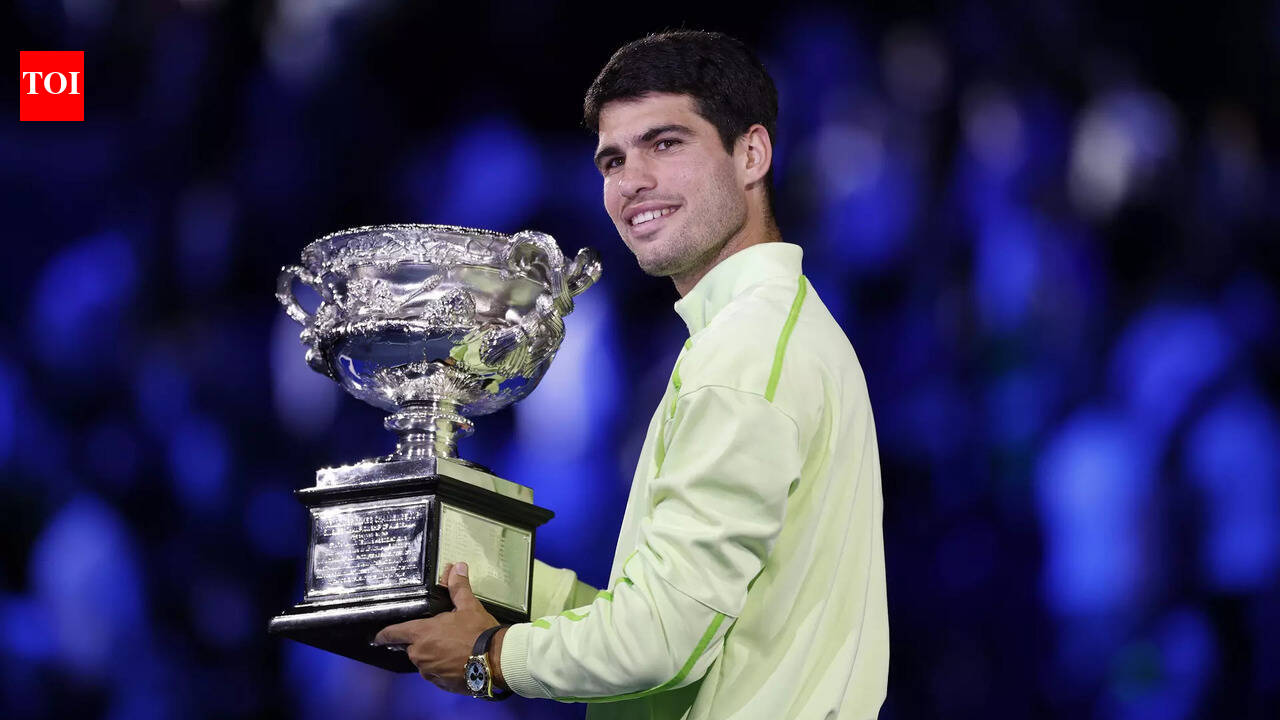
Melbourne: When Carlos Alcaraz fell back onto the Rod Laver Arena after just over three hours in the middle, he lay motionless for a while, stunned by the moment, caught between disbelief and the sudden weight of what he had achieved. The world No. 1 had just halted Novak Djokovic, the 24-time major champion, 2-6, 6-2, 6-3, 7-5 to lift the Norman Brookes Challenge Cup for the first time, continuing his relentless rewriting of the record books. At 22 years and 272 days, the Australian Open crown made Alcaraz the youngest man in history to complete a career Grand Slam. The path to the title, however, had been anything but smooth. Alcaraz arrived in Melbourne after a turbulent period, facing criticism at home and across the tennis world following his split from long-time coach Juan Carlos Ferrero in December, a backdrop that made the scale and composure of his triumph all the more striking. “Nobody knows better than my team how hard I’ve been working to get this trophy,” Alcaraz said of his seventh major title. “Pre-season was a bit of a rollercoaster emotionally. We did the right work, you pushed me every day to do the right things and I’m really grateful for everyone in my corner. This trophy is also yours.” Some 12 minutes into the match, Alcaraz unveiled his first drop shot, a clear signal of intent. He wanted to move Djokovic, to probe the older man’s legs early. Two minutes later in the fourth game, he saved the first break point he faced with another feathered drop shot. Djokovic, dragged around the court like a pawn in a carefully constructed board game, responded in the only way he knew how, with precision and patience, breaking on his third opportunity to move ahead 3-1. If Alcaraz arrived with a plan for the sport’s great symbol of longevity, Djokovic leaned on placement and control, closing out the opening set in just 33 minutes. Rod Laver Arena was captivated, and for the first time in his young career, Alcaraz, with Spanish legend Rafael Nadal cheering him on, sensed that the crowd’s volume tilted decisively toward his opponent. As he tried to accelerate the tempo in the second set, a tactic that played into Djokovic’s hands, the Spaniard muttered toward his box in search of answers. He eventually eased off the throttle, returning to variation and movement, and broke in the third game. As the sun dipped over Melbourne Park, Djokovic retreated further behind the baseline and on the scoreboard. The roof over Rod Laver Arena was only partially open on the coldest day of the fortnight, with temperatures peaking at just 20 degrees. Strong winds swept through Melbourne’s sporting precinct, blowing between 11.2 and 20.1 mph, with gusts reaching up to 29 mph, adding an unpredictable edge to the contest. The ten-time Australian Open champion left the court at the end of the second set, and as the roof began inching closer, Alcaraz got on his feet, protesting to the chair umpire. He did well not to let it distract him, carrying the momentum into the third, threatening in Djokovic’s opening service games before breaking in the fifth when the Serb’s crosscourt forehand drifted wide, igniting the Spanish contingent. Moments later, when the top seed emerged on top of a geometrical exchange of acute angles and the stands erupted, it was clear the world No. 1 had seized control. Djokovic called for the doctor at the end of the third set, gesturing toward what appeared to be acid reflux. Yet, just as the contest seemed to be slipping away, he produced one last stand, saving six break points from 15-40 in the second game with sheer resolve. Buoyed by the crowd inside Rod Laver Arena and thousands more braving the biting cold outside, the 38-year-old traded shot for shot with a younger, fresher opponent. The resistance held until the 12th game, when Alcaraz finally wrapped it up. A pivotal subplot in Sunday’s final was the serve. Alcaraz claimed 77 percent of the points on his first serve, while Djokovic, who saved 11 of 16 break points he faced in the match, only managed 66 percent. Alcaraz’s conscious effort to make that shot more efficient saw him borrow elements from Djokovic’s action and work on it in the off-season. Rather than chasing raw pace, the 22-year-old has actioned a cleaner, more repeatable motion, with the focus on disguise and placement over outright power. The influence is clear in how he now protects his service games under pressure, using variation and accuracy to set up his first forehand. For a player who stands at 6 feet, the shortest among the modern-day greats — Rafael Nadal and Roger Federer are both an inch taller than Alcaraz, while Djokovic is 6 ft 2 and Jannik Sinner at 6 ft 3 is significantly taller — this evolution is crucial. In a final against the very model he’s studied, it became a fascinating measure of how effectively the student had absorbed the master’s lessons.
About the Author