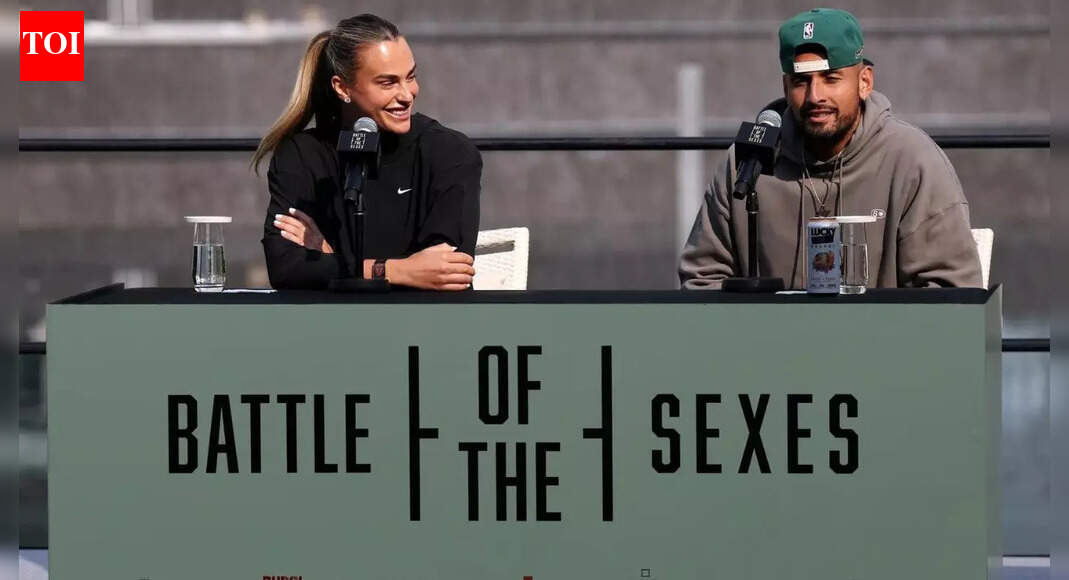
Aryna Sabalenka and Nick Kyrgios will meet in the “Battle of the Sexes” on Sunday, but the only similarity between the Dubai exhibition and the historic 1973 match is the name, according to Billie Jean King.The women’s world No. 1 Sabalenka, a four-time Grand Slam champion, will face Kyrgios, currently ranked outside the top 600 on the men’s tour, in a widely promoted exhibition that has divided tennis followers.The title recalls the September 1973 meeting between King and Bobby Riggs, a match that altered the course of women’s tennis and sport more broadly.At the time, women’s professional tennis was still establishing itself. King and her peers were fighting for recognition, stability and better prize money, with women earning far less than men. Beyond sport, women were also battling for equal rights across society.“It’s not the same thing,” King, now 82, told the BBC.“Ours was about social change… This one is not.“Mine was really political. It was rough, culturally, what was coming in with it.“I knew I had to beat him for societal change. I had a lot of reasons to win.”King, then at the peak of her career, defeated the 55-year-old Riggs 6-4, 6-3, 6-3 in front of 30,000 spectators at the Houston Astrodome, with an estimated 90 million watching on television.Few believe Sabalenka can repeat that outcome, even against Kyrgios, who once reached a career-high ranking of 13 but has played only six main-draw matches over the past three seasons and is now ranked 671.
Why the two contests are worlds apart
Evolve, the agency behind the Dubai event, has promoted the match as a sequel to the 1973 “Battle of the Sexes”.However, there are key differences. The rules will not be the same, with changes to court dimensions, service limits and scoring formats.The wider political and cultural settings also differ sharply. King’s victory has long been seen as a feminist moment that challenged sexism in sport. In contrast, neither Sabalenka nor Kyrgios appears to be playing for anything beyond the match itself.That has raised questions about whether women, and women’s sport more broadly, stand to gain anything from this exhibition.
When tennis was about social change
The early 1970s feminist movement in the United States saw women demand better rights, opportunities and freedoms. Sport was part of that struggle.Women’s tennis played a leading role. King and others formed their own tour, unionised and pushed for equal prize money, including at the US Open.Riggs, a former champion who described himself as a “male chauvinist pig”, argued that men deserved higher pay. He repeatedly challenged King to play him, claiming women could not match even an ageing male player.King initially refused, saying later: “We didn’t need him; we were making it on our own merits.”After Riggs defeated Margaret Court earlier in 1973, King felt compelled to step in. Her straight-sets win over Riggs became a wider symbol of women’s ability to compete and succeed when given the chance.“It wasn’t about tennis,” King later said. “It was about social change.”
An apolitical star and a different era
So what is the new “battle” about?King has not commented directly on the 2025 exhibition but has spoken warmly about Sabalenka’s tennis.“What I love about you is that when you come out to play, you bring all of yourself,” King told Sabalenka after her 2024 US Open title.Off the court, their views differ. King has consistently argued that sport and politics are linked. Sabalenka has taken a different stance.When asked about Russia’s war in Ukraine, the Belarusian said, “I don’t want sport to be involved in politics, because I’m just a 25-year-old tennis player.”King never claimed women were better than men but wrote in her 1974 autobiography that, from an entertainment point of view, women offered performances worth watching.Sabalenka has previously said she prefers watching men’s tennis because “it’s more interesting”.Such comments sit uneasily alongside ongoing debates about gender equality. While prize money is equal at all four Grand Slams, gaps remain elsewhere.At several lower-tier tournaments, women continue to earn less, receive less exposure and get fewer prime scheduling slots.
A lose-lose for women’s sports?
The Sabalenka-Kyrgios match may draw attention, but for women’s sport it carries risks.If Sabalenka wins, critics may argue that rule changes favoured her. Evolve has reduced her side of the court by nine per cent in length and width, citing calculations that women move nine per cent slower than men, though no data has been published.Both players will be allowed only one serve, and the match will be best-of-three sets, unlike the best-of-five format used in 1973. A split sets scenario will lead to a 10-point tie-break.If Kyrgios wins, it may reinforce claims that even the top-ranked woman cannot beat a lower-ranked man, arguments that could be used against women’s sport more broadly.The venue has also drawn attention. The event is being held in the United Arab Emirates, where the government has faced criticism over human rights issues, including gender discrimination and restrictions on speech.Hosting high-profile sporting events can help shift focus away from such concerns, a practice often described as sportswashing.
‘Enjoy the show’
King’s work off the court helped bring equal prize money at the majors, a milestone that did not exist in 1973.On Sunday, there is no title, ranking points or wider reform at stake.“The only reason they are putting this on is because their management company has gone, ‘we’re going to make a bit of money here.’ But what is in this for women’s tennis?” said former doubles champion Rennae Stubbs on her podcast, as cited by news agency AFP.Kyrgios has argued that criticism only fuels interest.“All the negative comments towards the battle of the sexes are doing nothing but giving it more attention,” he wrote on social media.“Aryna will go down as one of the greatest players to play this game. I will have entertained crowds around the world.”Sabalenka has been direct in her response: “Sit back and enjoy the show… No one cares what you have to say.”Despite her reservations, King hopes for a positive outcome.“I hope it’s a great match,” she said. “I want Sabalenka, obviously, to win — but it’s just not the same.”
About the Author