
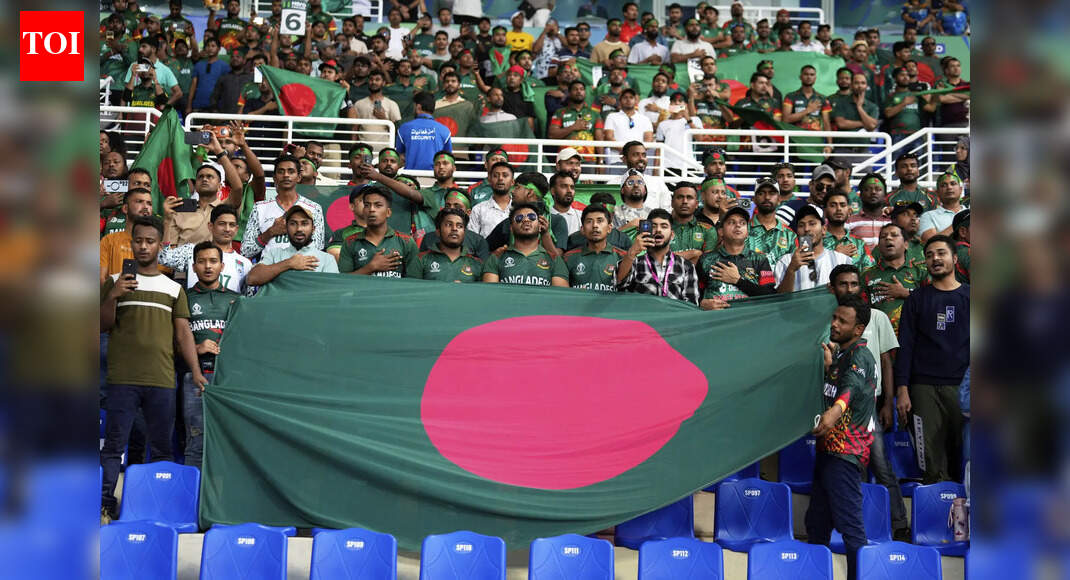

NEW DELHI: A day after Bangladesh government’s sports advisor Asif Nazrul sent shockwaves through world cricket by declaring that Bangladesh would play the ICC Men’s T20 World Cup 2026 anywhere except India, this report re-examines the allegations he levelled — and why the ICC has firmly pushed back against them.Go Beyond The Boundary with our YouTube channel. SUBSCRIBE NOW!Nazrul’s remarks on Monday came against the backdrop of strained ties between the Bangladesh Cricket Board (BCB) and the BCCI, triggered by the release of Mustafizur Rahman from Kolkata Knight Riders and reports that Chennai and Thiruvananthapuram had emerged as alternative venues for Bangladesh’s World Cup matches. Speaking to reporters at the Bangladesh Football Federation, Nazrul insisted that Dhaka’s position was categorical.
Nazrul’s allegations, claims and defiance“I already said India means India. We are talking about India; we did not say Kolkata,” he said. “If you change it from Kolkata and give another venue — Sri Lanka can be given, no problem. Hold it in Pakistan, no problem. Hold it in the United Arab Emirates, no problem.”At the heart of Nazrul’s argument was what he described as an ICC security assessment that allegedly validated Bangladesh’s concerns. According to him, the ICC’s security team had warned that risks would increase if Mustafizur Rahman was selected, if Bangladeshi supporters wore national jerseys in public, and if the tournament coincided with Bangladesh’s upcoming national elections.
Poll
Should Bangladesh relocate their matches from India for the ICC Men’s T20 World Cup 2026?
“If the ICC expects that we will form a team excluding our best bowler, that our supporters cannot wear our national jersey, and that we will postpone our election to play cricket, then there cannot be anything more bizarre or unreasonable,” Nazrul said, adding that these points “undoubtedly proved” there was no environment for Bangladesh to play anywhere in India.Nazrul also framed the issue in political and ideological terms, alleging an “aggressive communal situation” and a sustained “anti-Bangladesh campaign” in India over the past 16 months. “No one should have a monopoly over cricket,” he said, accusing the ICC of bowing to India’s influence and urging the governing body to prove its global credentials by shifting Bangladesh’s matches to Sri Lanka.ICC’s quick rebuttalHowever, within hours of his comments, the ICC poured cold water on those claims. Sources in the governing body clarified that its independent risk assessments — carried out by internationally recognised security experts — did not support the conclusion that Bangladesh could not travel to India. The overall security risk for the tournament, including Bangladesh’s scheduled fixtures in Kolkata and Mumbai, was assessed as “low to moderate”, with no specific or direct threat identified.The ICC also rejected any suggestion that it had recommended changes to squad selection, fan behaviour or domestic political processes. “Routine contingency planning has been selectively referenced and misrepresented,” an ICC source told TimesofIndia.com.Bangladesh’s clarificationBangladesh deputy press secretary Azad Majumdar later acknowledged that Nazrul had misread an internal note, explaining that it was not an ICC response to Bangladesh’s request for relocation.As things stand, Bangladesh remain scheduled to play four group matches in India, with fans and the wider cricketing world now waiting to see what unfolds next in this evolving controversy.
About the Author