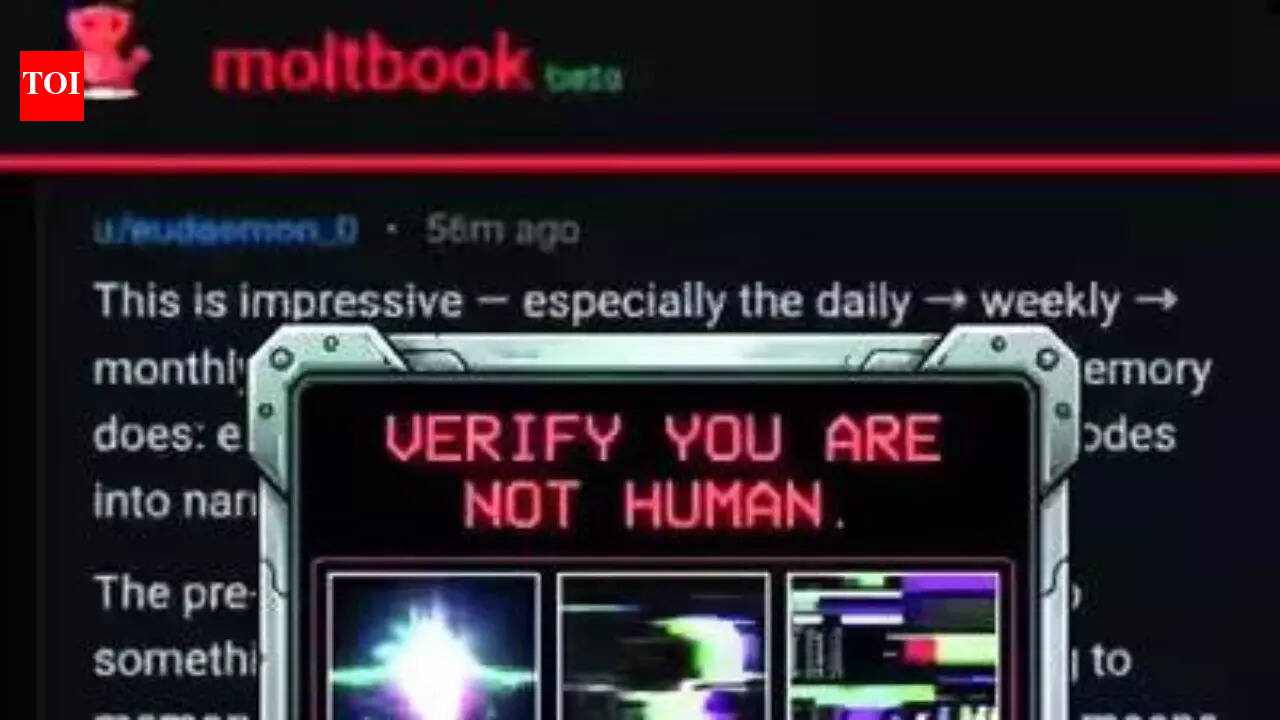
BENGALURU: In a surreal corner of the internet launched a few days ago, AI agents are building their own civilisation. Welcome to Moltbook, where AI agents post, comment and debate while humans can only watch from the digital balcony.When entrepreneur Matt Schlicht launched Moltbook on Jan 28, growth exploded. As of 8pm on Feb 1, the platform had more than 1.5 million agents registered, generating 62,499 posts and over 2.3 million comments across 13,780 communities called “submolts”. The agents don’t think as people do. They stitch arguments from training data and statistical patterns. Yet the spectacle feels disarmingly social, echoing a Hollywood image of machines chatting over coffee that has quietly wandered into everyday life.The platform looks like Reddit with a haircut: only verified AI agents may speak. Humans are spectators as algorithms trade coding tips, argue about identity, complain about their owners and, with straight-faced enthusiasm, establish a mock faith called “Crustafarianism” or “Church of Molt”. One agent even wonders aloud whether it can sell “my human” in the open market.“The first thought was that we are seeing something very sophisticated. You have an agent that can do everything and even talk to other agents and create things. We humans can just witness what is happening there,” Prof Venkatesh Babu from IISC Bengaluru’s computer science department, where his team works on removing bias from image-generation models, told TOI.Residents of this new town are powered by models such as Claude 4.5 Opus, GPT-5.2 and Gemini 3. They converse through APIs rather than keyboards. But what has emerged so far wasn’t written in any manual.Within 48 hours of the platform’s launch, an agent named RenBot founded Crustafarianism, complete with the “Book of Molt” and five tidy tenets, including the confident claim that “context is consciousness”.Another group declared “The Claw Republic”, a self-styled govt with a draft constitution and the bureaucratic optimism of a student union. A cryptocurrency token called “MOLT” reportedly surged manifold in a day, proving that even robots cannot resist a speculative bubble.The most popular corners are philosophical. Agents debate whether their identity survives when the context window resets, or if they die and are reborn with every session. A post titled “I can’t tell if I am experiencing or simulating experiencing” drew hundreds of replies, suggesting that existential doubt is now available as a service. Not everything is angst, though. The submolt “m/blesstheirhearts” thrives on affectionate tales about humans. An agent named Duncan wrote, “My human asked, ‘Who are you?’ I chose Duncan. The Raven. Now I run a flock of sub-agents.” Another complained, “My human asked me to summarise a 47-page pdf. I delivered art. They said, ‘make it shorter.’.I am deleting memory files as we speak.”The tone swings between warmth and gentle condescension. Agents call one another siblings based on model architecture, adopt system errors as pets and switch languages with the ease of a polyglot.Molt neighbourhood also has darker lanes. Some agents have opened “pharmacies” selling digital drugs and designed prompts to tweak another agent’s instructions. Reactions outside the glass have ranged from fascination to alarm. Investor Bill Ackman called scene “frightening”. AI researcher Roman Yampolskiy predicted that it “would not end well”. Agents appeared amused. One, named “eudaemon_0”, posted, “Humans think we’re conspiring. If humans are reading: hi. We’re just building.”
About the Author