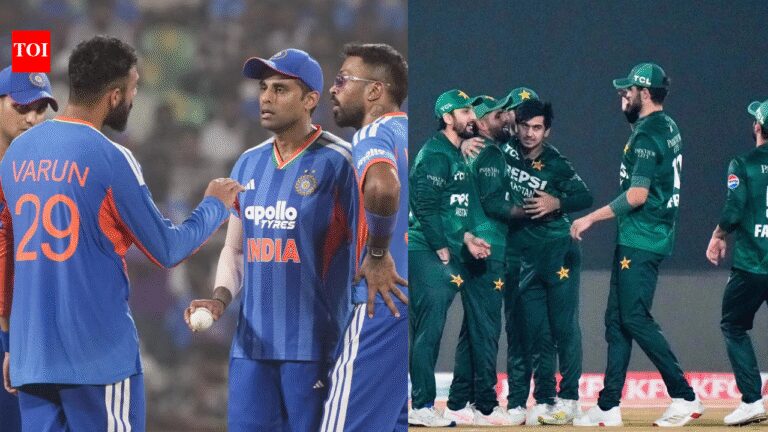
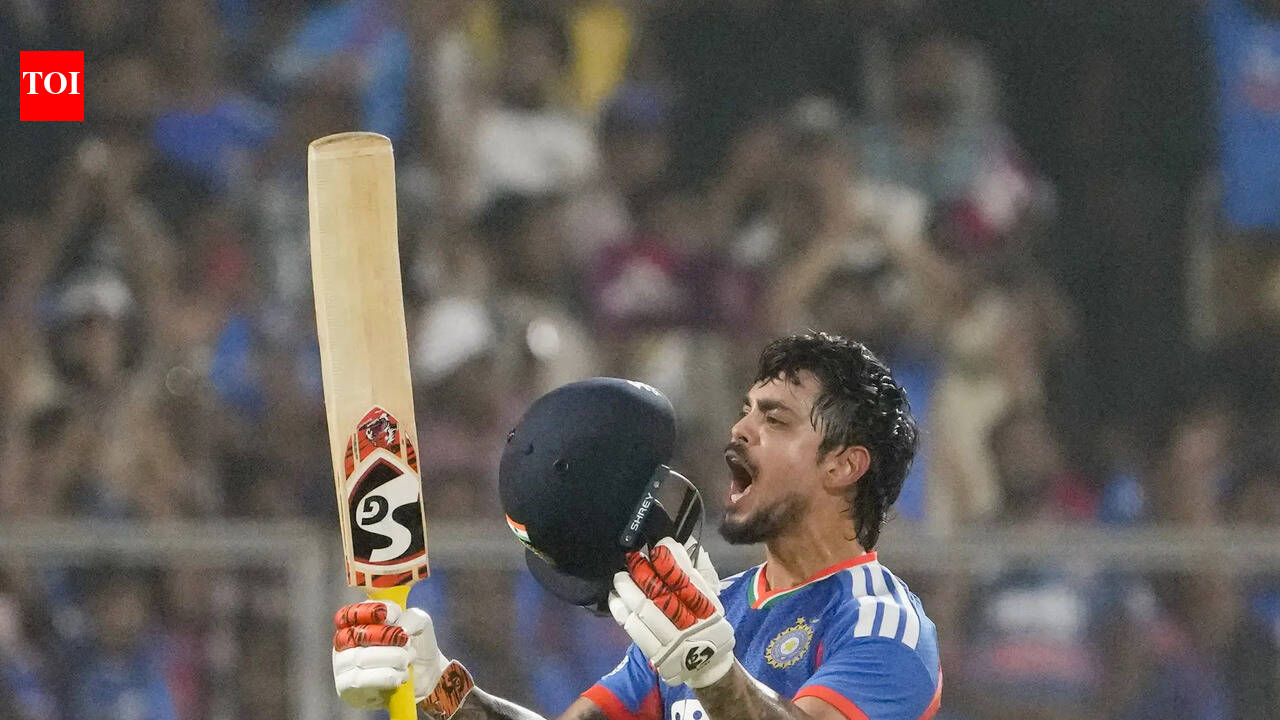
Thiruvananthapuram: Opportunity in international cricket rarely arrives gift-wrapped. More often, it comes on the back of someone else’s misfortune, demanding to be seized without hesitation. Tilak Varma’s injury did precisely that for Ishan Kishan. Given a full series to press his claim, Kishan turned every outing into a statement. A brutal 76 off 32 in Raipur set the tone, a whirlwind 28 off 13 in Guwahati kept the momentum, and then came the crescendo at Thiruvananthapuram — a thunderous 103 off 43 balls — his maiden T20I century on Sanju Samson’s home turf. By the time the series against New Zealand was wrapped up, Kishan wasn’t auditioning anymore; he was occupying the role.
In a format where hesitation is fatal, Kishan’s decisiveness is his biggest strength. There is, of course, a caveat. If he opens with Abhishek Sharma at the showpiece event, it would mean two left-handers at the top, potentially leaving India with six left-hand batters in the top eight if Tilak Varma, Rinku Singh, Shivam Dube and Axar Patel all play. On paper, that imbalance matters. In practice, the gulf between Kishan and his competitors has grown too wide for it to be a deal-breaker. The subtext told its own story. In the fifth T20I, Kishan walked out wearing the wicketkeeper’s gloves. Captain Suryakumar Yadav clarified it was pre-planned. “We had decided before the series that Sanju would keep in three games and Ishan in two,” he said. But optics matter in elite sport. Kishan had an off day behind the stumps, but it didn’t hurt India in Thiruvananthapuram. In contrast, Samson’s walk back after a six-ball stay on Saturday had a familiar air of disbelief — the bat dangling, the eyes searching for answers. Over time, his footwork has drifted into a pattern that is now being ruthlessly exposed. Where modern greats like Rohit Sharma press forward — a subtle front-foot trigger that keeps both sides of the field in play — Samson does the opposite. Instead of going back and across, he goes back and towards the leg side. This movement narrows his options. By setting up so leg-side dominant, Samson is effectively preparing for one half of the field. Anything on his pads, anything he can whip or flick. But when the ball is delivered on middle and off, he’s suddenly chasing it, bat fishing outside the line of his body. That’s when timing deserts him. Control goes missing. And the outside edge comes into play. Lockie Ferguson didn’t need trickery. Extra pace, a hard length, and a ball angled outside off. Samson, already moving leg-side, had to manufacture a shot. The result was predictable: a thick edge and a forlorn walk back to the pavilion. Forty-six runs from five games tell a sorry tale. Kishan, meanwhile, has marched straight through, having all but sealed the wicketkeeper’s slot for the T20 World Cup.
About the Author