

Childhood today moves like a timetable. Before a child has figured out what she enjoys, someone has already asked what she’s good at.Soha Ali Khan’s way of speaking about parenting feels like a quiet interruption to that rush. Not dramatic. Not preachy. Just a steady return to one idea: let children remain interested before you make them impressive.In conversations about raising her daughter Inaaya, Soha has pushed back against the idea that every hobby needs a destination. Speaking to NDTV she explained, “One pattern I consciously wanted to break was the idea that children should always be seen and not heard. With Inaaya I really wanted to encourage open communication, to let her ask questions, express her feelings and have a voice in the family.” That line does the work most parenting manifestos do and does it without sermonising.Curiosity, in her view, is fragile. It shrinks the moment it starts being evaluated. When children sense they are being watched for results, their questions become safer, their risks smaller. Rather than policing interests, Soha’s instinct is to let exploration breathe. In an interview with Indian Express she put it simply: the aim is not to convert play into performance but to allow play to remain play so the child can discover what she cares about.This does not mean the absence of structure. It means structure without urgency. Books, conversations and small rituals appear constantly in how she describes home life. In a feature for the Economic Times she talked about story time being sacred at home: Inaaya will bring a book and ask for a chapter, or invent a story “from your mouth” where the plot is all hers. Soha uses books not to build a résumé but to build an inner world.
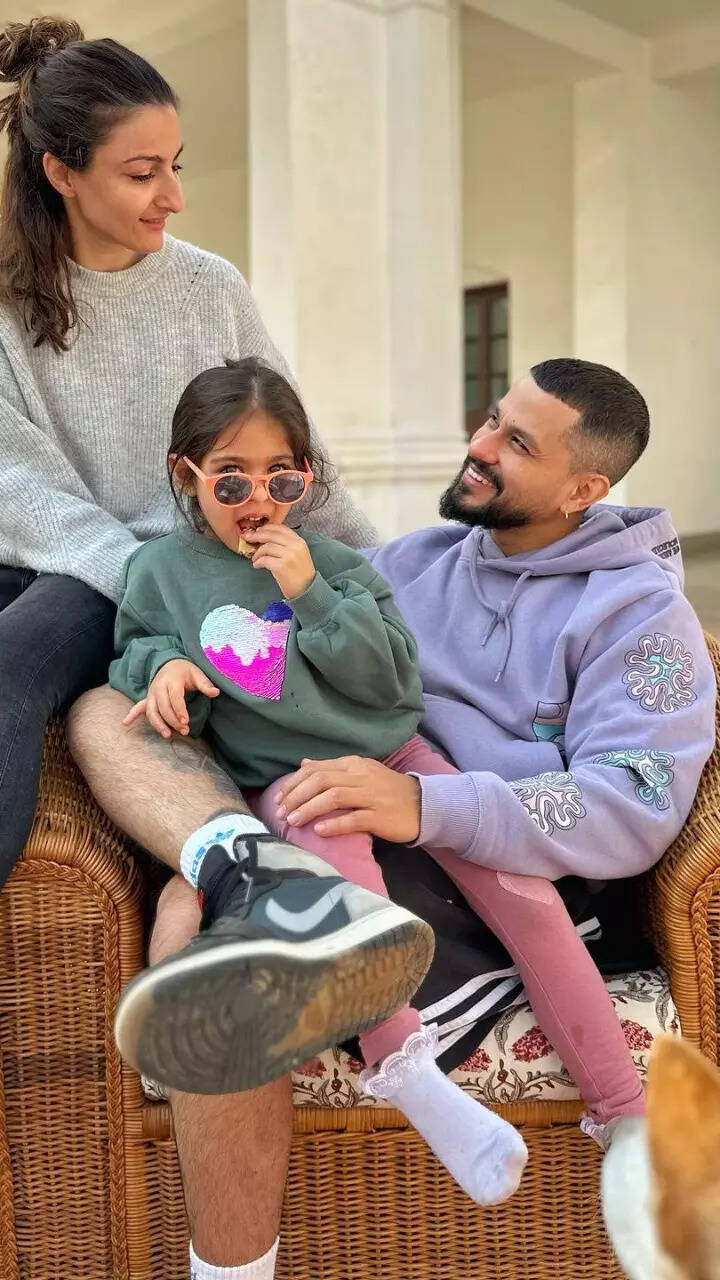
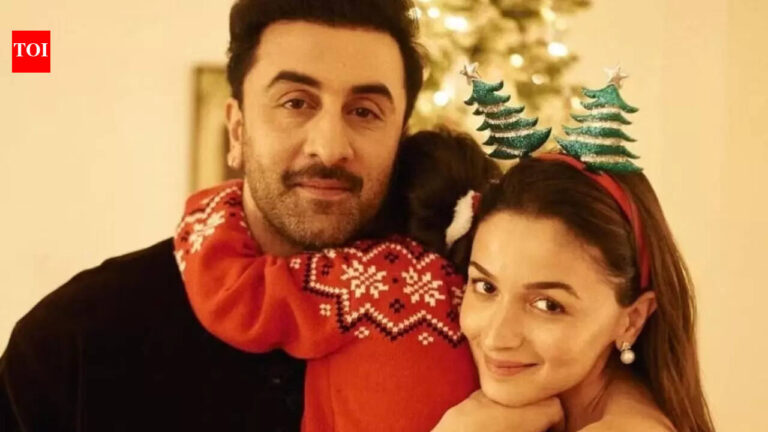
Soha and Kunal celebrated New Year 2023 with fam at Pataudi Palace.
There is also an awareness of how modern childhood is shaped by noise. Screens fill gaps instantly. Comparisons travel fast. In a recent Hindustan Times conversation she shared a practical rule she follows to reduce screen dependence and encourage empathy. The result, she said, is that Inaaya learns to notice things and to be curious in ways that screens rarely invite.Allowing boredom matters too. Soha has said on her podcast conversations, including a candid episode with Kareena Kapoor Khan on ‘All About Her’ that boredom is not failure. It is the quiet where new questions form. She told listeners that giving children the room to be unoccupied is an underrated generosity.Pressure hides in over-scheduling, in turning every activity into achievement, in the urge to correct too quickly. Soha’s stance feels like a conscious slowing down. Let a hobby stay a hobby. Let questions wander without steering them toward usefulness. In a Tweak India discussion she admitted she still worries. “I am constantly anxious as a mother” she said; but that anxiety, when named, becomes a guide rather than a script.What is striking is that her view does not reject ambition. It refuses to begin there. When curiosity leads, effort follows more naturally. Children will interact because they want to know, not because they desire approval.Humility shapes how she speaks about parenting. She does not present herself as someone who has figured it out. A lot of her interviews read like a fellow parent talking to other parents, not like a celebrity dispensing doctrine. That tone changes the dynamic. When adults admit they are learning, children feel less pressure to be perfect.The silent takeaway of her view is this: not every interest requires a plan. Attention without evaluation can be the most valuable thing an adult gives. Curiosity, then, is the mood not the result. Atmospheres, more than instructions, are what children grow inside.Soha’s message is easy to miss because it is quiet. It is the small permission slips like, a story at bedtime, an unanswered question left to bloom, a rule about screens used thoughtfully. It is not glamorous. It is human. And it is exactly the kind of thing a child needs to discover who she becomes.
About the Author