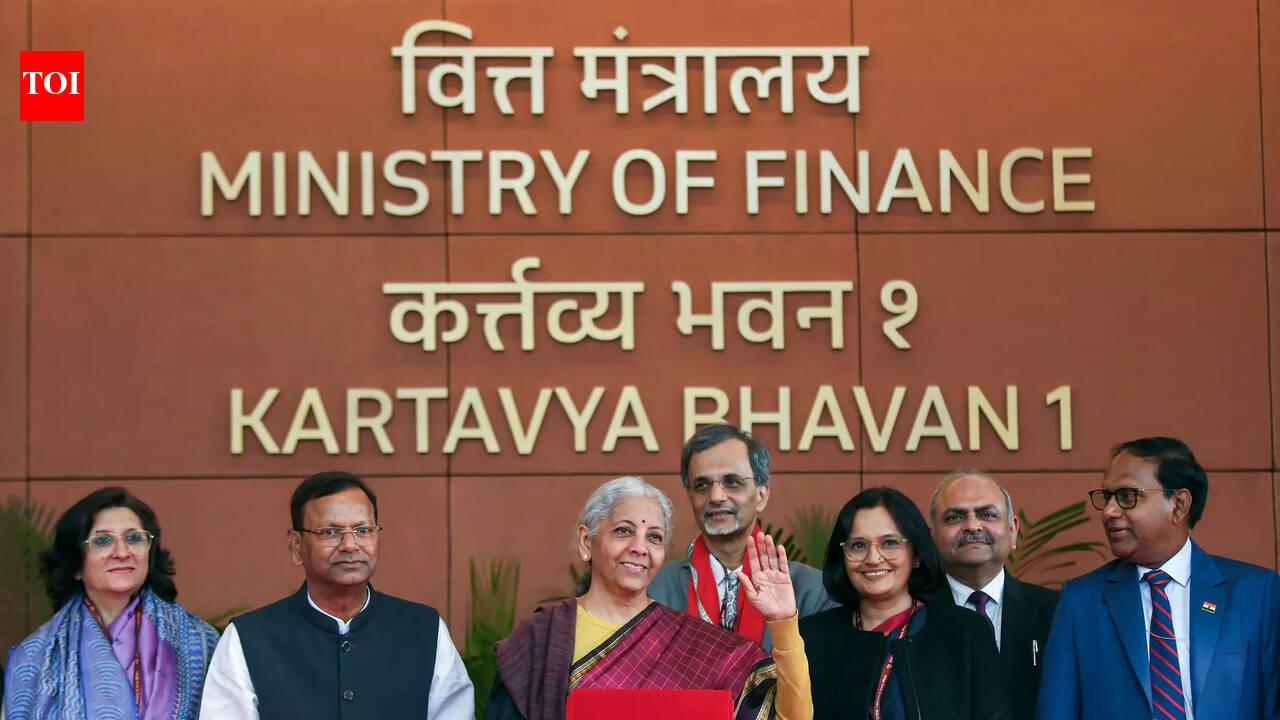
Budget 2026-27 emphasised infrastructure growth, manufacturing boosts, fiscal prudence, and tax simplifications.
Union Budget 2026-27, presented by finance minister Nirmala Sitharaman on Sunday, emphasised infrastructure growth, manufacturing boosts, fiscal prudence, and tax simplifications amid strong economic momentum. Key priorities include elevating capital expenditure while targeting a fiscal deficit reduction.
Capital expenditure has been set at Rs 12.2 lakh crore for FY27, up from Rs 11.2 lakh crore this year, to drive infrastructure and crowd in private investment. Fiscal deficit has been narrowed to 4.3% of GDP, with debt-to-GDP at 55.6% and a long-term goal of 50±1% by 2030. The total size of the Union Budget has been pegged at Rs 53.5 lakh crore.Net tax receipts are estimated at Rs 28.7 lakh crore, with Rs 1.4 lakh crore devolved to states.This marked FM Sitharaman’s ninth consecutive Union Budget presentation.
Here are the key takeaways from the budget
- New Income Tax Act, 2025 to come into effect from April 2026, simplified income tax rules and forms to be notified shortly. This will reduce compliance burdens for taxpayers, boost disposable incomes for the middle class, and stimulate household consumption and investments by modernizing the outdated 1961 tax code.
- Basic customs duty on 17 drugs or medicines to be exempted. The move lowers treatment costs for cancer and rare disease patients, expands the exempted list to 129 medicines, and eases access to critical therapies, supporting India’s healthcare affordability goals.
- To develop India as a global biopharma manufacturing hub, Biopharma Shakti scheme with an outlay of Rs 10,000 crore over the next five years has been proposed. It will create a network of 1,000 accredited trial sites to bolster biopharma industry. It addresses rising non-communicable diseases like cancer and diabetes, builds domestic biologic production capacity, and enhances innovation to manage chronic illnesses and improve life expectancy.
- The government has proposed to launch India Semiconductor Mission 2.0 with focus on industry-led R&D and training centres for chips. The outlay has been increased to Rs 40,000 crore. This accelerates self-reliance in
semiconductors , creates jobs in high-tech manufacturing, and positions India as a competitive global hub for chips, equipment, and IP design. - To boost
rare earth production , Centre has proposed to support the mineral-rich states of Odisha, Kerala, Andhra Pradesh and Tamil Nadu to establish dedicated rare-earth corridors to promote mining, processing, research and manufacturing. It reduces import dependence on critical minerals for electronics and renewables, boosts regional economies, and strengthens supply chains for strategic industries. - Basic customs duty exemption on capital goods for lithium-ion battery manufacturing extended; exemption also for capital goods processing critical minerals. These cuts lower production costs for EVs and renewables, spur domestic battery ecosystem growth, and secure supplies for clean energy transition.
- The government announced three dedicated chemical parks in every state using a cluster-based plug-and-play model to enhance domestic chemical production.
- The government has proposed a Rs 10,000-crore SME growth fund to incentivise small industries. A Self-Reliant India fund with Rs 2,000 crore will support micro enterprises; Rs 10,000 crore for container manufacturing over five years.
- Centre will develop cadre of ‘Corporate Mitras’ in Tier-II, Tier III towns to help MSMEs. Local mentors will improve access to finance, markets, and compliance, fostering entrepreneurship in smaller cities and driving inclusive growth.
- 7 high-speed rail corridors proposed between cities as “growth connectors”. This corridors will be Mumbai-Pune, Pune-Hyderabad, Hyderabad-Bengaluru, Hyderabad-Chennai, Chennai-Bengaluru, Delhi-Varanasi, and Varanasi-Siliguri.
- The government has proposed to launch the Mahatma Gandhi Gram Samaj initiative to support khadi, handicrafts.
- New dedicated freight corridors connecting Dankuni in the East to Surat. Proposal to operationalise 20 new waterways over next five years, starting with Odisha. These promote sustainable cargo movement, slash logistics costs by 20-30%, decongest roads, and boost eastern industrial hubs.
- A ship-repair ecosystem will be set up in Varanasi and Patna.
- Proposal to set up high-level committee on banking for Viksit Bharat to comprehensively review the sector.
- Creation of 5 tourism destinations in 5 Purvodaya States and the provision of e-buses to Buddhist sites in the North Eastern region.
- Proposal of 15 sites like Sarnath, Hastinapur to become vibrant cultural hubs for archeological revival.
- A scheme for upskilling 10,000 guides in 20 tourist sites through a standardised, high-quality 12-week training course in hybrid mode, in collaboration with an IIM.
- Sitharaman announced proposals for Allied Health Practioners and training for caregivers. To promote India as a hub for Medical-value tourism, she proposed a scheme to support states in establishing five regional medical hubs in partnership with private sectors.
- Proposal to set up three new All India Institutes for Ayurveda, upgrade AYUSH pharmacies and upgrade WHO traditional medical center in Jamnagar.
- Proposal to create five university townships & academic zones to host multiple colleges, skill centres, residential areas.
- Indian Institute of Creative Technologies, Mumbai to setup Animation, Visual Effects, Gaming and Comics (AVGC) content creator labs in 15,000 secondary schools and 500 colleges. To boost India’s Orange Economy.
- Proposal to set up one girls’ hostel in every district.
- A new National Institute of Design will come up in east India.
- The Budget has an outlay of Rs 20,000 crore over the next 5 years in Carbon Capture Utilization and Storage. Accelerates net-zero goals, creates green tech jobs, and positions India in global climate tech market.
- Bharat-vistaar, a multilingual AI tool to integrate the Agristack portals and the ICAR package on agricultural practices with AI systems. It will enhance farm productivity, improve farmer decision making and reduce risk through customised advisory support.
- Plans to launch a Khelo India mission that will also prioritise the long-term development of training centres and coaches over the next decade.
About the Author