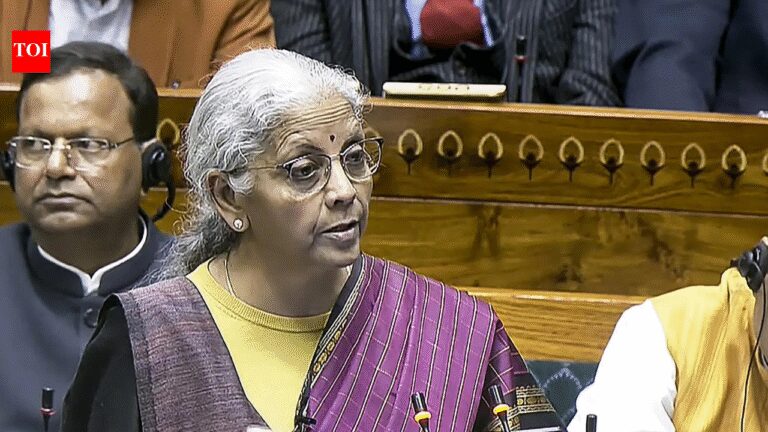
NEW DELHI: Union Budget 2026 moved towards strengthening India’s efforts towards becoming a global manufacturing powerhouse in electronics by announcing a new incentive plan for semiconductor manufacturing, while nearly doubling the outlay under the Electronics Components Manufacturing Scheme to Rs 40,000 crore.Finance Minister Nirmala Sitharaman said that the India Semiconductor Mission (ISM) 1.0 had helped expand India’s semiconductor sector capabilities. “Building on this, we will launch ISM 2.0 to produce equipment and materials, design full-stack Indian IP, and fortify supply chains,” she said, promising fresh funds to attract global fabrication companies, and supply chain players.
There has been considerable success in the development of the semiconductor ecosystem in India after the central govt had come up with a Rs 76,000 crore incentive package in December 2021. Under the plan, the govt had extended fiscal support of up to 50 per cent of a project’s cost to eligible display and semiconductor fabricators.India – which had previously failed to get any credible proposals for semiconductor manufacturing after trying for decades – had finally managed to score big when American Micron had become the first major player to enter the space with a Rs 22,500 crore testing and packaging unit in Gujarat in June 2023.This was followed up with approval to three proposals worth Rs 1.26 lakh crore in February 2024. These were — Rs 91,000 crore project of Tata Electronics to set up India’s first semiconductor fab unit with Taiwanese Powerchip Semiconductor Manufacturing Corp at Dholera in Gujarat; Rs 27,000 crore Semiconductor Assembly and Test (TSAT) unit by Tata in Morigaon, Assam; and Rs 7,600 crore project of CG Power with Japanese Renesas Electronics and Stars Microelectronics of Thailand.Sitharaman also boosted the govt’s support for manufacturing components required by the electronics industry, especially after it saw a big interest by the supplier community. “The Electronics Components Manufacturing Scheme, launched in April 2025 with an outlay of Rs 22,919 crore, already has investment commitments at double the target. We propose to increase the outlay to Rs 40,000 crore to capitalise on the momentum,” the Finance Minister said in the Budget speech. “We will also focus on industry-led research and training centres to develop technology and skilled workforce.”Also, to deepen value addition in the consumer electronics sector, she proposed to exempt basic customs duty on specified parts used in the manufacture of microwave ovens.In another measure, the FM said that to harness the efficiency of just-in-time logistics for electronics manufacturing, the Budget proposes to provide safe harbour to non-residents for component warehousing in a bonded warehouse at a profit margin of two per cent of the invoice value. “The resultant tax of about 0.7 per cent will be much lower than in competing jurisdictions,” the FM said.
About the Author