

What began as a single gruesome murder in Meerut has since grown into a grim catalogue of crimes that investigators across states are now studying with unease. The “blue drum murder” — the killing of ex-merchant navy officer Saurabh Rajput — has come to symbolise a broader pattern of domestic betrayal, third-party involvement, premeditation and extreme methods used to conceal murder.From Uttar Pradesh to Rajasthan and Punjab, multiple murder cases have since surfaced, either directly mirroring the Meerut modus operandi or explicitly linked to it in public discourse, police investigations and even protests by men claiming they feared becoming the “next blue drum victim”.

Meerut: The crime that set patternSaurabh Rajput, 35, an ex-merchant navy officer, returned to Meerut from London on February 24, 2025, hoping to surprise his wife Muskan Rastogi on her birthday. He never made it out of the house alive.
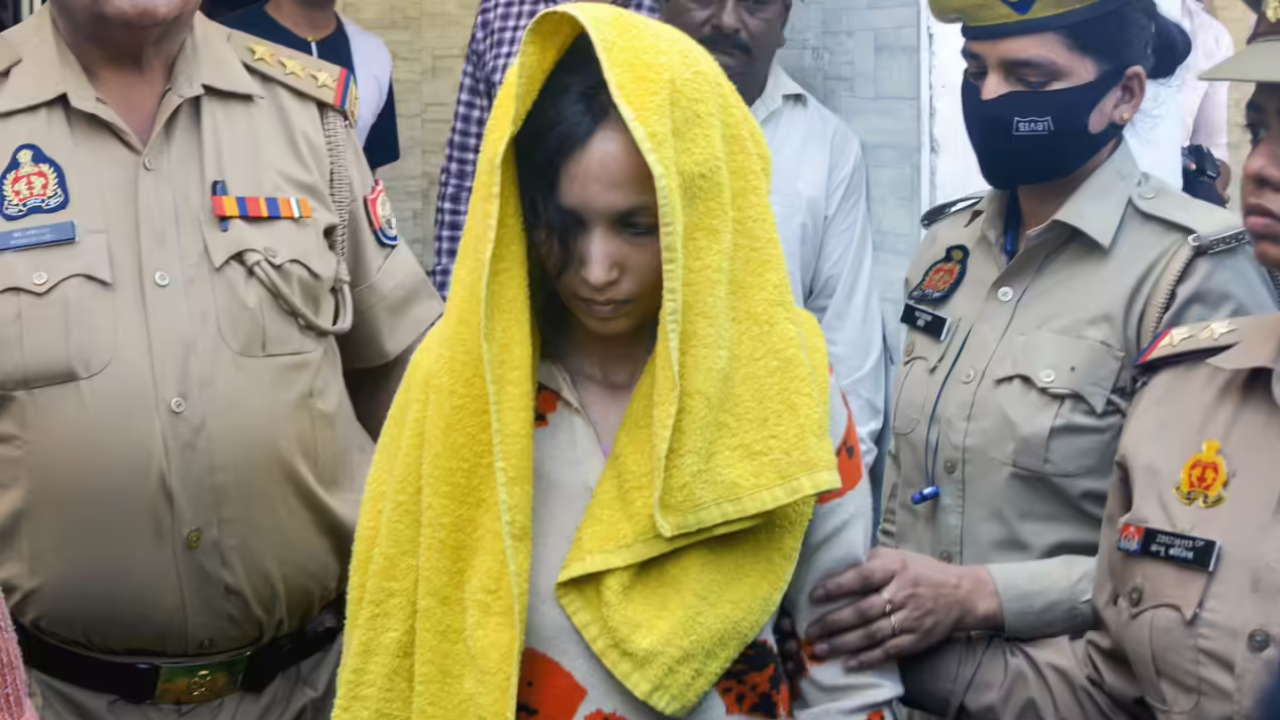
On the night of March 4 2025, Muskan allegedly drugged Saurabh with sedatives and called her lover, Sahil Shukla alias Mohit. As Saurabh lay unconscious, Muskan stabbed him multiple times. Sahil then slit his throat. The body was dismembered, sealed in cement inside a 220-litre blue plastic drum and left in the house for nearly two weeks.Meerut SSP Vipin Tada said, “After killing Saurabh, they wanted to dispose of the remains but failed. So, they left his body in the bathroom overnight along with the severed head. The next morning, Sahil bought 50kg of cement and a 220ltr-drum. They chopped off his hands, packed the dismembered body inside, and sealed it with cement. To cover up their crime, Muskan used Saurabh’s phone to send deceptive messages to his family from Shimla for several days.”
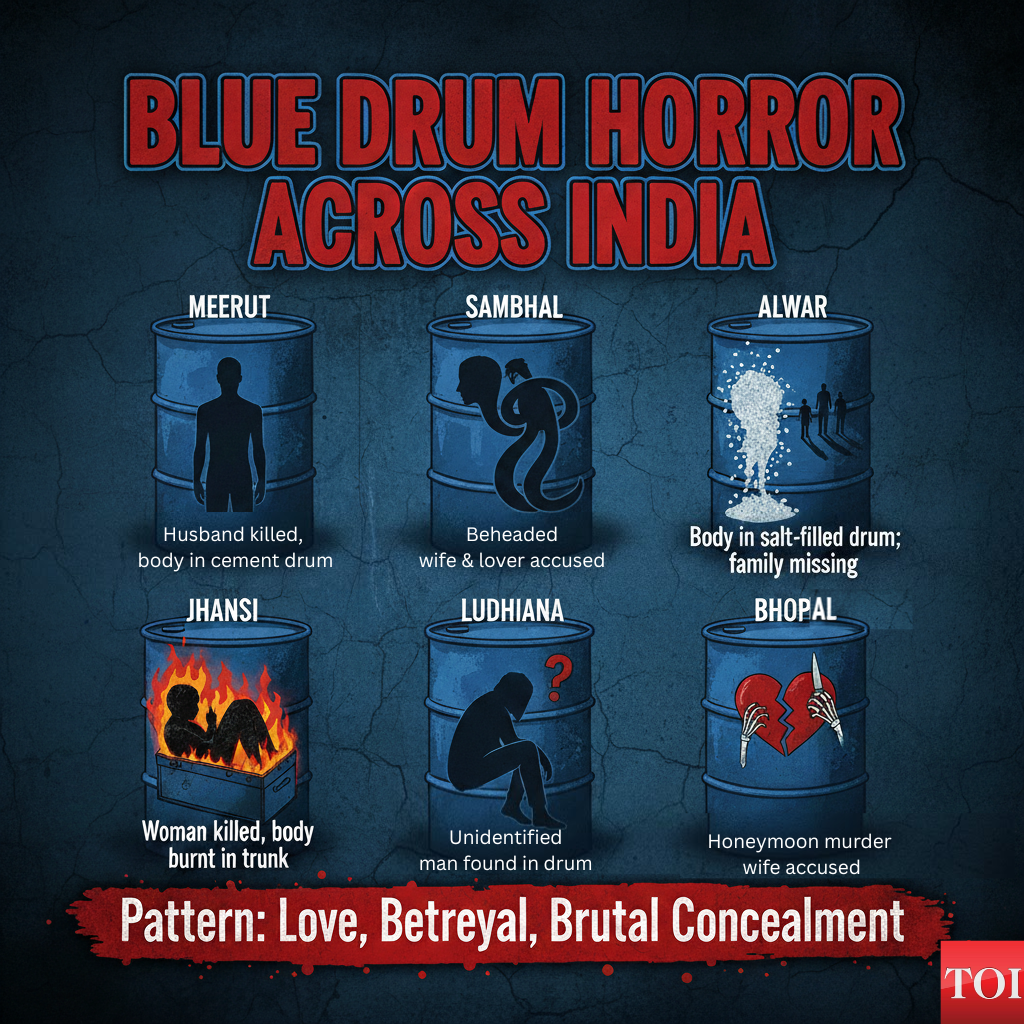
Muskan used Saurabh’s phone to send misleading messages to his family, suggesting he was in Shimla. She and Sahil themselves travelled there on March 5, returning 12 days later.The crime came to light only after Muskan confessed to her mother, Kavita Rastogi, who took her to the police.“Saurabh was mad for my daughter. He left his family just to marry her. He was like my son,” Kavita said. Sambhal: Déjà Vu in ChandausiIn Sambhal’s Chandausi town, police cracked another case marked by extreme brutality and deception.Rahul Kumar, a 32-year-old shoe trader, was allegedly murdered by his wife Ruby, 30, and her lover Gaurav Kumar, a neighbour. The crime took place on the night of November 17, 2025 after Rahul reportedly caught the two in a compromising position inside his house.Police said Rahul was first attacked, then his head was severed. Both hands and legs were chopped off, and the body parts dumped at different locations to delay identification.

Rahul Kumar, shoe trader
In a move investigators later described as calculated, Ruby filed a missing complaint the very next day, claiming her husband had disappeared.Sambhal SP Krishan Kant Bishnoi said, “The couple had been married for 12 years and have an 11-year-old son, who told cops that their parents used to fight over a man who frequently visited their house.”On December 15, police recovered a torso from a separate location. The limbs were missing. Days later, a polythene packet containing a human head was found in a drain. During examination, officers noticed the name “Rahul” inked on the chest, helping establish identity.The case immediately revived comparisons with the Meerut murder due to the dismemberment, spousal involvement and post-crime deception.Alwar: Salt, silence and a missing familyIn Rajasthan’s Khairthal-Tijara district, a foul smell led to the discovery of another body concealed in a blue drum — this time on the rooftop of a rented house in Kishangarh Bas.The deceased, Hansraj alias Suraj, around 35, had moved into the accommodation only six weeks earlier. He worked at a local brick kiln and had shifted from Shahjahanpur district in Uttar Pradesh.

Police said the body was covered with salt, allegedly to accelerate decomposition. Hansraj’s throat had been slit with a sharp weapon.Even more disturbing was what followed: Hansraj’s wife Sunita, their three children — Harshal, Nandini and Golu — and the landlord’s son Jitendra were all found missing.Khairthal-Tijara SP Manish Chaudhary said, “Hansraj was murdered and his body was placed in the drum with salt. This was a premeditated murder.”

Police revealed that Jitendra, whose wife had died 12 years earlier, frequently drank with Hansraj. Investigators are probing whether multiple people were involved and whether the family disappearance was part of a planned escape.Jhansi: Burnt remains, a son’s role, and a blue trunkIn Jhansi, police arrested Ram Singh, 62, a retired railway employee, for allegedly killing Preeti, 32, a woman he was in a relationship with.According to police, Ram Singh had a wife and another mistress, but developed a relationship with Preeti, whom he accommodated in a rented house. Frequent disputes over money allegedly triggered the murder.Police said Ram Singh killed Preeti and then burnt her body using wood and coal, allegedly with the help of his 16-year-old son. The remains were placed inside a large blue trunk.

The crime came to light when a loader driver hired to dispose of the trunk grew suspicious mid-way and alerted police. Inside the trunk were ash, charcoal and small fragments of burnt bones.Circle officer Laxmikant Gautam said, “The body had completely turned into ashes, except for a few parts of the bones.”Police also found a blue drum in the rented house, along with materials believed to have been used for burning the body.Ludhiana: Ragpickers Uncover Another Drum DeathIn Punjab’s Ludhiana, ragpickers stumbled upon a blue drum lying in a vacant plot in Sherpur area. When they tried to move it, a foul smell forced them to inform police.Inspector Kulwant Kaur said the drum contained the decomposed body of an unidentified man, around 40 years old. The limbs were tied with rope. The body was wrapped first in a bedsheet, then placed inside a plastic gunny bag before being stuffed into the drum.

Police believe the man had died at least two days earlier. A murder case was registered against unidentified accused, and efforts are underway to establish identity.Investigators acknowledged that the method bore resemblance to the Meerut case.Fear turns public: Protests and viral videosThe impact of the Meerut murder went beyond police investigations and crime scenes.In Bhopal, a 38-year-old man, Amit Kumar Sen from Gwalior, staged a protest holding a placard addressed to the chief minister, claiming his wife and her boyfriends could kill him.“She has cheated on me. She has killed my son. She can get me killed, too. Recently, many cases have come to light in the country where a wife, in collusion with her boyfriend, has had her husband murdered. My wife has three to four boyfriends.”
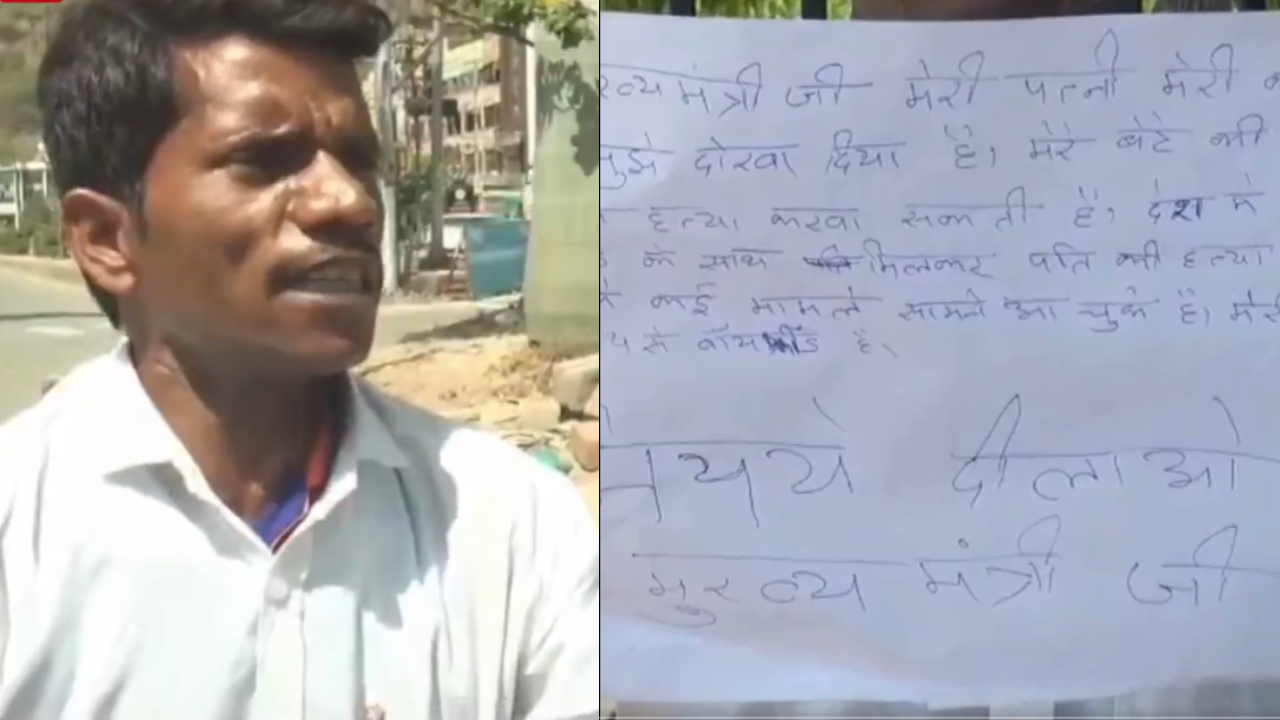
In Jhansi’s Mauranipur, a man named Pawan released a viral video alleging that his wife, a government school teacher, and her alleged lover — a local corporator — might kill him and his son and dump their bodies in a drum “like the Meerut case”.Police said complaints from both sides were under investigation.Why the ‘blue drum’ lingersWhile police caution against viewing these cases as a single trend, criminologists say certain factors recur: intimate relationships, third-party involvement, premeditation, and attempts to erase evidence through dismemberment or concealment.Psychiatrists note that such crimes often stem from emotional dependence, fear of separation, financial motives and a belief that murder is easier than escape through legal or social means.Former police officials point out that lovers frequently reassure the main accused that the law will not catch up, creating a dangerous sense of invincibility.A TOI analysis of news reports from March 1-June 12, 2025 revealed that 66 spousal murders have taken place. Of these, husbands killed their wives in 47 of the cases: stabbings, decapitations, beheadings and thrashings are common causes of death, with everything from rolling pins to pressure cookers used as weapons.

Their motives tend to be related to domestic disputes, domestic violence and alcoholism and, most commonly, infidelity, both suspected and real. Of the 19 reports of women killing their husbands, the vast majority included a third-party, most commonly the wife’s lover who was also involved in the crime. While most of the murders committed by men seem to be crimes of passion, the women seem more likely to pre-meditate killing.Psychiatrist Jyoti Kapoor says common motives for pre-meditated spousal homicides tend to be either financial, for survival or because of another relationship.“When you’re in a relationship and feel there is no alternative, there is a certain degree of helplessness. But this is a bad, irrational, unjustifiable coping mechanism. You use extreme methods to get something which you consider more important than someone’s life,” she says.“There’s an unhealthy dependence on this other person, like we saw in the Blue Drum case,” adds Kapoor.Meeran Chadha Borwankar, former Commissioner of Police, Pune, says the most common murder motive in marriages is infidelity.“But in live-in relationships, many times the inability to handle the situation leads to murder. For example, one partner insisting on marriage while the other is either married with spouse and family or is just not willing to formalise the live-in relationship,” she says.When asked about whether female killers are rising, she says, “In fact, they are still quite rare, thus getting media attention.”
Beyond sensation, towards accountabilityDespite the public fixation on the “blue drum”, experts warn against turning complex crimes into shorthand horror stories. While the method is striking, investigators stress that each case has distinct motives and circumstances.What remains undeniable, however, is the psychological imprint left by the Meerut murder. From Sambhal to Ludhiana, from Alwar to Jhansi, the blue drum has become a symbol — of betrayal inside homes, of violence masked as normalcy, and of how one crime can shape the narrative of many that follow.As investigations continue across states, police insist that justice will be determined by evidence, not echoes. But for now, the image of a sealed blue drum has etched itself into public memory — not as an object, but as a warning of how domestic relationships, when poisoned by deception and desperation, can end in unspeakable brutality.
About the Author