
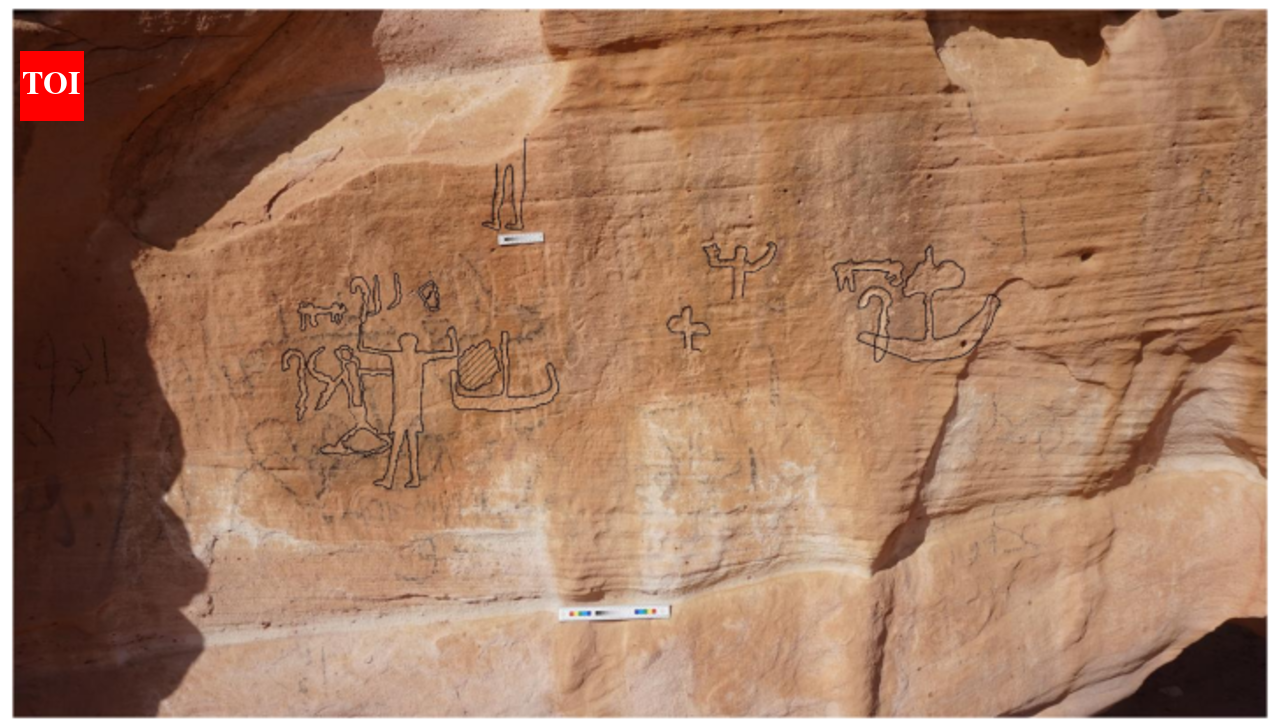
An early research paper focuses on the discovery of a very old rock carving in South Sinai, at a site called Wadi Khamila. The carving was found during archaeological surveys in 2025 and is being published for the first time. It dates to around 3000 BC and shows a clear scene of Egyptian dominance over the local population. This find adds an important new location to the known map of early Egyptian activity outside the Nile Valley.According to “Wadi Khamila, the god Min and the Beginning of „Pharaonic” Dominance in Sinai 5000 years ago” the rock panel shows a strong and simple image. One figure is carved striding forward with arms raised, a gesture that signals victory. In front of him is another figure, kneeling, with his arms tied behind his back and an arrow in his chest. Behind the standing figure is a boat. Together, these elements form a clear scene of control, defeat, and authority.
Evidence of early Egyptian colonisation found in Sinai rock art
The standing figure represents Egyptian power. He may depict an Egyptian ruler or possibly a god associated with control of borderlands. The kneeling figure represents the local people of Sinai, shown as defeated. This imagery was not meant to describe everyday life but to send a strong message about who held power in this region.Before this discovery, only three sites in south-western Sinai were known to contain similar Egyptian rock images from this early period. Wadi Khamila is now the fourth. This strengthens the argument that Egypt had an organised and purposeful presence in Sinai much earlier than previously assumed.
Egypt in Sinai and the meaning of the boat symbol
Egypt’s interest in Sinai was driven by resources. The region was rich in copper and turquoise, materials essential for tools, ornaments, and prestige. Egyptian expeditions travelled to Sinai seasonally to mine these resources. Over time, they carved Egyptian images and symbols into the landscape, marking the area as part of their sphere of influence.The boat carved behind the standing figure is an important detail. In early Egyptian art, boats often represent the ruler and the act of controlling territory. Even when a king is not named, the presence of a boat signals official authority and expansion by the Egyptian state.
Possible religious meaning
The raised-arm pose of the standing figure may link the image to the god Min. Min was associated with deserts, foreign lands, and mining expeditions. If the figure represents Min, the scene combines religion and politics, suggesting that Egyptian dominance was not only political but also divinely supported.
Real event or symbolic message
The researchers point out that it is difficult to know whether this scene records a real act of violence or follows a standard symbolic pattern used in Egyptian art. What matters most is the message it communicates. The carving clearly shows Egyptian control over the region, regardless of whether it depicts a specific event.
Condition of the panel and later use
The rock panel contains carvings from different periods. Some images were added later, including Nabataean and Arabic graffiti. Parts of the original scene were damaged or deliberately erased. This layered history shows that the rock remained meaningful long after the Egyptian period.
What this discovery tells us
Overall, the Wadi Khamila rock panel provides strong evidence of early Egyptian expansion into south-western Sinai. It links state power, resource extraction, religious symbolism, and visual propaganda in a single image carved more than five thousand years ago. The researchers believe many more discoveries remain in the area, and further study is planned.
About the Author