
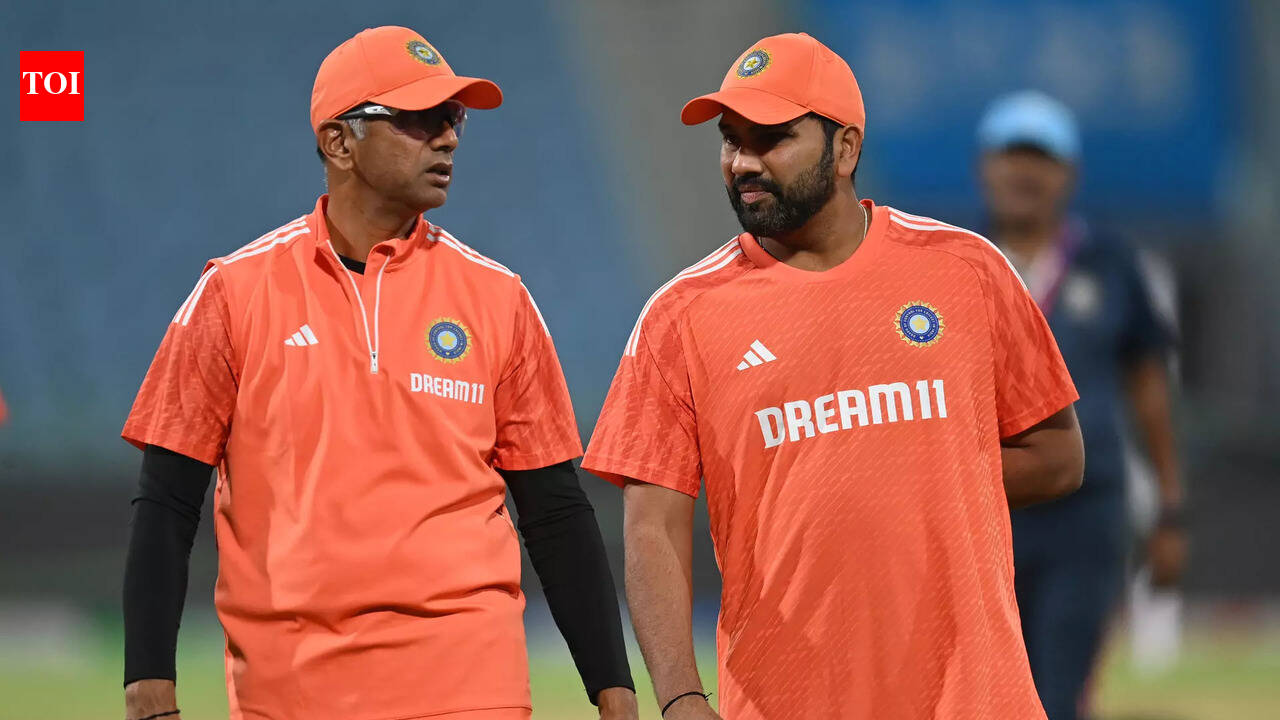

Bengaluru: Indian cricket legend Rahul Dravid says memories of India’s shock first-round exit from the 2007 World Cup in the Caribbean remain as vivid as the heartbreak of the 2003 World Cup final defeat — and the euphoria of the ICC T20 World Cup triumph that followed four years later. While Dravid endured early elimination as captain, his record as head coach at ICC events tells a different story. As India prepares to defend their T20 World Cup crown next month, the former India coach believes the team will head into the tournament as clear favourites.
“India are playing T20 cricket at a different level compared to most teams. They have had an 80% success rate over the last few years, which is remarkable in a format that comes with so many ups and downs,” Dravid said at a panel discussion during the launch of journalist R Kaushik’s book on Rohit Sharma. “They clearly start as favourites and should make the semifinals. But as I’ve learnt to my bitter disappointment, it’s about who is better on the day. Anyone can play a special knock and upset you.” Dravid underlined Rohit Sharma’s pivotal role in India’s white-ball resurgence, crediting the former skipper for leading the shift in mindset. “Earlier, there was a feeling that we were slightly behind in white-ball cricket and needed to push the envelope. Run rates were going up, risk-taking was increasing, and we had to adapt to that reality,” he said. “What was brilliant was that Rohit took the lead immediately. He took responsibility for setting the tempo himself, rather than asking others to do it.” Dravid said Rohit’s willingness to put the team above personal milestones made the transition seamless. “When your leader stands up and says, ‘I will do this even if it comes at the cost of my average or personal numbers,’ it becomes much easier to drive that message through the team,” he added. The former India captain also praised Rohit’s evolution as a leader. “I thought Rohit managed the transition into leadership really well. The team never felt that he had changed, and that’s a rare and important quality in a leader,” Dravid noted. Result-oriented pitches under scrutiny With renewed debate around pitch quality — especially after Australia wrapped up a 4-1 Ashes series at home with just 11 match days across five Tests — Dravid pointed to the pressure of World Test Championship points as a key factor behind increasingly result-oriented surfaces. “Every single Test match in the World Test Championship matters,” he said. “When every result counts, the importance of producing result-oriented wickets increases. In the past, when we played Test series in India, you were often looking at a 1-0 or 2-0 outcome in a three-match series. Draws were part of the equation. Today, the pressure on home teams to win every match has gone up significantly.”
About the Author


