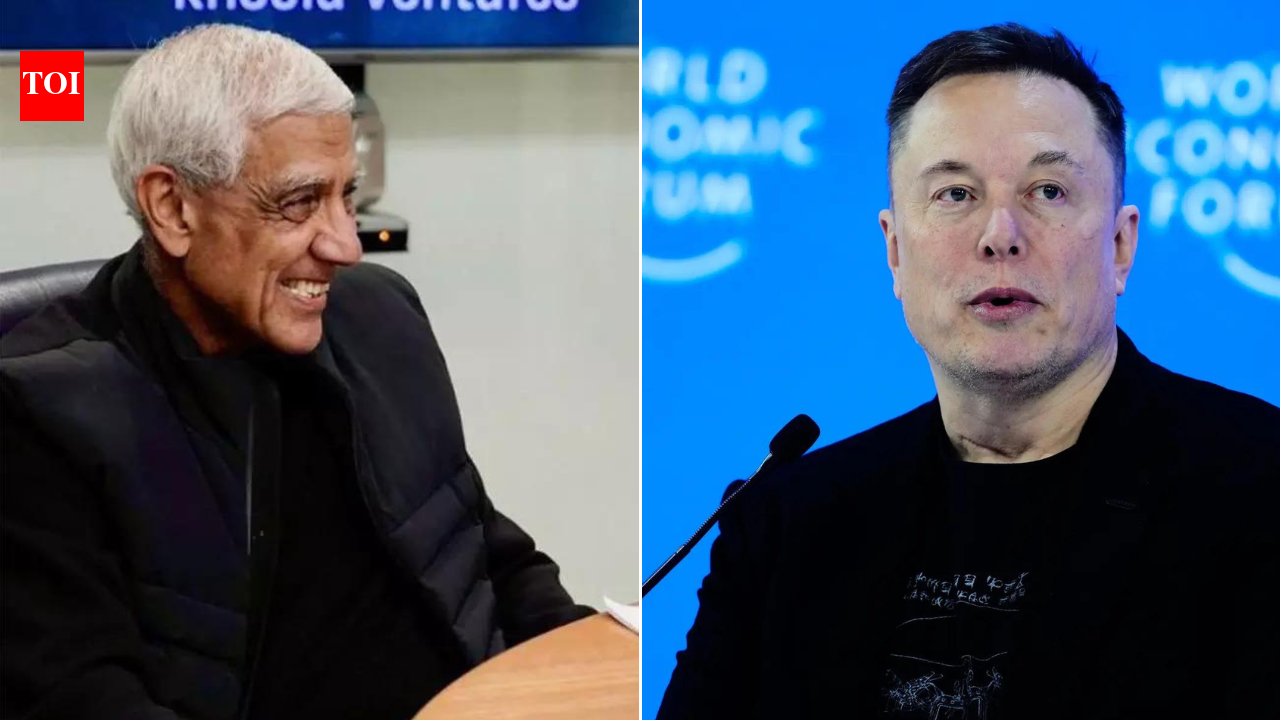
The TOI correspondent from Washington: Among Silicon Valley elites where tech titans have largely aligned with President Donald Trump’s purportedly race-driven MAGA vision, Indian-American venture capitalist Vinod Khosla has been an outlier. Exceptional as his opposition to Trump has been, the billionaire tech savant has set off a political and cultural firestorm this week with a blunt message aimed at MAGA maverick Elon Musk’s workforce: if you are a non-white employee at Tesla, SpaceX or X, you should quit — and come work for him instead.In a viral post on X, Khosla accused Musk of advancing a racially exclusionary version of Trump’s MAGA movement and urged employees who disagreed to walk away. “@elonmusk doesn’t want MAGA, he wants WAGA — ‘white America great again’ — as a ‘racism is great and desirable’ paradigm,” Khosla wrote, responding to Musk’s comments about white people becoming a “rapidly diminishing minority.” Khosla went on to invite “all non-whites… and all decent whites” at Musk’s companies to resign and send their LinkedIn profiles to Khosla Ventures. The extraordinary call — part political denunciation, part talent raid — crystallized Khosla’s position as one of the very few tech titans willing to openly challenge Trump’s growing alliance with Silicon Valley’s elite. While much of the industry – including companies like Google, Microsoft, and IBM, all led by Indian-Americans – has moved to accommodate, or even embrace, Trump II, Khosla has chosen defiance, framing the moment as a moral test for American capitalism.The Musk clash did not emerge in isolation. For months, Khosla has used his social media presence to attack Trump’s leadership, values and approach to governance. In January 2026, he described the administration’s agenda as “The Undoing Project,” accusing Trump of orchestrating a “rampant, multifarious attack on American values, norms, institutions, laws, and democracy.” He has warned that fear and cynicism are being used to silence opposition and has repeatedly urged Republicans, executives and investors to speak out.Khosla’s hostility toward Trump is deeply personal as well as political. An immigrant from India and a co-founder of Sun Microsystems, he has argued that Trump’s rhetoric and policies undermine the meritocratic ideals that powered Silicon Valley’s rise. In earlier posts that resurfaced during the 2024 election cycle, Khosla said he despised Trump for his “lack of values, his pathological lying, his selfishness,” accusing him of appealing to “the least appealing parts of American society.”That worldview now puts Khosla sharply at odds with the prevailing direction of the tech industry. A growing cohort of influential “tech bros” has signed up, explicitly or implicitly, for MAGA. Musk stands at the center of that universe, having donated heavily to Trump’s campaign and emerged as the president’s most powerful ally in Silicon Valley. Others in Trump’s orbit include PayPal co-founder Peter Thiel, investor and podcaster David Sacks, and venture capital heavyweights Marc Andreessen and Ben Horowitz, all of whom have praised Trump’s promises of deregulation, tax cuts and a lighter regulatory touch on artificial intelligence and crypto.Even executives who once positioned themselves as Trump skeptics have largely shifted to pragmatic cooperation. Leaders of Meta (Mark Zuckerberg), Amazon (Jeff Bezos), Apple (Tim Cook), Google (Sundar Pichai), Microsoft (Satya Nadella), and IBM (Arvind Krishna) have attended Trump events, increased political donations and pledged billions in US investments, while tech lobbying has surged to record levels. The calculation is straightforward: access, influence and regulatory relief outweigh ideological discomfort.By contrast, open opposition has become rare. Aside from Khosla, only a handful of prominent figures — including LinkedIn co-founder Reid Hoffman and entrepreneur Mark Cuban — have maintained public distance from Trump. While dozens of top venture capitalists now lean pro-Trump, outspoken critics can be counted on one hand.The divide carries consequences for tech workers, many of whom remain politically liberal even as their employers drift right. Over 450 employees from Google, Meta, Amazon, Apple, Microsoft, and OpenAI recently signed an open letter demanding their CEOs “pick up the phone” to stop ICE excesses. Khosla’s call for non-white employees to leave Musk’s companies is tapping into that tension, highlighting a widening gap between executive power and workforce values. As Trump settles deeper into his second term, Silicon Valley increasingly looks like a sector that has chosen alignment over resistance. Khosla, by contrast, is betting that dissent still matters — even if it leaves him standing nearly alone.
About the Author