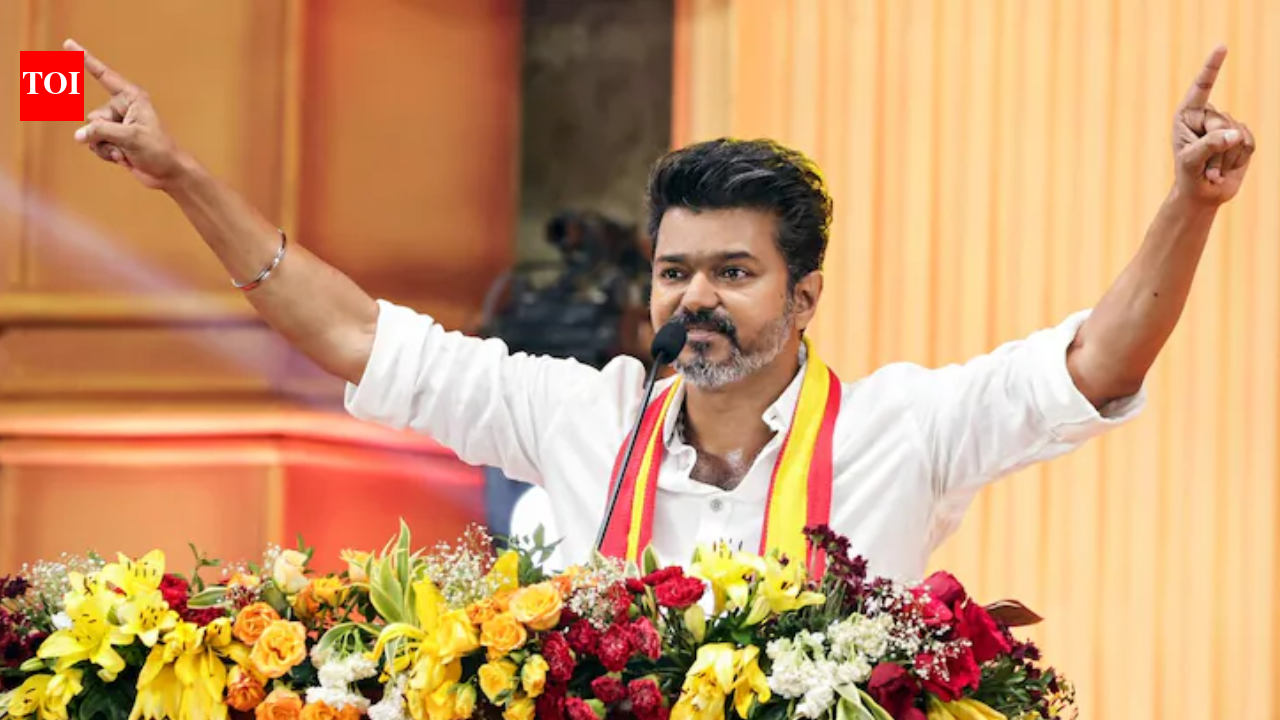
NEW DELHI: When Prashant Kishor entered Bihar’s electoral arena with Jan Suraaj, he set out to challenge the state’s entrenched caste politics with a different pitch — one centred on governance failures, migration and the promise of jobs. The message found an audience. The votes, however, did not follow.Kishor’s transition from celebrated strategist to politician fell short, highlighting just how hard it is for political outsiders to break through systems built on long-standing loyalties and social networks.As Tamil Nadu prepares for another assembly election, a familiar outsider story is taking shape once again. Actor Vijay Thalapathy has positioned himself as an alternative for the people in a state where politics, for a very long time, has revolved around the Dravida Munnetra Kashagan (DMK) and the All India Anna Dravida Munnetra Kazhagam (AIADMK).But will Vijay face the same fate as Prashant Kishor? There is one key difference. This is Tamil Nadu — a state where cinema does not merely entertain, but also governs.
Tamil Nadu politics’ tryst with cinema
Film stars are worshipped like gods in Tamil Nadu. Before the screening of their films, fans offer milk baths on towering cut-outs of these stars. Many stars even have temples across the state.This level of popularity could be one of the reasons that motivates these stars to pivot to politics and attempt to transform their fan base into a voter base. The best examples are M G Ramachandran and Jayalalithaa, who withdrew from active stardom and went on to occupy the top job in the state. While MGR served as chief minister of Tamil Nadu for more than a decade, Jayalalithaa was chief minister for over 14 years across six terms.Similarly, several other actors like Rajinikanth, Kamal Haasan, Sivaji Ganesan and Vijayakanth have experimented with politics and turned into full-time politicians.However, many stars were unable to convert their stardom into votes and fell flat during polls.Kamal Haasan launched his party – Makkal Needhi Maiam – in February 2018, positioning it as a centrist, non-Dravidian alternative to the DMK and AIADMK. However, in the 2019 Lok Sabha elections, the party failed to win a single seat. In the 2021 Tamil Nadu assembly elections, Kamal Haasan himself contested from Coimbatore South but lost to the BJP.Additionally, MNM could garner only a little over 2.6 per cent of the statewide vote, as per electoral records.In March 2024, MNM joined the DMK-led Secular Progressive Alliance ahead of the general elections, choosing alliance-building over ideological isolation. Haasan was subsequently offered a Rajya Sabha seat as part of the alliance’s power-sharing arrangement.Rajinikanth, too, had made a euphoric announcement to his fans that he would launch a political party, claiming that his outfit would contest all 234 assembly seats in the state.However, he soon made a U-turn and dropped the plan to take the plunge into politics, citing health concerns.“With extreme sadness, I say that I can’t enter politics. I alone know the pain I went through while announcing this decision,” Rajinikanth said in a three-page statement.“Without entering electoral politics, I will serve the people. This decision of mine will disappoint my fans and people, but please forgive me,” he added.
How Vijay is different from Rajinikanth and Kamal Haasan
Unlike Rajinikanth and Kamal Haasan, Vijay has decided to bid farewell to films after a long career spanning 33 years.His upcoming film Jana Nayagan (if released) would be his last.“Politics is not a time pass for me. It is a deep quest. I wish to immerse myself completely in politics. I have decided to dedicate myself entirely to the service of the people after completing my responsibilities towards one more film I have signed up for,” the 51-year-old Vijay said.Meanwhile, actors like Kamal Haasan and Vijayakanth had to face unfavourable electoral results after deciding to remain active in both films and politics.By stepping away from cinema altogether, Vijay is attempting to address a credibility gap that has historically hurt actor-politicians. Full-time political commitment — rather than episodic engagement between film releases — has often been a prerequisite for voter trust in Tamil Nadu, as demonstrated by stalwarts like MGR and Jayalalithaa in the state.
Can TVK convert fan frenzy into votes?
Ahead of the upcoming elections, TVK has been successful in pulling crowds. In October 2024, TVK drew over 8 lakh people during its first state conference in Vikravandi.Thousands of people attend Vijay’s rallies to hear him speak or catch a glimpse of him. The superstar has supporters across every class, gender and age group in different regions of Tamil Nadu.Unlike many film stars, Vijay’s supporters are organised and politically active. In the 2021 local body polls, his “fan club” candidates won 115 of the 169 seats they contested.Meanwhile, his fan clubs have also taken on the role of foot soldiers on social media and regularly conduct blood-donation camps, free medical check-ups, education support drives and disaster-relief work.Additionally, TVK has a significant social media presence. Vijay has claimed that his party has the largest social media force in India.“TVK’s social media army is the biggest in India — not just our claim, but what others are saying after witnessing it. You are no longer just fans on social media; you are TVK’s virtual warriors,” he had said.Yet, Tamil Nadu’s electoral history suggests that crowd mobilisation does not automatically translate into seat conversion. Booth-level organisation, caste arithmetic and alliance mathematics continue to play a decisive role — factors that even popular actors have struggled to master in their first electoral outings.After the Karur stampede, Vijay’s die-hard fans defended him and his party even after the top leadership of TVK went off the radar.
Ghost of the Karur stampede
However, Vijay and his party may also have to bear the brunt of the stampede in Karur, which claimed 41 lives. Both the AIADMK and DMK have pinned the blame on TVK functionaries and accused Vijay of mismanagement that allegedly led to chaos in September last year.Moreover, the CBI is also grilling Vijay over the stampede, taking up a significant chunk of his time that could otherwise have been used for pre-poll strategy or campaigning.On January 19, the central probing agency questioned the TVK chief for over six hours at its headquarters in New Delhi for the second time in connection with the stampede case.According to officials, several questions related to decision-making about the rally, reasons for his delay, continuation of the speech, his knowledge of the chaos, turnout and crowd mismanagement were put to him.The call on attributing responsibility to individuals in the chargesheet will be taken only after a thorough analysis of the statements of the actor, senior political officials of his party, and police and district administration officials involved in granting clearance and managing the rally, they said.Politically, the impact of the probe remains ambiguous. While rival parties have sought to frame the stampede as evidence of administrative inexperience, sections of Vijay’s support base view the investigation as pressure politics — a narrative that could either erode confidence or consolidate sympathy, depending on how the case unfolds closer to polling.
Possibilities for TVK
Since Independence — barring a brief stint of Congress rule — the chief minister’s post in Tamil Nadu has largely alternated between the two Dravidian parties — DMK and AIADMK. Vijay’s entry into state politics as a challenger has given voters a third option.At the same time, Vijay’s emergence has introduced new calculations for both the DMK and AIADMK. While the DMK appears wary of losing sections of its youth and urban vote, the AIADMK is closely watching whether TVK dents its traditional base or cuts deeper into the ruling party’s support.Amid reports that the BJP has been pressuring him to join the NDA — citing the CBI inquiry into the Karur stampede and the CBFC sitting on the certification of his film Jana Nayakan — Vijay has said he will not give in to any pressure.He said TVK would contest the assembly elections on its own and win if other parties chose not to align with it. “Unlike the party that ruled and the one that is ruling, we will not allow corruption … I won’t touch a paisa, you know that I don’t need to touch that,” Vijay said, asking his party functionaries and cadres to be as clean.Cleaning up the system cannot be done overnight, he said, adding, “It’s a process.”Even if TVK were to emerge only as the third-largest party, its presence could still alter Tamil Nadu’s political arithmetic. In a fractured mandate, a strong TVK showing could place Vijay in the role of a potential kingmaker — reshaping alliances and bargaining power within the state.In a tripartite contest, it will be interesting to see whether Vijay can emerge as a winner — or whether his entry ends up splitting votes to the advantage or disadvantage of the DMK or AIADMK.Just as the box office determines whether a film is a hit or a flop, election results will reveal whether Vijay succeeds or fails in his political endeavour.
About the Author