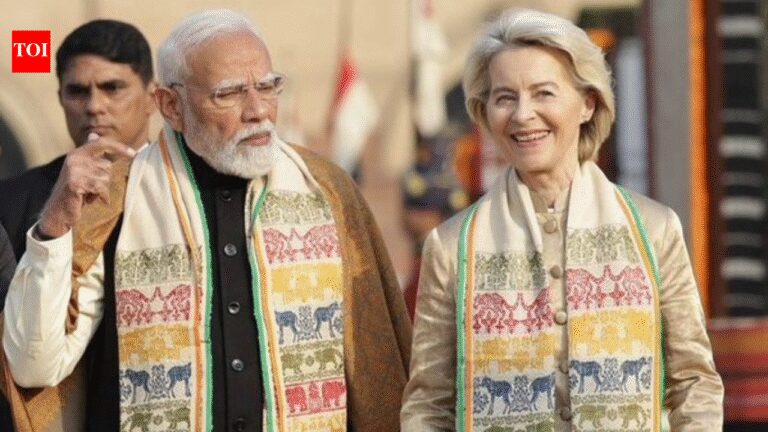
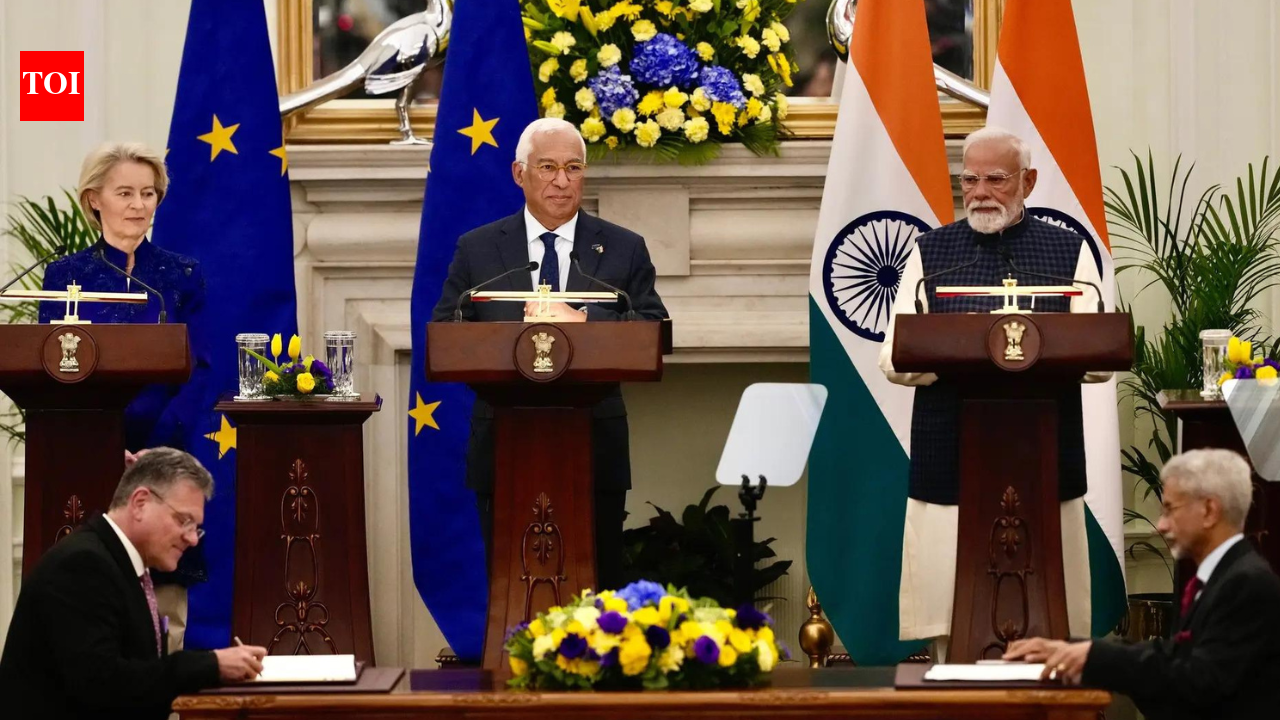
PM Modi, European Council President Antonio Costa and European Commission President Ursula von der Leyen watch as Jaishankar, and European Commission Commissioner for Trade and Economic Security Maros Sefcovic sign documents after reaching FTA
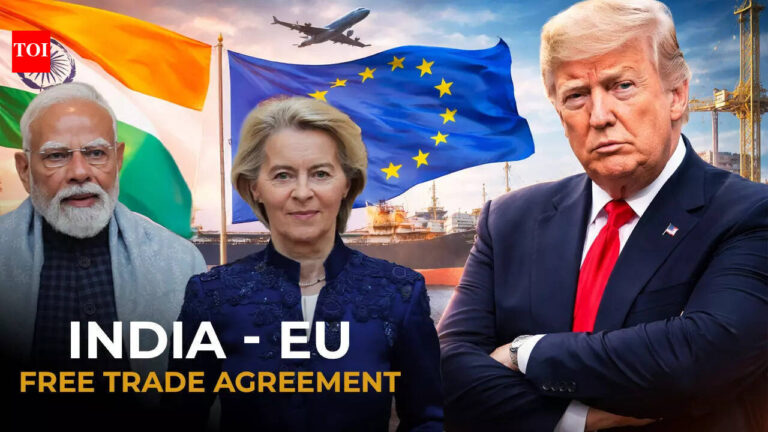
India and the European Union on Tuesday signed a document formally announcing the conclusion of negotiations for their long-awaited free trade agreement (FTA), but the deal itself has not yet been signed and will take several more months to be finalised and implemented.The announcement was made during the India-EU Summit in New Delhi, attended by European Commission President Ursula von der Leyen and European Council President Antonio Costa, who held talks with Prime Minister Narendra Modi.
What was signed is a procedural document marking the conclusion of negotiations, not the legal text of the trade pact.
Legal scrubbing
The final agreement will now undergo “legal scrubbing”, which is a detailed technical and legal review by both sides, a process expected to take at least five to six months.Over the next two weeks, negotiators will prepare a cleaner, consolidated version of the text before it is sent for legal vetting which will take at least 5-6 months, according to officials. Only after this process is completed can the FTA be formally signed.Even after signing, the agreement will still require ratification before it can come into force. In India, the deal will need approval from the Union Cabinet. On the European side, it must be cleared by the European Parliament, a process that could take additional time.Officials indicated that while the agreement could be signed later this year, it is more likely to be implemented in early 2027, depending on how quickly the ratification procedures move on both sides.Prime Minister Narendra Modi, speaking earlier at India Energy Week, hailed the pact as the “mother of all deals” and said it would open up major opportunities for both India and the European Union. However, trade experts noted that Tuesday’s development represents a milestone in negotiations rather than the legal entry into force of the FTA.The India-EU trade negotiations were first launched in 2007, stalled for several years, and were relaunched in 2022 before concluding this week.
What’s the process now?
As the document marking conclusion of pact is signed, here are the steps the EU still needs to take, according to the European Commission1. Publish negotiated draft texts2. Legal revision and translation into all official EU languages3. Propose the agreement to the Council for the signature and conclusion4. Adoption by the Council5. Signing of the agreement between the EU and India6. European Parliament’s agreement to the deal7. The Council’s decision on concluding the deal (essentially allowing it to enter into force)Once India also ratifies the Agreement, it can enter into force, said the commission in a list of FAQs released.
‘Mother of all trade deals’ sealed
India and the European Union have concluded negotiations on a landmark free trade agreement being hailed as the “mother of all deals,” marking one of the most significant economic partnerships for both sides. The pact is expected to sharply expand market access. For India, it promises duty-free or reduced-tariff access for key labour-intensive exports such as textiles, apparel, leather goods, marine products, gems and jewellery and engineering goods, helping boost jobs and MSME growth. Indian services firms are also likely to gain better opportunities in sectors such as IT, consulting and professional services.For the EU, the deal will lower or remove tariffs on a wide range of exports to India, including machinery, chemicals, medical equipment, processed foods and beverages, and possibly automobiles over time. Both sides also aim to strengthen supply chains, promote clean technology cooperation and increase investment flows.
About the Author