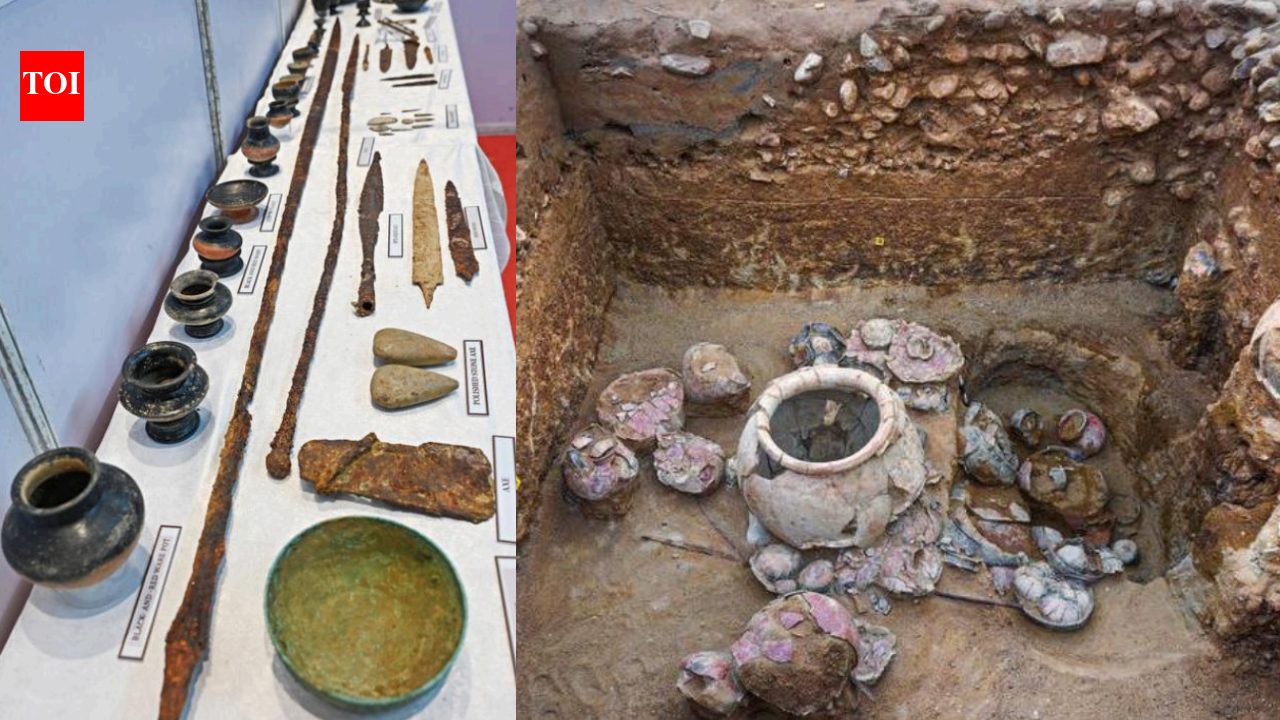
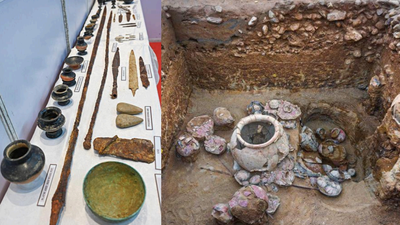
CHENNAI: An ancient warrior could have used this iron spear to protect cattle and wealth from enemies, or it could have been a ceremonial piece smelted for a powerful person and buried with him.After getting the oldest Iron Age date (3,345 BCE) from Sivagalai in Tuticorin, archaeologists from Tamil Nadu have unearthed an 8ft long iron spear from Thirumalapuram, about 80km away. Experts told TOI this is the longest iron implement from the Iron Age discovered in India so far.Archaeologists also found a second spear of shorter length. “We found two spears placed in an ‘X’ formation next to an urn. One was 8ft long and the other 6.5ft. There were also gold objects inside the urn,” said K Vasanthakumar, who excavated the site. The longer spear is slightly rounded at one end, indicating ease of holding.“It might have been used by ancient warriors, as such burial sites have thrown up several weapon-grade objects such as daggers, swords, knives, and spears,” said Vibha Tripathi, an Iron Age expert and retired professor of archaeology at Banaras Hindu University. “They might have also buried them underground, inside a chamber. Preservation of iron is much better here than in other parts of the country. In the Gangetic plains, the soil is moist, making iron corrode faster, so much that sometimes we get only an impression of iron,” she added.R K Mohanty, former professor in protoand ancient Indian history, department of archaeology, Deccan College, Pune, said the longest spear could have been a customised piece for ceremonial purposes. “It might have been made to show the social status and position of the person buried in the urn,” he said.Tripathi and Mohanty urged the TN state department of archaeology to conduct more studies to learn about the evolution of iron use in the region to gain global acceptance for the finding. “It takes high temperatures of 1,200°C to 1,500°C to smelt iron. We should expand the studies to other sites within the region and outside Tamil Nadu,” Mohanty said.“ It is the technological expression of that period. The iron product was in existence in Tamil Nadu between 3000 BCE and 2500 BCE,” said K Rajan, academic and research adviser to the TN state department of archaeology. “In two years, the department, in partnership with department of metallurgy at IIT Gandhinagar, will conduct a study of various iron age sites across the state to track the evolution of iron technology,” said R Sivanandam, joint director of TN state department of archaeology.
About the Author