
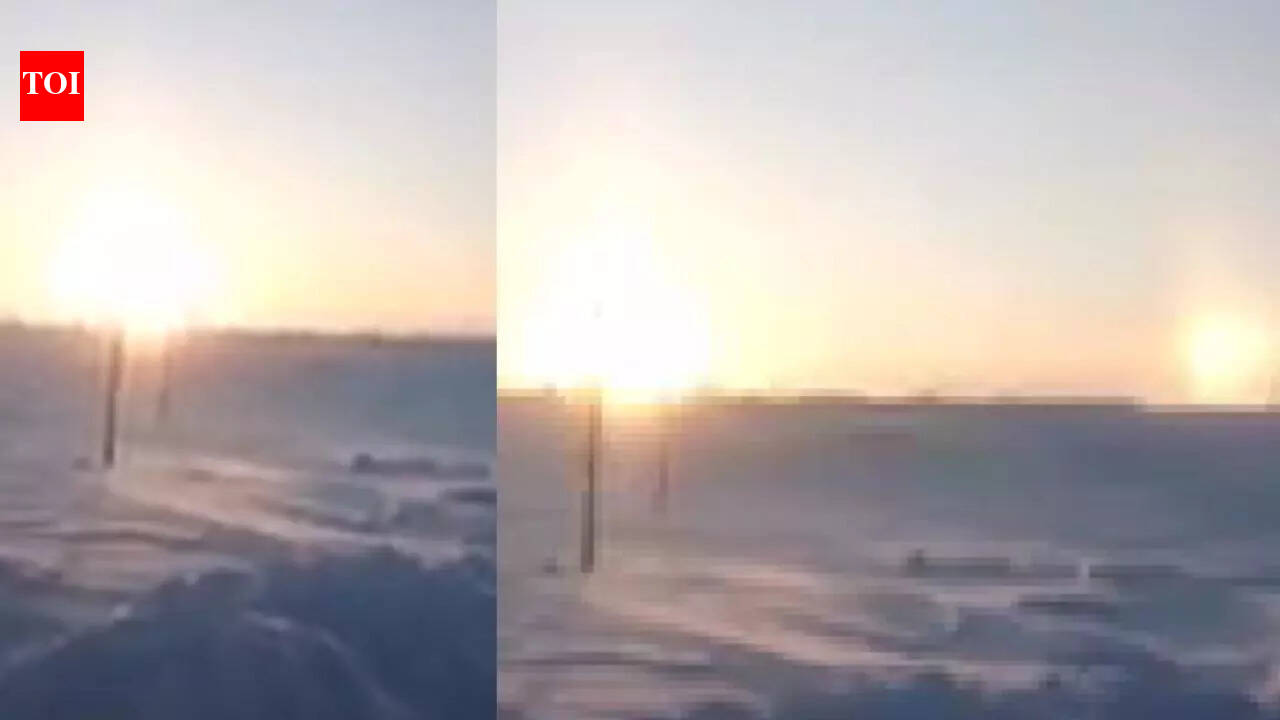
Residents of Russia’s Sakhalin region were treated to a surreal sight recently: what looked like two suns rising side by side in the morning sky. The breathtaking view quickly went viral on social media, but it’s not some sort of celestial aberration-it’s an atmospheric optical phenomenon known as a sundog. Sundogs, also referred to as mock suns or parhelia, form when sunlight intersects with hexagonal ice crystals that hang suspended in the atmosphere, most commonly in high cirrus clouds or as diamond dust under extremely cold conditions. When the sun’s rays pass through and are refracted by such crystals, they create bright, often colorful spots flanking the real Sun. Though unusual and striking for the ordinary observer, sundogs are well-known to scientists, offering a stunning demonstration of the ways in which light and ice can transform the sky for a time.
Understanding Sundogs: When ‘two suns’ appeared in the sky over Russia
Sundogs, which can also be called mock suns or parhelia, can be perceived as a series of colorful light phenomena appearing adjacent to the Sun. They can form at either side, or in some cases, at both, which is why sundogs can appear as though there is more than one Sun. The literal translation of “parhelia” is beside the Sun, which is a fitting description of sundogs. This is due to the two words from which this term is composed: the prefix ‘para’, which means beside, and ‘helios’, which means Sun.Sundogs, in fact, are associated with other optical effects such as the Sun halo and the Moon halo. In fact, all of these are associated with the refraction and diffraction of sunlight by ice crystals in the atmosphere.
How Sundogs form : Science behind the illusion
At the core of every sundog are always ice crystals in flat, hexagonal forms lofted high in the atmosphere, in cirrus or cirrostratus clouds at an altitude of anywhere from 20,000 to 40,000 feet. However, in very cold climates, ice crystals also occur in “diamond dust” forms at lower altitudes when the temperature plummets below minus 30 degrees Celsius.Generally, the flat, plate-like crystals are aligned horizontally as they fall, with a little wobbling because of the currents of air. If the rays of sunlight enter the crystal at one face and then exit at the other at an angle of 60 degrees, then the rays are subject to refraction twice. This bends the rays at an angle of at least 22 degrees, accounting for the fact that sundogs are at the same height above the horizon as the Sun.Usually, if there is a concentration of light within a bright spot as opposed to a full circle, this is referred to as two sundogs, which can even take on the demeanor and allure referred to as “false suns” accompanying the true sun itself, as a result of this geometric wonder.
Colours, shapes, and the physics behind sundogs
The sundogs are not typically bright white, though often tinted with a pretty color that occurs as a result of a phenomenon involving the diffused light of the sun. The area closest to the sun often displays shades of red, which deepen to orange and then yellow, graduating into blue around the edges. There are different refractions of light with different wavelengths, with red light, having a larger wavelength, bending less than blue light to create a sideways rainbow effect of ROY G.BIV.The size and shape of sundogs can differ depending on their crystal size and wobbles. The size of crystals can be substantial, which causes them to wobble while they are in a fall, extending sundogs during this time. On other occasions, they can combine in parts of a complete 22° halo, which makes them less prominent but ethereal.
Origins of the term “Sundog”
The name ‘sundog’ for this phenomenon seems to have mythological, rather than scientific, origins. The old world viewed this as the brilliant spots being followed by the sun, as a dog is supposed to follow its owner. In Greek mythology, the sky god Zeus was said to travel across the sky with two dogs, and they were referred to as ‘false suns,’ signifying their glow.The technical term, “parhelia,” consists of “para” which means “with” and “helio” which means “Sun,” which literally describes a parhelion “with the Sun.” The attractive and colorful term “sundog” eventually became a popular term to describe a parhelion.
Ideal conditions for observing sundogs
While sundogs can happen anywhere in the world at any time when the Sun is above the horizon, their visibility depends on specific conditions. A low Sun-almost during sunrise or sunset-is enhancing because light passes through ice crystals at a shallower angle, resulting in more pronounced bright spots.Cold weather also plays a significant role. In sub-zero temperatures, especially during winters at higher latitudes, there is a greater possibility of the atmosphere containing the hexagonal ice crystals required for producing sundogs. Thus, Sakhalin hosts ideal weather for watching this rare optical illusion in cold winters.
Historical and scientific significance
Before the scientific theories of the refraction and dispersion of light, sundogs gave birth to several myths and legends. Sundogs have also been viewed as omens, the signs of the divine, or the companions of the Sun. But with experiments conducted by the pioneer, Sir Isaac Newton, to show us the exact reasons behind sundogs, we have an in-depth scientific knowledge.The recent display from Sakhalin serves as a noteworthy reminder that even “ordinary” sunlight, in its encounter with nature in certain forms, often results in “extraordinary” optical phenomena. One appreciates here the beauty in optical phenomena in nature in connection with their interrelation with light in its various forms.
About the Author