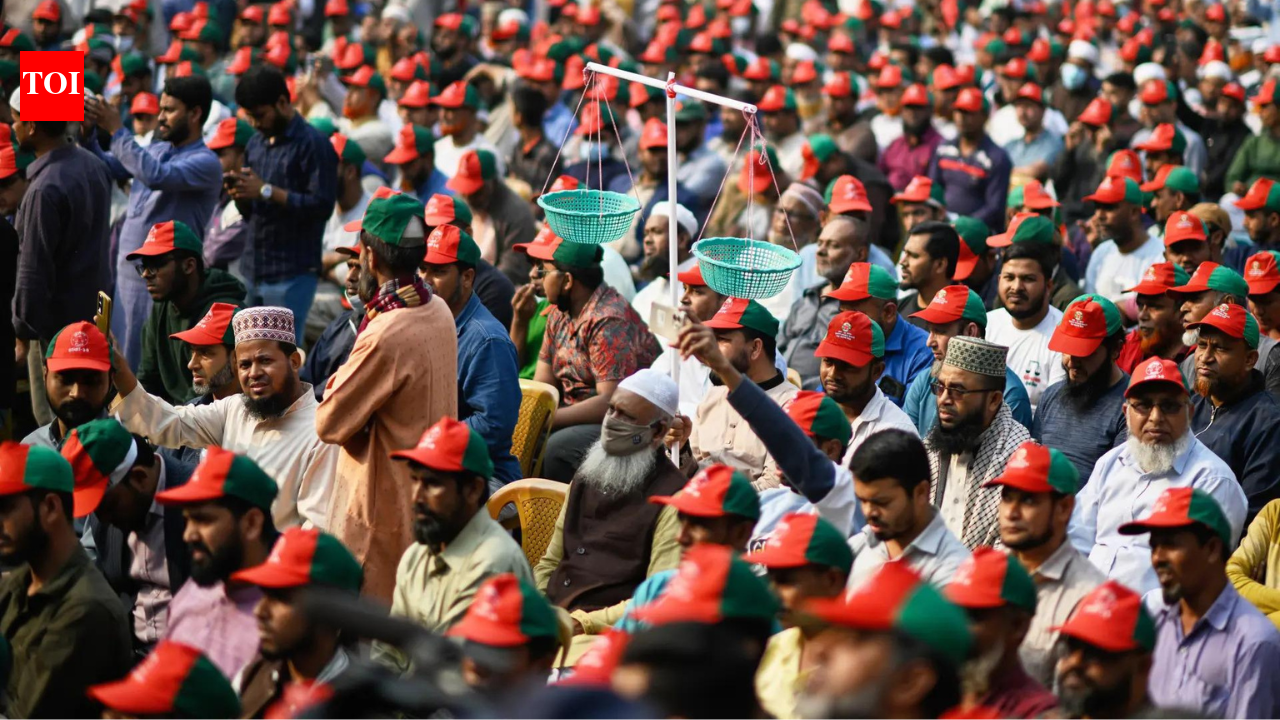
Supporters of Bangladesh’s Jamaat-e-Islami Party attend an election campaign rally (File photo: AP)
The United States wants to be “friends” with Jamaat-e-Islami, a party that has historically been anti-India and opposed Bangladesh’s 1971 liberation.According to a Washington Post report, US embassy officials in Bangladesh recently met Jamaat-e-Islami leaders at the party’s Sylhet regional office, marking the latest in a series of contacts between the US State Department and Islamist groups ahead of Bangladesh’s February elections.
“We want them to be our friends,” the report cited a US diplomat saying during an interaction with the local press.The US embassy, however, dismissed the claim that the States supported any “particular party” in Dhaka.“The conversation that took place in December was a routine gathering, off-the-record discussion between US Embassy officials and local journalists. Numerous political parties were discussed. The United States does not favour one political party over another and plans to work with whichever government is elected by the Bangladeshi people,” the Post cited spokesperson for the US Embassy in Dhaka, Monica Shie, saying.
US engagement with Jamaat
US engagement with Jamaat-e-Islami has steadily expanded over the past two years, beginning in 2023 when a US diplomat met a senior Jamaat leader in Dhaka on the eve of violent protests against Sheikh Hasina’s government. The outreach accelerated in 2025. In March, two former US ambassadors visited Jamaat’s headquarters, in June, the party was invited to the US embassy for discussions on internal governance and its stated positions on women’s and minority rights, and in July, the chargé d’affaires Traci Anne Jacobson met Jamaat chief Shafiqur Rahman at the party’s headquarters. Despite Rahman’s record of extremist rhetoric, including praising Hamas leader Yahya Sinwar and making openly antisemitic remarks, the US granted him a visa in November 2025, underscoring Washington’s growing willingness to engage the Islamist group ahead of Bangladesh’s elections.
What it means for India?
With the ban on Awami League, the only pro-India force, and her chief sitting in India, the picture doesn’t look promising for New Delhi. The anti-India sentiments have already manifested in the rise in crime against minorities, especially Hindus recently.In the Awami League’s absence, three forces are likely to dominate the polls: the Bangladesh Nationalist Party (BNP), the Islamist Jamaat-e-Islami (JI), and the National Citizen Party (NCP), which emerged from the 2024 student movement. Together, these groups are expected to shape the outcome of the 2026 elections.The concern is, no matter which party wins, its ties with India will remain a rocky path.A Jamaat-e-Islami (JI) win would worry India because the party is historically anti-India and opposed Bangladesh’s 1971 liberation, making it unlikely to sustain close ties with New Delhi. Jamaat could push Bangladesh to diversify away from India, including towards China or Pakistan on defence and infrastructure. Despite softer public messaging, its core ideology remains anti-secular, and its organisational strength, shown by its student wing’s Dhaka University poll win in 2025, makes it a clear security concern for India.A BNP victory, meanwhile, might mean a cooler but pragmatic relationship with India. The party has rebuilt after skipping the 2024 polls, nominated candidates for 237 seats, and is campaigning on “Bangladeshi nationalism,” often tapping into “India Out” sentiment and a tougher sovereignty-first stance. However, BNP has shown willingness to engage pragmatically on trade and security, with recent goodwill exchanges such as its positive response to PM Modi’s message on Khaleda Zia’s health.The NCP grew out of the 2024 student movement as a youth-led, reformist alternative to Bangladesh’s traditional party duopoly, led by figures like Nahid Islam, who played a central role in protests against Hasina and later joined the interim government under Muhammad Yunus as an adviser after her ouster. Its relations with India have only worsened.Bangladesh has been demanding the return of ousted PM Sheikh Hasina, who fled to India last year following violent protests in the South Asian nation.The two nations, since then, have had a tumultuous relationship, with both temporarily suspending visa services citing security concerns recently.What has infuriated the nation more is the repeated criticism by Sheikh Hasina from India, who has placed full responsibility for Bangladesh’s turmoil on Yunus. She has accused the interim administration of emboldening extremist elements, failing to safeguard minorities, and weakening ties with New Delhi. She has alleged that radical groups were using Yunus to steer foreign policy without public consent, asserting that relations with India could stabilise only once legitimate governance was reinstated. Hasina has been convicted of “crimes against humanity” and has been sentenced to death by a Dhaka court. A report by the UN human rights office estimated that as many as 1,400 people died between July 15 and August 15 during the “July Uprising,” following a sweeping security crackdown ordered by her government.
About the Author