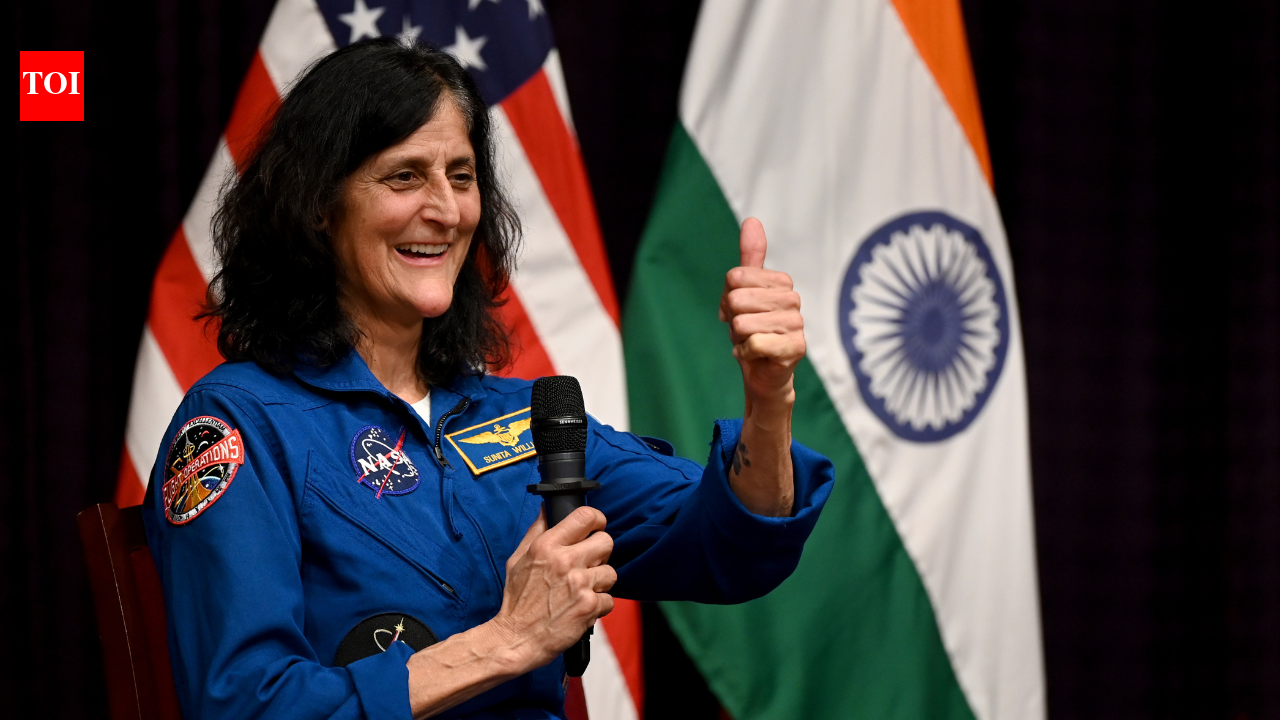
NEW DELHI: “When I reached International Space Station for the first time, the first thing I did was to locate India (on Earth), from where my father belonged to, and Slovenia, from where my mother belonged,” said Indian American astronaut Sunita Williams in Delhi on Tuesday — the only female astronaut who has set the world record for most cumulative spacewalking time by a woman with a total of 62 hours and 6 minutes. During her lifetime, Williams went to space three times as a Nasa astronaut, totalling 608 days in space.Williams’s father, Deepak Pandya, is from Jhulasan village in Gujarat’s Mehsana district, where he was born before migrating to the US. Her mother, Ursuline Bonnie Pandya, is of Slovenian-American descent. Nicknamed ‘Suni’ or ‘Soncka’ in Slovenia, Williams was born in the US state of Ohio and has an elder brother, Jay Thomas, and a sister, Dina Ann.“Though I spent nine months in space during my latest trip to the ISS, I missed meeting Group Captain Subhanshu Shukla who reached the station just after I left,” Williams said during an interactive session, ‘Eyes on the Stars, Feet on the Ground’ at American Center here. During her last trip to space before hanging her astronaut suit, Williams went to ISS in 2024 for a scheduled 8-day space trip but had to spend 9 months on ISS as the Boeing Starliner that took her to ISS malfunctioned and had to return empty-handed. Later, SpaceX’s Dragon brought Williams and her crewmate Butch Wilmore back to Earth on March 18, 2025, with the duo ending up spending 286 days in space. India’s Group Capt Shukla went to space as part of the Axiom mission on June 25, 2025.Williams faced several health issues after returning to Earth after remaining in zero gravity for a long time. However, the 60-year-old was seen in high spirits in Delhi on Tuesday, guiding and inspiring Indian students to join the space sector. To cheer her at the Delhi event was the mother of another Indian-American astronaut, Kalpana Chawla, who died in the Space Shuttle Columbia crash in 2003. Williams, wearing a trademark deep blue space overalls and sporting a pair of space-themed canvas shoes, stepped off the dais and reached out to Chawla’s mother, Sanyogita Chawla, 90, who was sitting in the front row, and gave her a warm hug.When asked about the renewed global interest in the Moon, Williams acknowledged the existence of a modern “space race”. “I think there is a space race going on. We want to get back to the moon sustainably and start the conversation about rules of engagement— how we actually work together with other countries. We want to do this in a productive, democratic way, much like Antarctica,” she said.Williams asserted that the horizon of space exploration is rapidly expanding beyond traditional boundaries, stating that the commercialisation of space is creating unprecedented opportunities for innovation. “Commercialisation of space is great. It means there are opportunities for people to work in so many different companies— not only rockets and spacecraft, but parts of space, experiments, satellites, and 3D printing of metals,” she said.“In my childhood, I never dreamt of becoming an astronaut. We used to watch Star Trek on black & white TV. After I did my schooling and graduated, my brother pushed me to join the military and, thereafter, I became a Navy officer,” she said. Williams had logged more than 3,000 flight hours in more than 30 types of aircraft during her career in the US Navy before donning the astronaut suit. While flying aircraft as a Navy commander, I then wished that I should go to the Moon. From then on, I pursued the career of an astronaut,” Williams recalled.
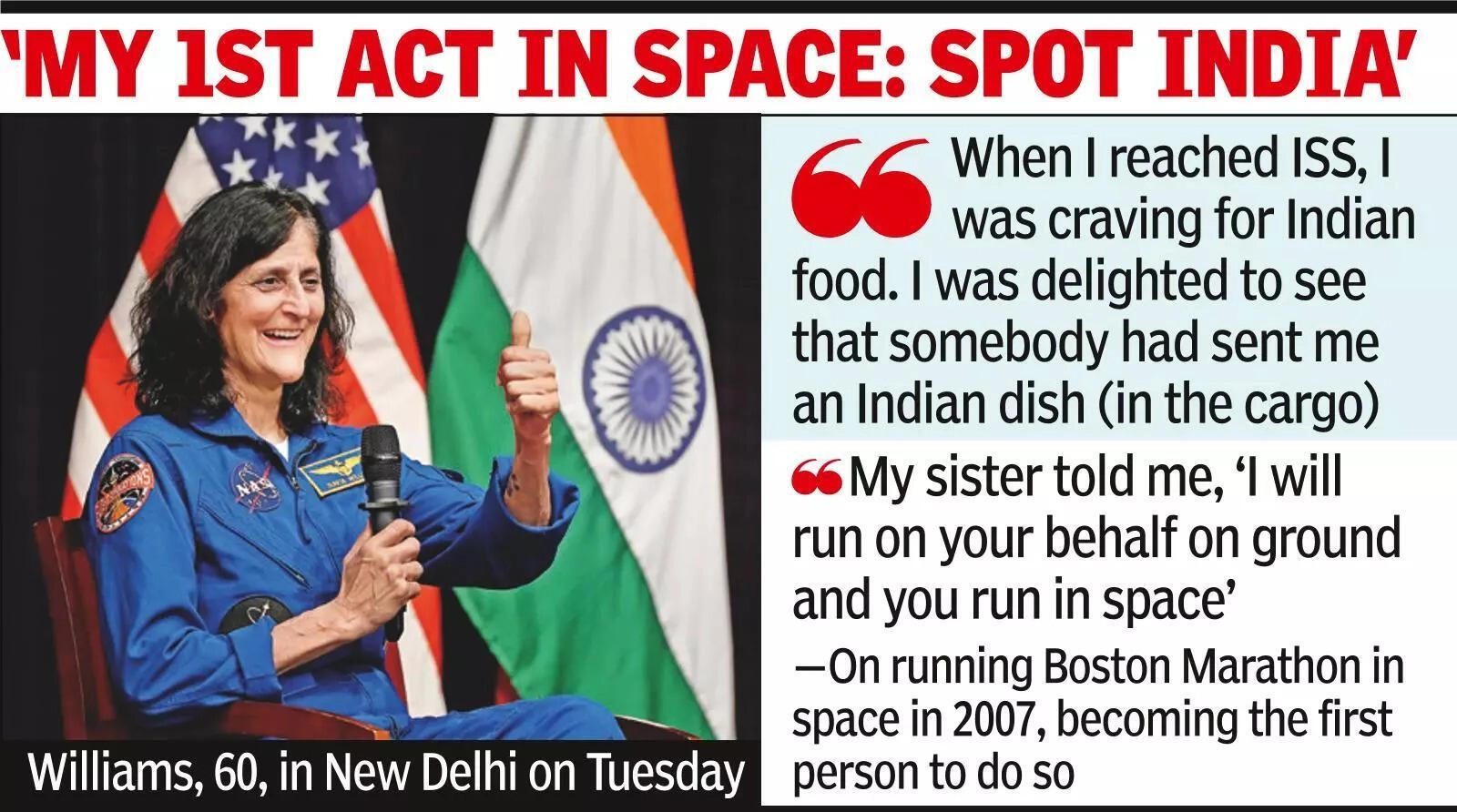
“When I reached the ISS, I was craving for Indian food. I was delighted to see that somebody sent me an Indian dish (in the food cargo) though others were making faces. I was glad to also receive 3D printed models of my dogs on ISS.” In Nasa circles, Williams was called the ‘samosa astronaut’, as she liked carrying samosas to space.An athlete since childhood, Williams wanted to participate in a marathon. “So, my sister told me, ‘I will run on your behalf on the ground and you run in space. So that is how I decided to run a marathon in space,” she revealed. Williams ran the Boston Marathon in space in 2007 after qualifying by running the Houston Marathon in 2006, marking the first time a marathon was completed in orbit. She ran on a treadmill aboard the ISS, finishing in 4 hours and 24 minutes while her sister and others ran on Earth.Recalling her most difficult space job, Williams said she went for a spacewalk after the Starliner faced a technical issue and returned to Earth and the Dragon spacecraft was docking at ISS. “While I was replacing a defected reflector, I had ensured that the Dragon capsule was not damaged with my steel helmet. So, I did the job of replacing the reflector by bending my head on one side for over 1.5 hours. After I returned to my space cabin, I faced neck cramps the whole time.” Williams, during her extended 9-month stay on ISS, conducted along with her crew over 150 scientific experiments and technological demonstrations, accumulating more than 900 hours of research across various fields like space gardening, microgravity biology, and water recovery systems.The Nasa astronaut said the perception about life on Earth changes when people go to space. “I am married and I argue with my husband like other couples do. But after reaching space (seeing the vast expanse of universe), I used to wonder why we argue (on minor issues) at all,” she said, adding, “The first thing I ate after returning to Earth was the bread my husband baked for me.”
About the Author