
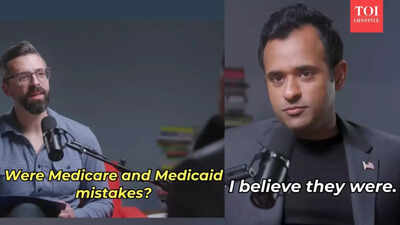
A short clip shared on social media this week has reignited the perennial American debate over government-run health care programs after Republican political figure Vivek Ramaswamy appeared to agree with interviewer Ezra Klein that Medicare and Medicaid were “mistakes,” particularly Medicaid. The moment, captured and amplified by MeidasTouch on X (formerly Twitter), quickly spread across platforms, provoking intense online debate from both critics and supporters.In the viral exchange, first circulated in an X clip credited by The Downballot, Klein posed a question about the legacy of the two largest federal health insurance systems in the US, asking whether they were mistakes. Ramaswamy responded that with hindsight, he believed they were, singling out Medicaid as a program he would view critically. The brief statement touched off a wave of reactions, with commentators across the political spectrum engaging on the topic.
What Vivek Ramaswamy said
When asked were Medicare and Medicaid mistakes, Ramaswamy said, “I believe they were, with the benefit of retrospect, particularly Medicaid, particularly the welfare state, without work attachments attached to it. Medicare and Social Security I put in a different category, which we can get to later and I think is a little bit orthogonal to the discussion, certainly that I’m most interested in having that I think is on the money right now.”Klein asked why are they in a different category and Ramaswamy answered, “I think that Social Security, I mean, you kind of had the real, my real issue there is if we’d ever actually taken advantage of the surplus that we had, it’s a bit more mechanical issue that if you just allowed for the surplus to be invested at rates of normally normalised returns of the stock market or diversified portfolio, we’d have a far excess surplus that would be sustaining itself. So it was you pay in, you pay out versus having a redistributionist quality to it versus what I think of as the welfare state. My principle issue with it is that it actually, I think the evidence would show, in my opinion, that it has harmed the very people that it was created to actually help.”He added, “But my core focus actually, even in my presidential campaign, had been less taking aim at that, though I do think that that’s a project we have to come back to, but was to take aim at at least the regulatory state that was a close cousin of that state. And I think basically what happened in the 60s is we traded off our sovereignty for this stuff. And I think the problem we’re basically going to run into as a country is eventually that stuff is going to run out in the form of our national debt crisis and we’re left with neither sovereignty nor stuff. And I think this should be the central focus and concern of the conservative movement, which is not quite today. That brings me back to this distinction between the national protectionist and the national libertarian camps of the America First movement. And the irony is I’ve made the case for the more national libertarian strain, let’s just say in recent months, in a more pronounced way in particular.”Talking about one of the criticisms he has received on “a reversion to a kind of neoconservatism or neoliberalism”, Ramaswamy said, “My sort of retort back to that, and this is at the bleeding edge of America First debates right now, is that actually the America First wing, the protectionist wing’s acceptance of the big state, is actually the permanent codification of the neoconservative premise that rejected the classical conservatism that was hostile to the existence of the nanny state in the first place. How many conservatisms can dance on the head of this particular panel? Yeah, I was used to doing an etymology and lexicons, so I feel like we’re using too many terms. But hold on the terms for a minute.”
What Ramaswamy’s comment means in a broader context
Ramaswamy’s critique is not entirely out of step with broader philosophies in conservative circles that advocate for significant reform of federal entitlement programs or a shift toward work requirements and reduced federal involvement. For example, in his Ohio gubernatorial campaign, Ramaswamy has called for work requirements on Medicaid and welfare benefits, framing current structures as discouraging employment and fostering dependence.
it’s nothing short of amazing how vivek has managed to be hated by all factions of american political class and he isn’t even gujrati wow https://t.co/mcpP3d53RT— r/aita (@kafkandthewhore) January 18, 2026
About the Author