

Interest in the so-called ‘Einstein visa’ has risen sharply amid growing difficulty in securing traditional US work visas such as the H-1B. According to a recent report by CBS News, brokers and consultancies are increasingly marketing services that promise to help applicants qualify for this elite immigration pathway, which is officially known as the EB-1 extraordinary ability category. The report notes that some brokers assist applicants in appearing ‘extraordinary’ on paper, sometimes by adding their names as co-authors on scholarly articles or helping them obtain awards and judging roles for a fee. CBS News found that a majority of clients using such services are from India and are seeking EB-1A or similar employment-based immigrant visas. While brokers deny any illegal activity and describe their role as legitimate profile-building, the investigation raises concerns about whether some applicants are effectively paying for credentials rather than earning them organically.

One Arizona-based service highlighted in the report is run by Indian-origin entrepreneur Ranjeet Mudholkar, himself an EB-1A green card holder. The company claims it can make clients eligible for Einstein visas within months and says 56 individuals have successfully obtained visas through its programme. However, some former participants told CBS News that they later realised they were ‘buying’ credentials. Investigators observed that many successful applicants had received honours such as the ‘Globee Business Award,’ which can be obtained through paid nomination processes, and had published articles in India-based journals that charge publication fees. Responding to the allegations, Mudholkar told CBS News that his company does not sell or mandate specific awards, journals, or publications. “Our company does not sell, require, or mandate any specific awards, journals, or publications, nor does it submit evidence without legal review and advisement,” he said, adding that participants retain agency over where they publish. He also stated that some clients may have misunderstood the programme and assumed shortcuts that were not offered.
What is the EB-1 ‘Einstein visa’?
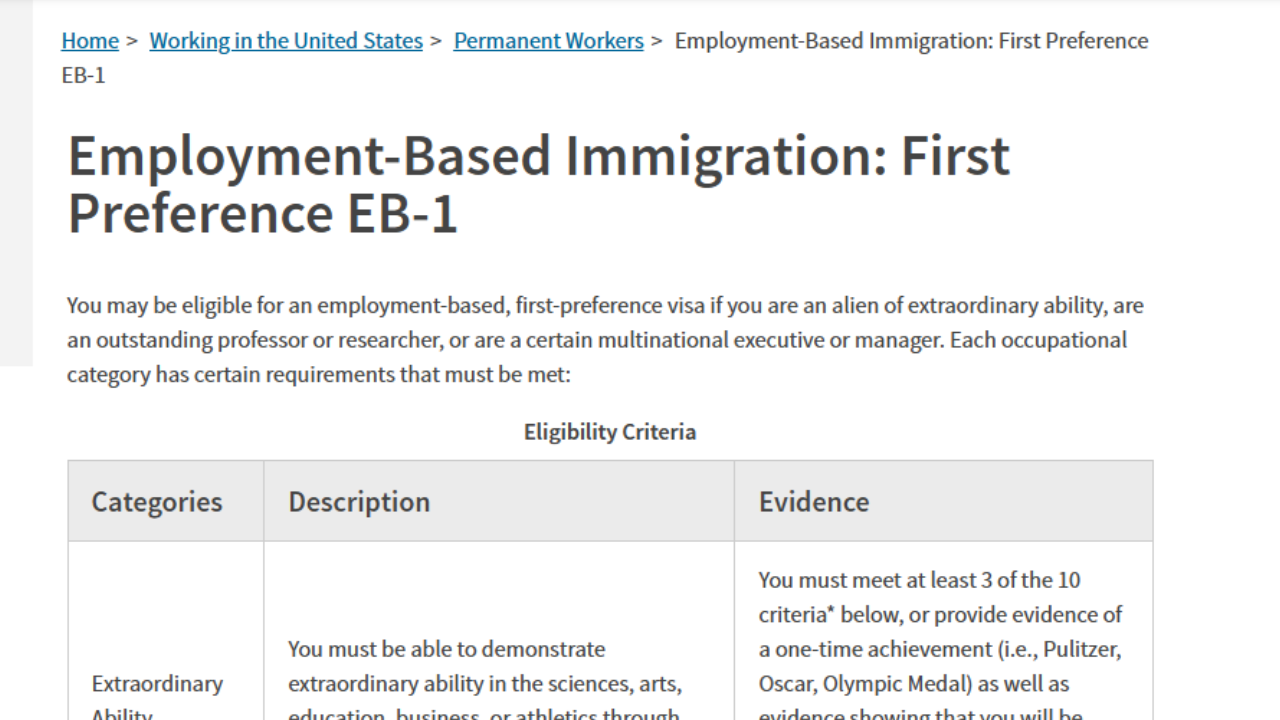
The term ‘Einstein visa’ is informal and not used by the US government. Officially, it refers to the Employment-Based Immigration: First Preference (EB-1) category under US immigration law. According to US Citizenship and Immigration Services (USCIS), an applicant may qualify for an EB-1 visa if they fall into one of three groups: An individual of extraordinary abilityAn outstanding professor or researcherA certain multinational executive or manager Both these categories of employment have their set of criteria. The extraordinary ability subcategory, otherwise known as EB-1A, is perhaps most commonly referred to as the “Einstein visa” because it is intended for those people who are already at the top of their professions.
EB-1A eligibility criteria: extraordinary ability
Under the category of extraordinary ability, one has to show that their ability in the fields of sciences, arts, education, business, and athletics was demonstrated through sustained national or international acclaim. USCIS has also stated that one has to either present evidence of a major one-time achievement internationally recognized through a Pulitzer Prize, an Oscar, Olympic medals, among other achievements. Otherwise, one has to meet at least three criteria of the ten. These criteria include evidence of receipt of nationally or internationally recognised prizes or awards for excellence, membership in associations that demand outstanding achievement, published material about the applicant in major trade publications or other major media, and evidence that the applicant has been asked to judge the work of others. Applicants may also submit evidence of original scientific, scholarly, artistic, athletic, or business-related contributions of major significance to their field; authorship of scholarly articles in professional or major trade publications; display of work at artistic exhibitions or showcases; performance in a leading or critical role for distinguished organisations; commanding a high salary compared to others in the field; or commercial success in the performing arts. Importantly, no offer of employment or labour certification is required for extraordinary ability applicants.
Other EB-1 categories explained
The EB-1 category also includes outstanding professors and researchers and certain multinational managers or executives, though these classifications operate under different rules. Outstanding professors and researchers must demonstrate international recognition for their achievements in a particular academic field and have at least three years of experience in teaching or research. They must be entering the US to pursue a tenure or tenure-track teaching position, or a comparable research role, at a university, institution of higher education, or qualifying private employer. Applicants must meet at least two of six specified criteria and must have an offer of employment from a prospective US employer. Multinational managers or executives must have been employed outside the US for at least one year in the three years preceding the petition, or the most recent lawful non-immigrant admission if already working in the US. The US petitioner must have been doing business for at least one year, have a qualifying relationship with the foreign employer, and intend to employ the applicant in a managerial or executive capacity. No labour certification is required for either of these categories.
Application process under EB-1
The application process differs depending on the EB-1 classification. Individuals applying under the extraordinary ability category may file for themselves by submitting Form I-140, Petition for Alien Worker. In the case of exceptional professors and researchers, as well as multinational executives, the US employer has to submit the form I-140 to the US authority on behalf of the visa applicant. In this regard, the employer will have to prove its continued ability to pay the offered wage as at the date indicated in the priority date. If an EB-1 petition is approved, the applicant’s spouse and unmarried children under the age of 21 may be eligible to apply for admission to the United States as dependents in immigrant status.
About the Author