

Leadership does not become louder as one moves higher. It becomes subtler. At senior levels, the real test is no longer about managing tasks or meeting targets. It is about how deeply one understands people, how carefully one handles transitions, and how responsibly one carries the emotional weight that comes with influence. The higher the position, the greater the responsibility to lead with restraint and care. A recent message from a Delhi University professor captures this truth with striking clarity.
A goodbye that led by example: What this DU professor’s note taught students about leadership
A goodbye that said more than it meant to
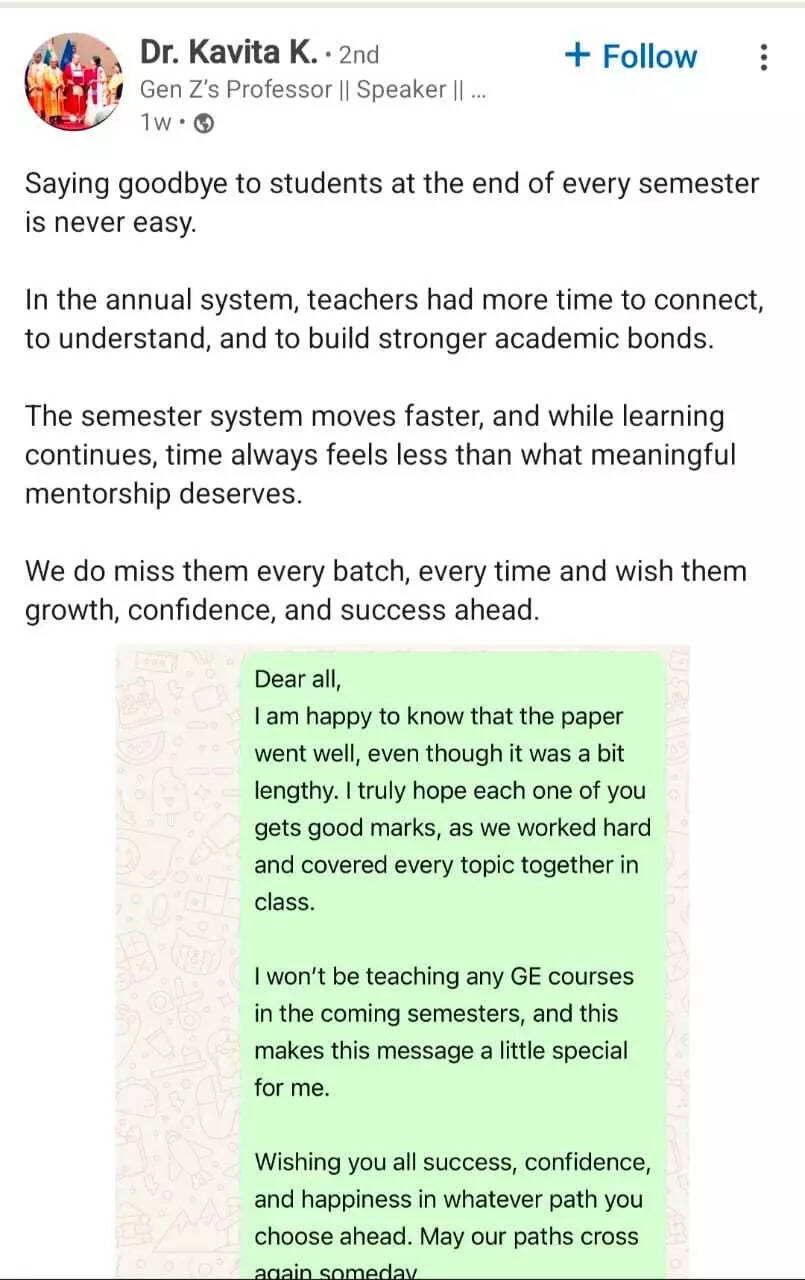
Dr. Kavita K, a professor at Kirori Mal College, University of Delhi, recently shared a farewell note to her students at the end of the semester. The message, posted on LinkedIn, was not dramatic or self-conscious. It was honest. And that is why it travelled far beyond the classroom.“Saying goodbye to students at the end of every semester is never easy,” she wrote. In that single line, she articulated what many teachers feel but rarely say aloud. She went on to contrast the current semester system with the older annual format, pointing out that the earlier structure allowed teachers more time “to connect, understand students, and build stronger academic relationships.” The observation was not a complaint. It was a quiet acknowledgment of loss, of time, of continuity, of deeper bonds.
Leadership in fast systems needs slower people
Modern institutions move quickly. Semesters end, batches rotate, and names blur. At junior levels, leadership is often about keeping up. At higher levels, it is about slowing things down just enough so people do not feel disposable.Dr. Kavita’s words reflect that maturity. “We do miss them every batch, every time, and wish them growth, confidence, and success ahead,” she wrote. It is an unusual thing for a system to admit that those who leave are remembered. That their absence is felt. This is leadership not as authority, but as stewardship.
A message sent because it mattered
Along with her post, Dr Kavita shared a screenshot of a WhatsApp message she had sent to her students after their examination. She congratulated them on completing what she described as a lengthy paper and said she hoped they would be rewarded with good marks for the effort they had put in throughout the course.There was no requirement to send that message. No institutional rule demanded it. She also told her students that she would not be teaching any general elective courses in the coming semesters, calling the note a “little special” for that reason. Senior leadership is often defined by how endings are handled. This one was handled with care, not detachment.
The emotional labour we rarely talk about
The message ended with words wishing students success, confidence, and happiness in whatever paths they choose next. As the post circulated online, many readers reflected on mentorship in higher education and the emotional labour that teaching involves, work that is rarely acknowledged, let alone measured.This emotional labour increases with seniority. The more students one teaches, the more goodbyes one carries. The more influence one has, the more responsibility there is to leave people better than one found them.
What this teaches us about real leadership
At the top, leadership is no longer about being seen. It is about being felt. Dr Kavita’s farewell is a reminder that the most valuable leaders do not rush people through systems. They pause long enough to recognise them.In an age obsessed with efficiency, this kind of leadership feels almost radical. It is quiet. It is human. And long after the semester ends, it is what students remember.
About the Author