
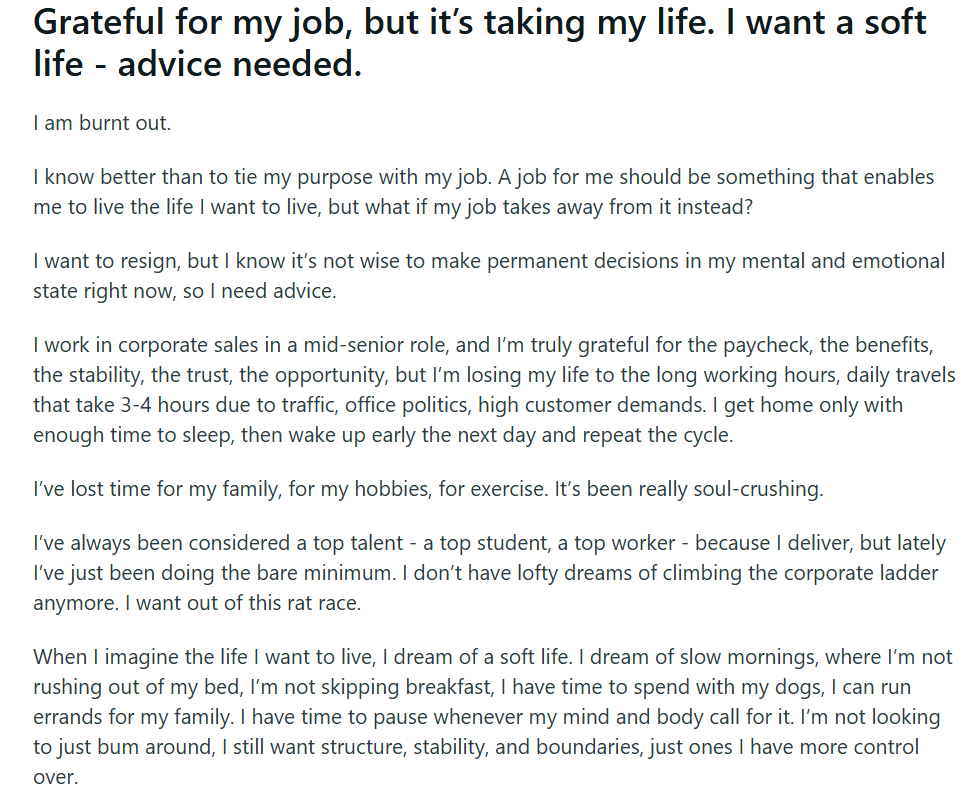
“I am burnt out,” an employee recently wrote on Reddit, before listing his reasons with care, almost apology. A stable job, a good paycheck, trust from the organisation, and yet, “I’m losing my life to the long working hours, daily travels that take 3-4 hours due to traffic, office politics, high customer demands.”There is no rage in the words. Only exhaustion, and a request that feels telling. “Bring me back to reality,” the employee asks people online. “Be my big sister or brother who’s been here too.”The question they are circling is not whether work is hard. It is whether this level of depletion has become the price of staying employed, ambitious, and respectable in India’s white-collar economy.
When high performance starts thinning out
The employee describes a familiar pattern. Home reduced to a place for sleep, days structured around commute, and family time, hobbies, exercise slipping away. “I’ve lost time for my family, for my hobbies, for exercise. It’s been really soul-crushing.”They also describe something that unsettles many organisations more than burnout itself. A high performer no longer striving. “I’ve always been considered a top talent because I deliver, but lately I’ve just been doing the bare minimum.”This is often framed as a personal failing or a temporary phase. But instead, it mirrors withdrawal from a system that no longer feels reciprocal to some.
The idea of a ‘soft life’
The life the employee imagine is not one of idleness. “I still want structure, stability, and boundaries,” the employee writes. “Just ones I have more control over.” They speak of slow mornings, breakfast not skipped, time with their dogs, the ability to pause when the body asks for it. What they call a “soft life” is, on closer reading, a bounded one.This tension between gratitude and depletion sits at the heart of India’s current debate on burnout. Employees are told to be thankful for stability in an uncertain economy. Employers speak of resilience and growth. But the cost of maintaining this equilibrium is increasingly visible in long commutes, constant connectivity, and a workday that refuses to end.
A pressure cooker environment
Even Zoho CEO and co-founder Sridhar Vembu earlier described this environment as a “pressure cooker”. In an interview with PTI, he pointed to burnout, loneliness following migration to large cities, long commutes, and stressful work conditions as forces pushing people to their limits. Companies that push workers “very hard”, he warned, may not be able to sustain that pace.What is striking is not that burnout exists. It always has. What has shifted is how normal it has become, especially among those who are doing everything right. Educated, employed, valued, and exhausted.
When burnout stops being individual
Management research has long argued that burnout is not only about individual coping. It happens when work conditions exceed a person’s capacity to respond. Excessive workloads, low autonomy, poor support, unclear expectations, and leaders under stress passing that pressure downwards. In such environments, exhaustion is followed by cynicism and a sense of diminished effectiveness.The Reddit post is talking about this exact progression without naming it. The employee still functions, they still show up, but the sense of purpose has thinned. “I don’t have lofty dreams of climbing the corporate ladder anymore,” they write. “I want out of this rat race.”
The right to disconnect enters Parliament
This is not a rejection of work itself, it is a rejection of a particular bargain. One where pay and benefits are treated as sufficient compensation for time, energy, and emotional availability that spill far beyond office hours.That bargain is now being questioned in Parliament. Recently, Lok Sabha MP Supriya Sule introduced a private member’s proposal called the Right to Disconnect Bill, 2025. The Bill seeks to give employees the legal right to disengage from work communications outside official hours and on holidays. Employers who violate this boundary could face penalties.The proposal recognises what many employees already experience. Digital tools have erased the edge of the workday, messages arrive late at night, calls come early in the morning, availability becomes a signal of commitment. The Bill argues that this constant reach contributes to sleep loss, emotional fatigue, and cognitive overload.Private member’s bills rarely become law. But they often surface pressures that are already widespread. The question is not only about emails and calls, it’s about whether disconnection has become a privilege rather than a right.
Wanting out, without a way out
For the employee on Reddit, this lack of boundary is part of a larger erosion. They speak of dreaming about remote work, freelancing, or digital roles that offer “freedom of time”. At the same time, they acknowledge constraints, a family to support, no room for risky decisions. “I know the grass isn’t always greener,” they write.This realism complicates the narrative. Burnout here is not a dramatic collapse, it is a slow narrowing of life, managed carefully so that nothing breaks all at once.
When endurance becomes the model
In organisational research, there comes a point where burnout stops being solvable through individual strategies. Exercise, meditation, and better time management help, but only up to a limit. When job demands remain unchanged, the cost is deferred, not eliminated.The employee’s words reads like someone approaching that limit and stopping to ask whether continuing makes sense. Not just for them, but as a model of success.India’s corporate growth story has long celebrated endurance. Long hours are treated as proof of ambition, commutes are accepted as inevitable, and exhaustion is framed as a phase to push through. Those who leave are described as opting out.
What kind of success is being built
But as more employees articulate this unease, the frame begins to change. Burnout starts to look less like a personal weakness and more like a design problem.If comapnies and organisations depend on sustained overexertion, they may deliver short-term results but erode their own foundations. High turnover, disengagement, and declining creativity are not individual failures. They are system outcomes.The uncertainty may be the most honest part of the story. Many employees are not seeking escape, they are seeking proof that work can coexist with life, rather than consume it.The question facing Indian workplaces is no longer whether burnout exists. It is whether it has been accepted as normal. And if so, what kind of success is being built on it.
About the Author