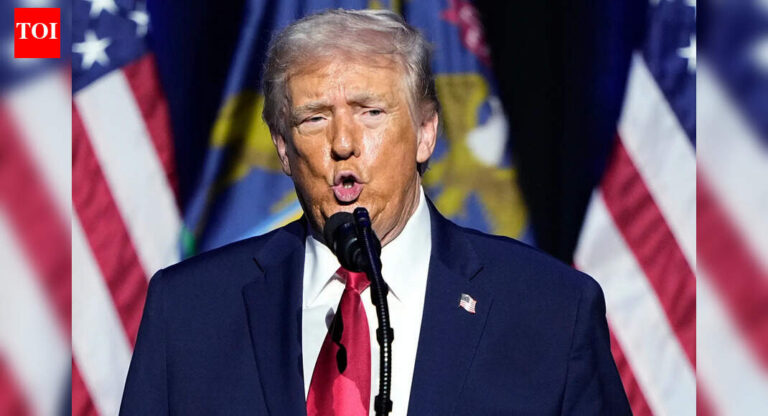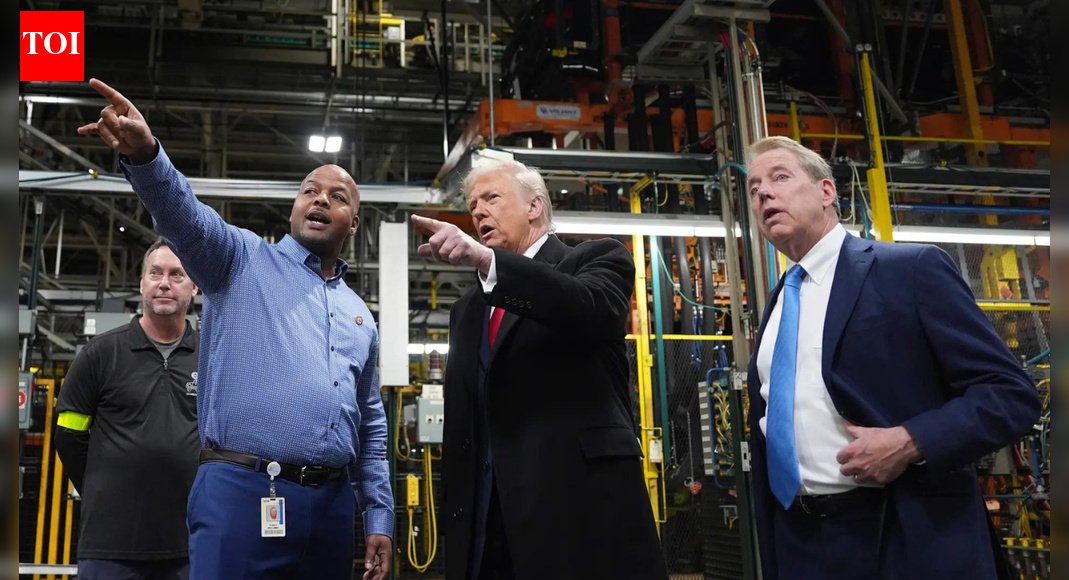
US President Donald Trump a visited a Ford Motor Co. assembly line in Michigan on Tuesday in an attempt to push his manufacturing agenda, as his administration works to counter voter anxiety over jobs, inflation and the cost of living. Trump walked the factory floor at Ford’s River Rouge complex in Dearborn, watching F-150 pickup trucks move through different stages of production. The F-150 is the bestselling domestically produced vehicle in the US. He observed how gas-powered and hybrid versions are assembled, along with the all-gas Raptor model built for off-road performance. Wearing a suit amid workers in reflective vests, Trump stopped to chat with assembly line employees, some of whom applauded as he arrived, and spoke with Ford executive chairman Bill Ford. “All US automakers are doing great,” Trump said, later adding that the “quality is unbelievable,” as quoted by the Associated Press. After leaving the plant, Trump headed to MotorCity Casino, where he addressed members of the Detroit Economic Club. He framed the speech as a straightforward exercise in listing his administration’s accomplishments. “This is the easiest speech to make,” Trump said, explaining that all he was doing was “spewing off what the hell we’ve done.” “Right now I’m feeling pretty good,” he added. Despite the confident tone, recent election results suggest many voters remain unconvinced. Tuesday’s stop marked Trump’s third visit to a swing state since last month focused on economic messaging, following Republican losses in off-year elections in Virginia, New Jersey and other states where concerns about everyday expenses dominated. The White House said after the trip that Trump plans to travel more frequently to make his economic case directly to the public and address lingering financial fears. Trump previously dismissed affordability concerns as a “hoax” fueled by Democrats. At the same time, his administration has imposed sweeping tariffs on US trading partners, while selectively easing some measures affecting the auto industry, including extending import levies on foreign-made auto parts until 2030. Speaking on the factory floor, Trump highlighted tariffs on vehicles imported from China and said he hopes to prevail at the Supreme Court, which is reviewing the legality of his broader tariff strategy. He also downplayed the relevance of the United States-Mexico-Canada Agreement, the North American trade deal he negotiated during his first term, suggesting it is no longer necessary for the US. The USMCA is scheduled for review this year. Earlier, before departing Washington, Trump had pointed to encouraging inflation data as evidence his economic approach is working. December figures showed inflation eased slightly as gas and used-car prices declined. Consumer prices rose 0.3 per cent in December from the previous month, matching November’s increase, according to the Labor Department. “We have very low inflation,” Trump told reporters on the White House lawn, adding that “growth is going up. We have tremendous growth numbers.” Even so, surveys continue to show Americans remain worried about inflation and rising daily expenses. Trump’s effort to refocus attention on economic growth comes amid controversy over his Justice Department opening a criminal investigation into Federal Reserve Chair Jerome Powell. Powell has described the move as a direct attempt to undermine the Fed’s independence on interest rates, a view echoed by former central bank leaders, economic officials and some Republican lawmakers. Asked about the investigation before heading to Michigan, Trump repeated his long-standing criticisms of Powell but declined to comment on the case itself. The Michigan visit also intersected with the administration’s rollback of electric vehicle policies. Ford announced in December that it was abandoning plans for an electric F-150, despite heavy investment in electrification, after the Trump administration cut targets for EV sales by 2030, eliminated tax credits and proposed easing emissions and fuel economy standards. Trump’s stop followed similar economy-focused appearances last month in Pennsylvania and North Carolina. In Pennsylvania, remarks about immigrants from “filthy” countries overshadowed his inflation message. In North Carolina, he argued that tariffs had strengthened the economy, even as residents complained of higher prices. Like Michigan, Pennsylvania’s event was also held at a casino, the Mount Airy Casino Resort. Trump carried Michigan in 2016 and again in 2024, after losing the state to Democrat Joe Biden in 2020. He marked his first 100 days in office with a rally-style speech outside Detroit, where he focused heavily on past political grievances rather than detailed economic plans. During that earlier visit, Trump also appeared at Selfridge Air National Guard Base and announced a new fighter jet mission, easing concerns about the base’s future. The move was welcomed by Democratic Gov. Gretchen Whitmer, who shared a hug with the president at the time. Democrats sharply criticised Tuesday’s trip. They pointed to national Republicans’ opposition to extending health care subsidies and recalled Trump’s comments during an October 2024 address to the Detroit Economic Club, when he warned that another Democratic term would leave the country in ruins. “Our whole country will end up being like Detroit,” Trump had said then. “You’re going to have a mess on your hands,” he added. Curtis Hertel, chair of the Michigan Democratic Party, accused Trump of political opportunism. “After spending months claiming that affordability was a ‘hoax’ and creating a health care crisis for Michiganders, Donald Trump is now coming to Detroit — a city he hates — to tout his billionaire-first agenda while working families suffer,” Hertel said in a statement. “Michiganders are feeling the effects of Trump’s economy every day,” he added.
About the Author