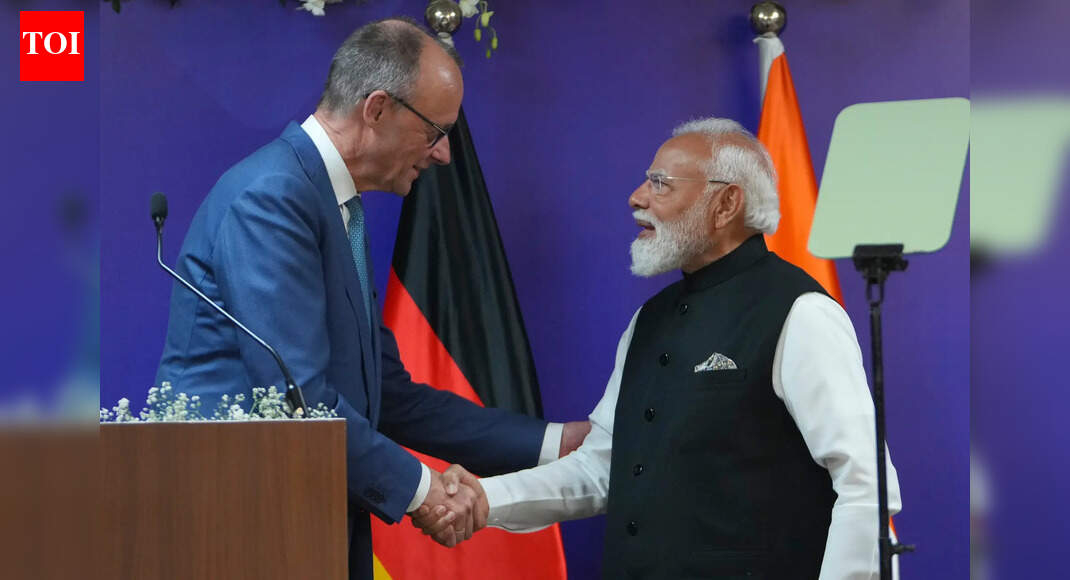

India and Germany have adopted a higher education roadmap that places universities and student mobility at the centre of a broader bilateral push, with Prime Minister Narendra Modi inviting foreign institutions to establish campuses in India during German Chancellor Friedrich Merz’s official visit in Gandhinagar.Addressing a joint press conference, Modi said the roadmap would give “a new direction” to education ties and explicitly invited universities to open campuses in India, according to ANI. The statement positions higher education as a policy instrument rather than a symbolic add-on to diplomacy.
Why campuses matter to students
For students, the signal matters. India’s higher education policy has, over the past few years, opened regulatory pathways for foreign universities to operate locally. The roadmap with Germany builds on that framework by tying academic collaboration, mobility and institutional presence to a government-backed bilateral plan rather than ad hoc partnerships.The education component sits within a larger set of outcomes from the visit. The Ministry of External Affairs said India and Germany concluded 19 agreements across sectors, including education, skilling and human resources, as part of the two-day engagement, ANI reports. Among these was the adoption of the higher education roadmap and related arrangements on skills development.
Beyond exchanges, towards institutional presence
What distinguishes the roadmap is its emphasis on campuses, not just exchanges. For Indian students, local campuses of foreign universities can change the cost and access equation by reducing the need to study abroad while offering international curricula and credentials at home. For institutions, campus presence allows deeper integration into India’s academic and research ecosystem.
Mobility signals and visa facilitation
Student mobility also features in the package. Germany announced visa-free transit for Indian passport holders transiting through the country, a move Modi described as strengthening people-to-people ties, according to ANI. While not a student visa reform, transit facilitation reduces friction for Indian students travelling to Europe for study or academic collaboration.
Linking higher education to skilling priorities
The roadmap also aligns with skilling priorities. As part of the education and mobility outcomes, a National Centre of Excellence for Skilling in Renewable Energy is to be established at the National Skill Training Institute in Hyderabad, ANI reports. This links higher education to applied training and employment pathways, particularly in sectors where India and Germany are expanding cooperation.
Education as part of a wider strategic partnership
Education is being positioned alongside technology, energy and defence as a long-term partnership pillar. Modi said cooperation in technology and renewable energy has strengthened year after year, while the Ministry of External Affairs highlighted agreements in critical and emerging technologies that intersect with university research and talent development.
What implementation will determine
For students, the practical impact will depend on implementation. Campus establishment requires regulatory approvals, faculty pipelines and alignment with Indian quality frameworks. Mobility provisions hinge on visa regimes beyond transit. Still, the roadmap creates an institutional anchor for these decisions.
The long view for students
The larger context matters. The visit coincides with 75 years of India-Germany diplomatic relations and 25 years of strategic partnership. By placing higher education within this frame, both sides are signalling that universities and students are part of the infrastructure of the relationship, not peripheral beneficiaries.As with most education roadmaps, the immediate outcome is intent rather than enrolment. The test will be whether campuses materialise, programmes scale and students experience reduced barriers.(with ANI inputs)
About the Author